Claude’s voice mode is now available for Opus and Sonnet
Source Entity
Terrence O’Brien
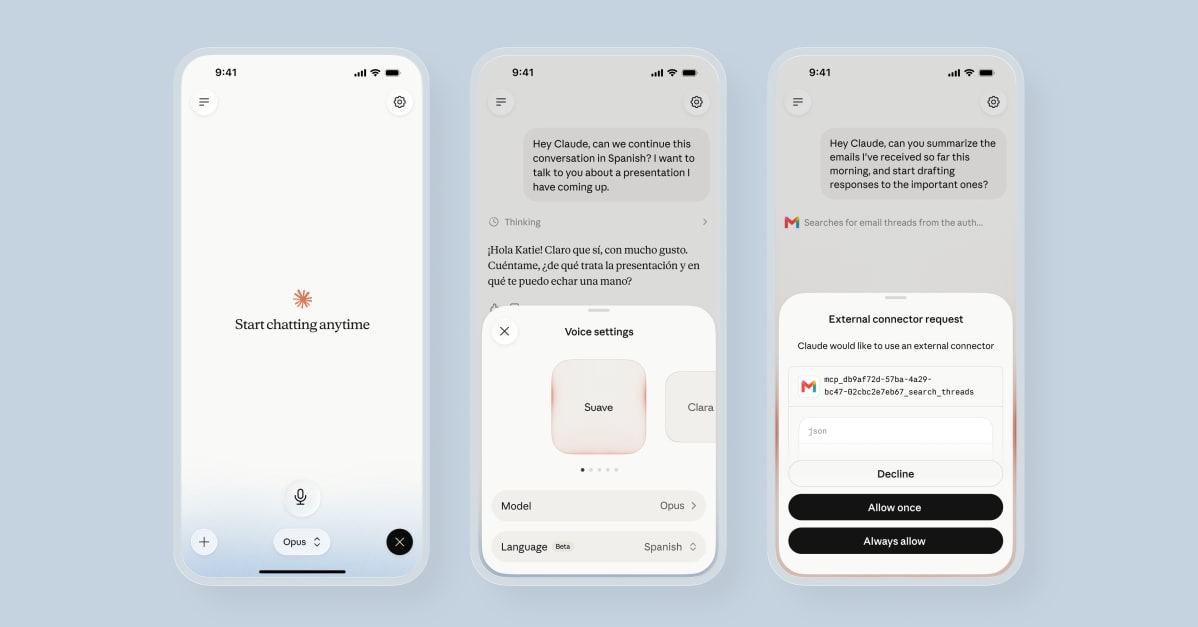
Anthropic has upgraded its Claude voice mode to support the more powerful Opus and Sonnet models alongside Haiku. This expansion allows users to leverage advanced AI capabilities for complex tasks within apps like Gmail, Slack, and Canva.
Anthropic Elevates Voice Interaction with Claude
Anthropic has officially expanded its voice mode capabilities, moving beyond the lightweight Haiku model to incorporate its more robust Opus and Sonnet offerings. This strategic shift represents a significant evolution in how users interact with AI, transitioning from simple query-response patterns to complex, multi-faceted workflows. By integrating these high-performance models into voice interfaces, Anthropic is directly addressing the limitations of its initial release, which was primarily optimized for speed rather than logical depth.
Bridging the Gap Between Speed and Intelligence
When voice mode was first introduced last year, it was designed for rapid, low-latency interactions. However, user behavior quickly demonstrated that the demand for voice-based AI extended far beyond casual inquiries. Users began utilizing the tool for substantive business problem-solving, a task for which the Haiku model was not originally intended. The current update acknowledges this reality, offering a more versatile toolset that can handle the nuance of professional environments.
Enhanced Productivity Across Ecosystems
Beyond the model upgrade, Anthropic is deepening its integration into essential workplace platforms, including Gmail, Slack, and Canva. This interoperability ensures that the enhanced intelligence of Opus and Sonnet is not siloed but is instead woven into the fabric of daily digital tasks. Users can now leverage voice commands to draft emails, reschedule meetings, or iterate on client pitches, effectively turning Claude into a hands-free executive assistant.
Dynamic Model Selection
To balance performance and utility, the updated voice mode defaults to the fastest version of the model previously used in a user's text chat. This design choice aims to maintain a fluid conversational experience while ensuring that users have access to the specific reasoning capabilities required for their current task. Whether providing feedback on communication styles or brainstorming product market research, the system is now better equipped to handle sustained, complex dialogues.
Competitive Landscape and Future Implications
This move comes shortly after OpenAI’s recent updates to its own conversational models, underscoring the intense competition within the generative AI sector. As firms like Anthropic continue to refine voice-first interactions, we can expect a future where AI assistants are less about 'searching' and more about 'collaborating.' The shift toward voice-enabled, high-reasoning models suggests a trajectory toward more natural, human-centric computing, where the friction between thought and digital output is significantly reduced.