How bees helped engineers solve flaw regarded as Solar panels’ biggest shortcoming
Source Entity
TOI TECH DESK
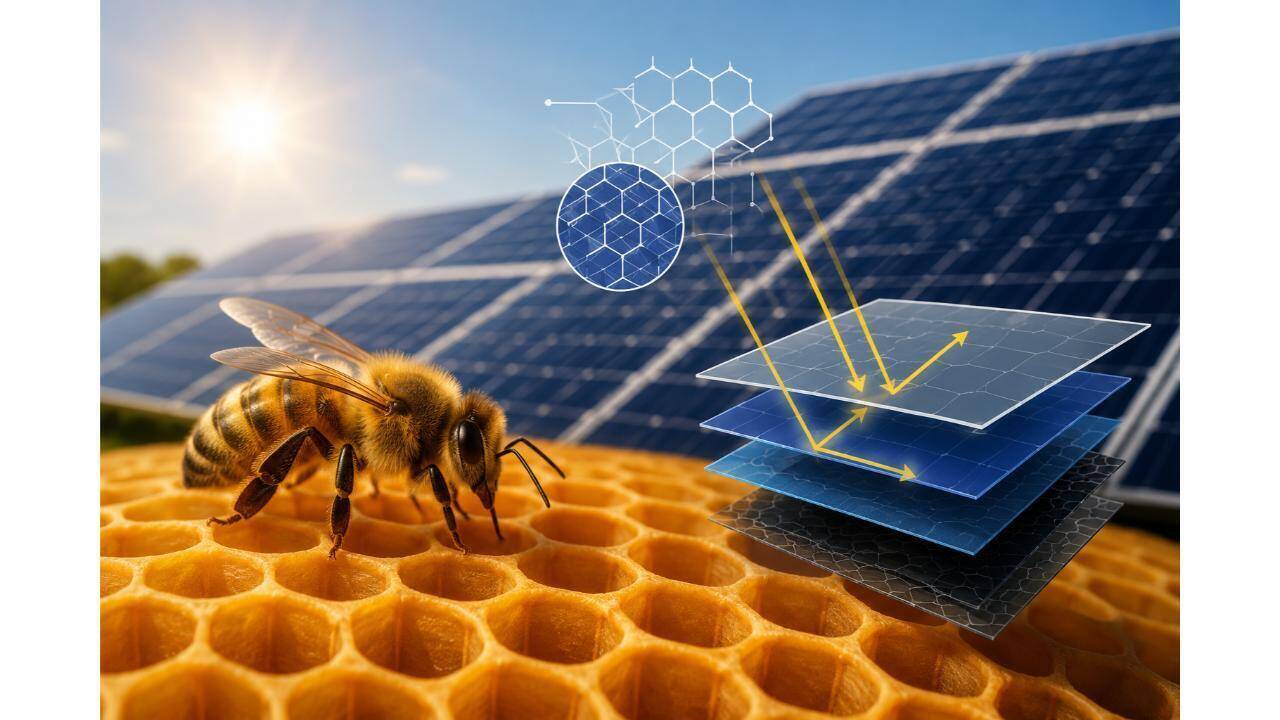
Engineers developed a new solar panel design inspired by bee honeycombs. This innovative three-dimensional concave structure redirects reflected light back into the panel. Researchers report significant power output increases compared to conventional flat panels. The flexible metamaterial allows integration into curved surfaces and vehicles. This advancement expands solar power applications beyond traditional rooftop installations.
Nature's Blueprint: Solving the Solar Reflection Dilemma
For decades, the solar energy industry has grappled with a fundamental physical limitation: the reflection of photons. Conventional solar panels are typically flat, meaning that light hitting the surface at an angle—particularly during the early morning or late afternoon—is often reflected away rather than absorbed. This loss of potential energy has been regarded as one of the biggest shortcomings of photovoltaic technology. However, a groundbreaking engineering achievement has now emerged, utilizing biomimicry to solve this problem by looking at the intricate geometry of bee honeycombs.
The Mechanics of the Honeycomb Structure
At the heart of this innovation is a three-dimensional concave structure that mimics the hexagonal cells of a beehive. Unlike traditional flat surfaces, these concave cells act as micro-traps for incoming light. When light hits the panel, the curvature of the honeycomb-inspired design ensures that photons which would otherwise bounce off a flat surface are redirected back into the active area of the panel. This process, effectively creating a "light-trapping" mechanism, significantly boosts the overall power output by maximizing the absorption of sunlight regardless of the angle of incidence.
Biomimicry and Engineering Efficiency
Biomimicry—the practice of learning from and mimicking strategies found in nature—has long provided solutions for complex human problems. In this instance, the hexagonal efficiency of the bee's honeycomb provides more than just structural strength; it offers a geometric solution to photon management. By replicating this pattern, engineers have transitioned from a passive absorption model to an active redirection model. This shift represents a critical evolution in material science, where the physical shape of the collector is just as important as the chemical composition of the photovoltaic cell itself.
The Role of Flexible Metamaterials
Beyond the geometric shape, the integration of flexible metamaterials is a game-changer for the industry. Traditional silicon-based panels are rigid and brittle, limiting their installation to flat rooftops or dedicated solar farms. The use of metamaterials—engineered materials with properties not found in naturally occurring substances—allows these honeycomb structures to be printed or molded onto curved surfaces. This flexibility removes the structural constraints of solar energy, enabling the technology to be wrapped around cylinders, spheres, or the aerodynamic contours of modern machinery.
Expanding the Horizon: From Rooftops to Vehicles
The implications of this advancement extend far beyond residential energy. The ability to integrate high-efficiency solar capture into curved surfaces opens the door for widespread adoption in the automotive and aerospace sectors. Electric vehicles (EVs), for example, can now incorporate solar-harvesting "skins" across their chassis, providing a continuous trickle charge that extends range and reduces reliance on charging stations. Similarly, drones and satellites can utilize these flexible, high-output panels to increase their operational endurance without adding the weight of larger battery packs.
Future Trends and Energy Decentralization
Looking forward, this technology signals a move toward "invisible" solar integration. As we move away from bulky, rectangular panels and toward flexible, honeycomb-inspired membranes, solar power can be integrated into the very fabric of urban architecture—from curved glass facades to wearable tech. This will likely accelerate the trend of energy decentralization, where every surface of a city becomes a potential power generator. The transition from rigid installations to adaptive, biomimetic surfaces will likely be the catalyst for the next leap in renewable energy adoption.
Conclusion
By synthesizing the structural genius of nature with cutting-edge metamaterials, engineers have effectively mitigated the reflection flaw that has hindered solar efficiency for years. This honeycomb-inspired design not only increases power output but fundamentally changes how and where solar energy can be harvested. As this technology scales, it promises to transform the landscape of green energy, moving us toward a future where power generation is seamless, flexible, and ubiquitous.