Benchmarking Qwen3.8 27B quantizations: 4-bit holds up, 1-bit collapses
Source Entity
Hacker News
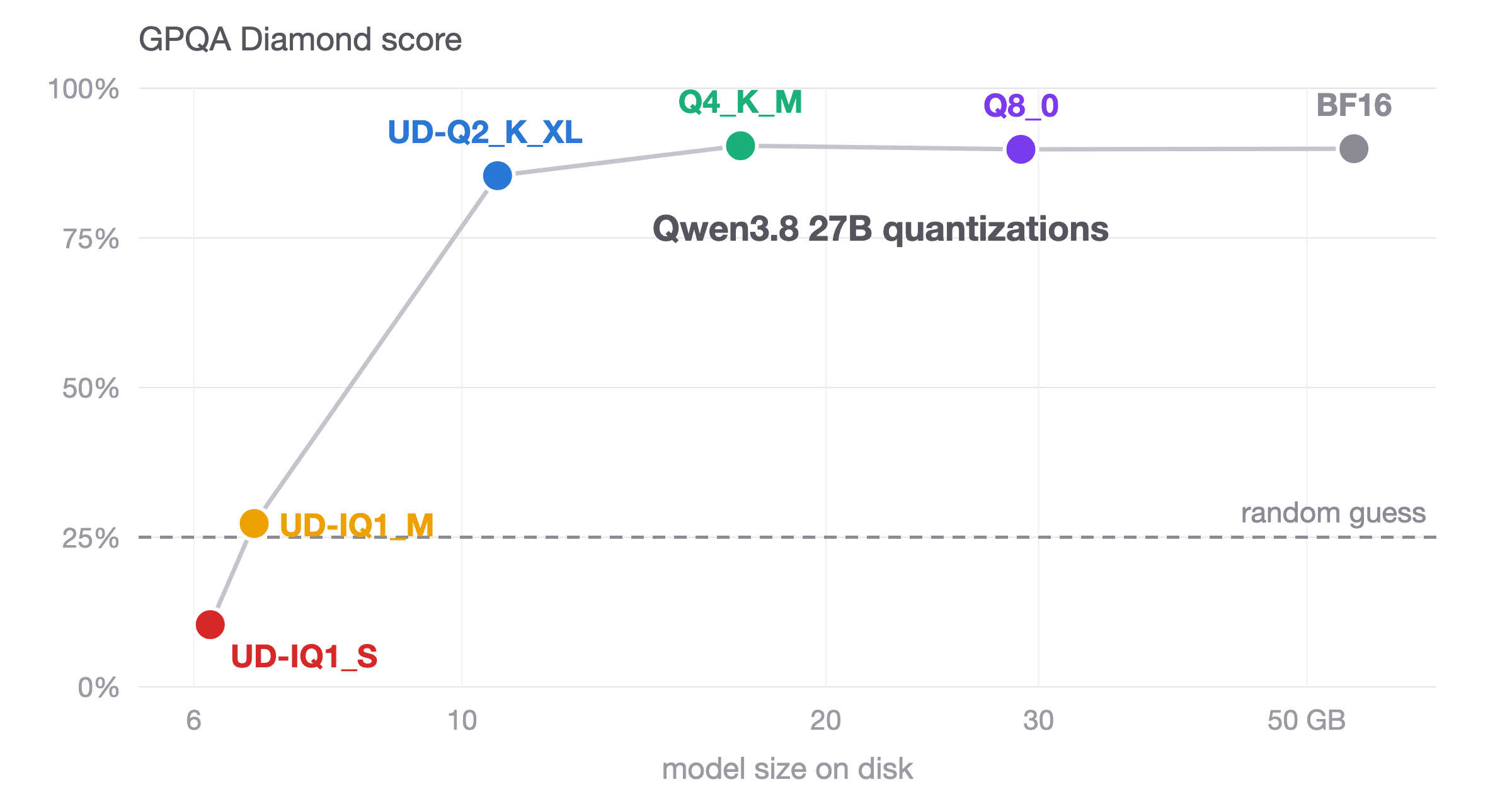
Recent benchmarking reveals that while 4-bit quantization effectively optimizes the 27B Qwen model for consumer GPUs, 1-bit compression leads to total performance failure. Meanwhile, the Kimi K3 2.8T model has achieved a milestone by running on consumer Apple Silicon hardware using advanced SSD-based streaming.
The Frontier of Model Quantization and Consumer Hardware
Recent technical evaluations of the Qwen3.8 27B language model underscore a critical turning point in how developers balance parameter density with hardware accessibility. The full BF16 version of the model, requiring 55 GB of VRAM, remains largely inaccessible to the average enthusiast. However, empirical testing shows that the 17 GB Q4_K_M quantization offers a remarkable parity with the full model on complex tasks like Terminal-Bench 2.1. This allows the model to reside comfortably on high-end consumer cards like the RTX 4090 while retaining enough headroom for significant context windows.
The Quantization Cliff: When Compression Fails
While 4-bit quantization (Q4_K_M) serves as an effective 'sweet spot,' the industry is testing the absolute limits of bit-reduction. The findings regarding the 1-bit UD-IQ1_S (6.2 GB) reveal a stark reality: performance degradation is not linear. At 1 bit, the model effectively collapses, performing at the level of random chance on the GPQA Diamond benchmark. This suggests that for reasoning-heavy tasks, there is a fundamental threshold of information density below which the neural network loses its ability to maintain coherent logic.
Scaling to Trillions: The Kimi K3 Breakthrough
Beyond mid-sized models, the emergence of the Kimi K3 2.8T model represents a shift toward running massive, unpruned architectures on local hardware. By utilizing a fork of the Deltafin engine and the ARGODRIVE storage solution, developers have enabled the execution of the full 2.8-trillion-parameter model on Apple Silicon. Unlike pruned models that sacrifice expert layers to save space, this implementation forces the system to utilize all 16 experts for every token, ensuring full fidelity at the cost of speed.
The Role of Storage in AI Inference
Historically, inference speed was strictly gated by VRAM capacity. The Kimi K3 experiment shifts this bottleneck toward storage throughput. By streaming parameters directly from a RAID-like array of four SSDs, the system bypasses the limitations of onboard RAM. While the resulting throughput of 1 token per second is modest, it proves the feasibility of running 'never-pruned' models on consumer-grade workstations, effectively democratizing access to massive-scale intelligence.
Future Trends in Local AI
The convergence of quantization research and efficient storage-streaming architectures suggests a future where model size is no longer a binary barrier to entry. We are moving toward a tiered ecosystem: high-speed, 4-bit optimized models for real-time interaction, and massive, full-precision models for deep-thought tasks, both running locally. As quantization techniques like UD-IQ1_S are refined and storage interfaces like ARGODRIVE evolve, the dependency on centralized cloud inference for large-scale models will continue to diminish, fostering a more robust local AI development landscape.