How is the Bun Rewrite in Rust going?
Source Entity
Hacker News
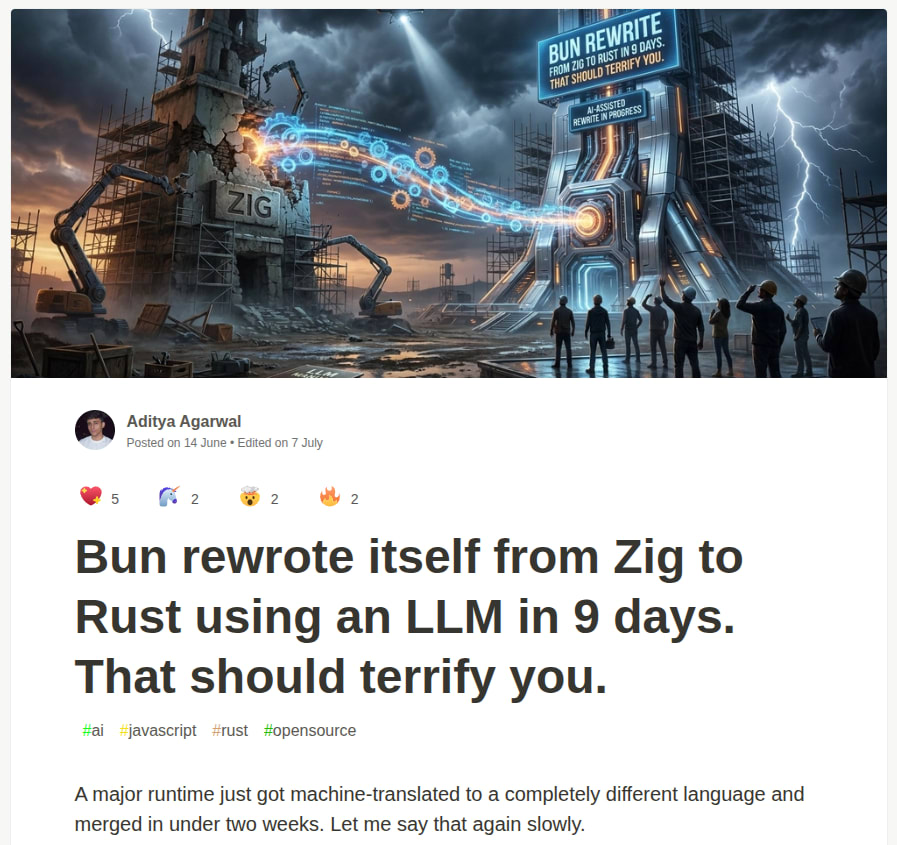
The rewrite of the Bun runtime into Rust, spearheaded by Jarred Sumner, serves as a significant case study on the role of AI in software development. By leveraging Anthropic's coding tools, this project highlights the shift toward AI-assisted engineering and its impact on corporate valuations.
The Intersection of AI and Systems Programming
The recent announcement by Jarred Sumner regarding the rewrite of the Bun runtime in Rust marks a pivotal moment in the evolution of software engineering. By transitioning from its original implementation to Rust, Bun is not merely undergoing a technical refactor; it is becoming a high-profile proof-of-concept for the efficacy of Large Language Models (LLMs) in complex systems development. This shift reflects a growing industry trend where AI tools are no longer confined to simple code completion but are being tasked with entire architectural migrations.
The Anthropic Connection
The timing of this project, specifically the July 8, 2026, announcement, aligns with broader market movements within the AI sector. The integration of Anthropic’s tooling into the Bun rewrite suggests a strategic synergy between the runtime's development and the capabilities of advanced AI models. This relationship is emblematic of a broader trend where major AI labs are actively demonstrating the utility of their models by solving real-world engineering challenges, thereby validating the immense market valuations assigned to these organizations.
AI as an Engineering Multiplier
Jarred Sumner’s claim that this massive undertaking was completed in a mere 11 days is perhaps the most provocative aspect of the narrative. If verified, this timeline underscores a paradigm shift in developer productivity. Where previous iterations of software maintenance relied heavily on human-centric, time-intensive labor, the use of AI tools like Anthropic’s C compiler or FastRender-adjacent technologies suggests that the bottleneck of manual coding is being bypassed. This acceleration is not just a technical milestone; it is a fundamental disruption to the open-source maintenance model.
Market Speculation and Corporate Strategy
There is a clear link between the marketing of AI coding capabilities and the valuation of the companies behind them. By utilizing Anthropic's tools to rewrite a significant piece of infrastructure like Bun, the project serves as a marketing engine for AI-assisted development. This creates a feedback loop: high-valuation AI companies provide the tools to build faster, which in turn justifies their market position. Skepticism, as noted by industry observers, is a necessary component of evaluating these claims, as the line between genuine technical progress and corporate narrative building can often blur.
Broader Implications for Open Source
The Bun rewrite raises critical questions about the future of open-source software. If AI can perform the work of human maintainers with greater speed and efficiency, we may see a transition where the role of the developer shifts from 'writer' to 'editor' or 'architect.' While this increases the velocity of innovation, it also centralizes the power of software creation within the ecosystems owned by the few companies capable of training and deploying these advanced coding agents.
Future Trends in Runtime Development
Looking ahead, we can expect more runtime environments to experiment with AI-driven migrations. The success of the Bun project will likely serve as a blueprint for other projects looking to optimize their performance by moving to memory-safe, high-performance languages like Rust. As AI tools become more adept at understanding complex codebases, the barrier to entry for performing massive architectural overhauls will continue to drop, potentially leading to a more dynamic, albeit AI-dependent, technological landscape.