Same Model, Different Harness: CUGA, Hermes, and Deep Agents — When to Pick CUGA?
Source Entity
Hugging Face - Blog
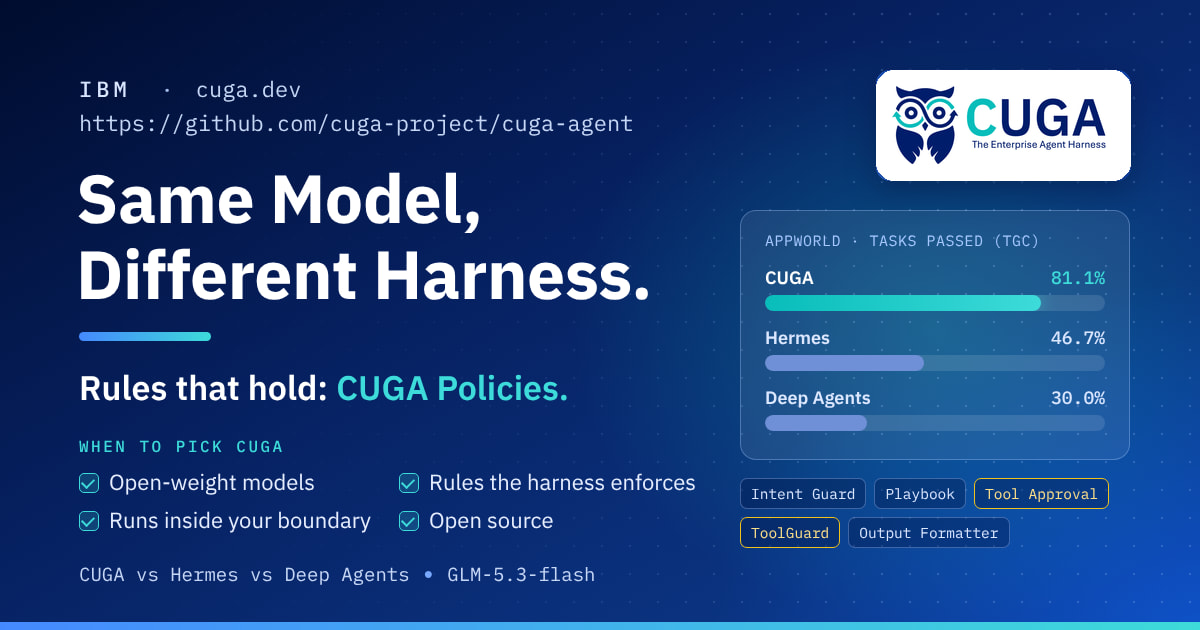
The choice of agent harness significantly impacts AI performance, sometimes more than the underlying model itself. Analysis shows that selecting the right framework can drastically improve task completion rates, especially for enterprise deployments requiring strict rule enforcement.
The Critical Role of Agent Harnesses in AI Performance
In the rapidly evolving landscape of artificial intelligence, the focus has historically remained on the large language models (LLMs) themselves. However, a shift is occurring as developers realize that the 'harness'—the framework or orchestration layer that wraps around a model—is equally, if not more, critical to practical success. With nearly 200 different agent harnesses currently available, as tracked by community repositories like awesome-agent-harness, the industry is moving toward a more nuanced understanding of how these wrappers dictate actual performance outcomes.
The Performance Delta: Harness vs. Model
The impact of the harness on task completion is profound. Recent testing demonstrated that by keeping a single open-weight model constant while swapping the harness across 90 AppWorld tasks, completion rates jumped from 30% to 81%. This stark delta underscores that a superior model can be severely hindered by an inefficient harness, while a mid-tier model can be optimized to perform at high levels through a well-engineered orchestration layer. This is further corroborated by data from best-of-Agent-Harnesses, where the GLM-5.2 model saw its performance on SWE-bench Pro more than double—from 23% to 52%—simply by changing the supporting framework.
Why CUGA Stands Out for Enterprise
While many harnesses are designed for research or general-purpose tasks, enterprise requirements are fundamentally different. CUGA distinguishes itself by addressing the specific needs of corporate environments. Unlike benchmarks that focus primarily on raw completion metrics, CUGA emphasizes the enforcement of strict operational rules and the ability to deploy entirely within a company’s own secure boundary. For organizations concerned with data privacy, compliance, and controlled AI behavior, this capability to enforce logic at the harness level is a critical differentiator.
Moving Beyond 'The Best' Harness
The data suggests that the industry must move away from asking, "Which harness is the best?" to a more contextual inquiry: "Which harness is best for my specific constraints?" Because no single harness is universally superior, selection should be driven by the specific workflow, the security requirements of the enterprise, and the need for internal deployment. The sheer volume of available frameworks indicates that the ecosystem is maturing, moving from a "model-first" mentality to a "system-first" architectural approach.
Future Trends and Strategic Outlook
As the agentic AI field continues to fragment into specialized use cases, we can expect to see a consolidation of frameworks that prioritize enterprise-grade features like CUGA. Future development will likely focus on interoperability, allowing organizations to swap models while maintaining a stable, rule-enforcing harness. This modularity will be the cornerstone of sustainable AI integration, ensuring that businesses can upgrade their underlying models without having to re-engineer their entire agentic orchestration layer.