Divide by Depth for Instant 3D
Source Entity
Hacker News
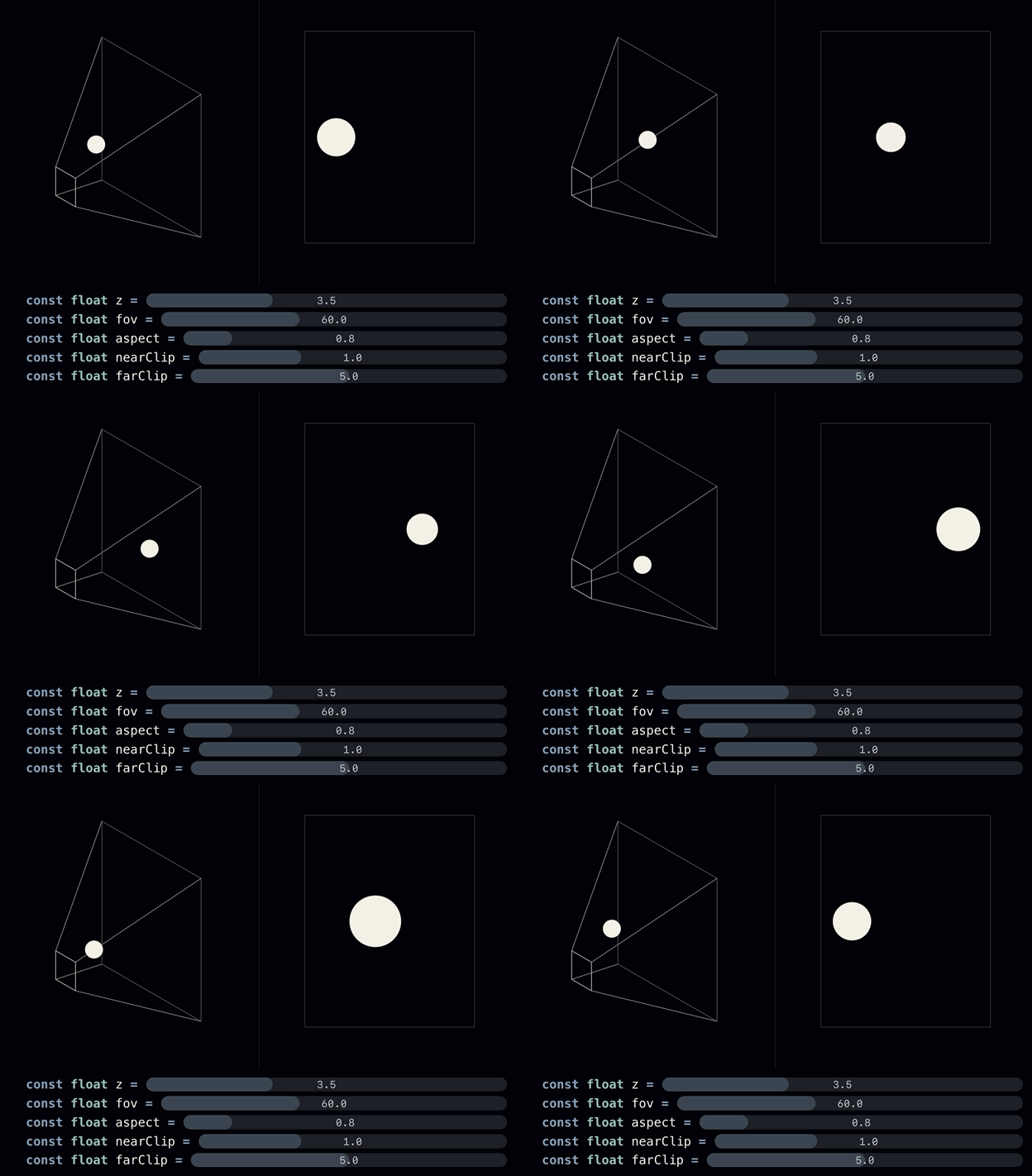
The article explores the fundamental mathematical principle of perspective projection in 3D graphics. By dividing 3D coordinates by depth, developers can project spatial data onto a 2D plane to create realistic visual depth.
The Mathematical Foundation of 3D Projection
At the heart of modern digital imagery and game engine development lies a deceptively simple mathematical operation: perspective projection. As highlighted in the recent technical discourse, the transition from 3D space to a 2D screen is governed by the formula (x', y') = (x/z, y/z). This operation, known as perspective division, is the engine that allows developers to simulate human vision on flat displays, creating the illusion of depth by scaling objects based on their distance from the observer.
Moving Beyond High-Level Frameworks
Many modern software engineers begin their careers utilizing high-level game engines that abstract away the underlying rendering pipeline. While these frameworks offer efficiency and ease of use, they often obscure the essential mechanics of graphics programming. By bypassing these abstractions and engaging with lower-level code, developers can unlock a deeper understanding of how spatial transformation matrices and projection work, providing the necessary vocabulary to implement custom, creative visual techniques that standard tools might not support.
Understanding the Z-Axis in Graphics
In the provided model, where 'y' represents the vertical axis and 'z' represents forward depth, the division of 'x' and 'y' by 'z' is the critical step in the rendering process. This process ensures that as an object's depth increases, its projected size on the screen decreases, effectively mimicking the vanishing point perspective found in physical reality. This mathematical relationship is the primary reason why distant objects appear smaller, a concept that is foundational to both real-time game rendering and pre-rendered cinematic CGI.
Implications for Graphics Programming
This principle of dividing by depth is not merely a theoretical curiosity; it is a performance-critical calculation performed millions of times per second by Graphics Processing Units (GPUs). Understanding this core formula allows developers to troubleshoot rendering artifacts, optimize clipping planes, and implement custom camera behaviors. It bridges the gap between abstract coordinate systems and the tangible visual output that users interact with in virtual environments.
Future Trends and Educational Shifts
As graphics technology continues to evolve toward more immersive formats such as Virtual Reality (VR) and Augmented Reality (AR), the importance of grasping fundamental projection math remains paramount. While hardware becomes more powerful, the core requirement to translate 3D data into 2D display formats remains constant. Educators and industry professionals are increasingly emphasizing a return to 'first principles' in graphics education, ensuring that the next generation of developers understands the math behind the 'Camera' object rather than just relying on pre-built, black-box solutions.
Conclusion
The exploration of perspective projection serves as a reminder that even the most complex digital experiences are built upon foundational mathematical truths. By demystifying the division of 3D coordinates by depth, we gain a clearer picture of how computer-generated imagery functions. Mastering these basics is essential for any developer looking to move from being a user of technology to a creator of sophisticated, custom graphics pipelines.