Why Fibonacci?
Source Entity
Hacker News
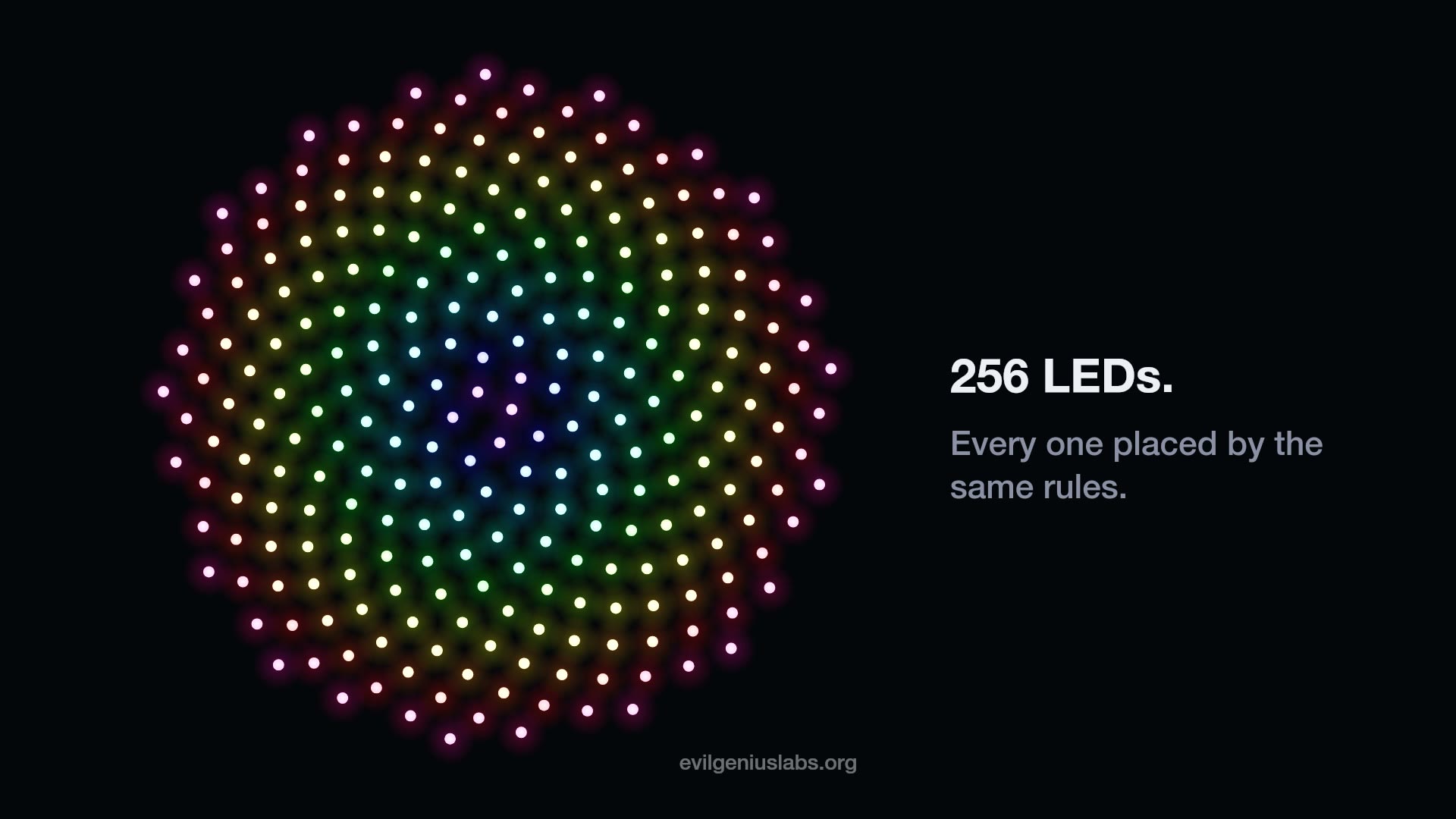
The creator details the evolution of their Fibonacci-inspired LED art, highlighting the transition from early influences to advanced Fermat spiral techniques. The design process relies on the mathematical precision of the golden angle to emulate natural patterns.
The Intersection of Mathematics and Light: The Fibonacci LED Evolution
The artistic application of mathematical sequences has long fascinated creators, but few have bridged the gap between abstract theory and physical hardware as effectively as the creator of these Fibonacci LED arrays. Inspired initially by Jim Bumgardner’s 2015 work, the artist has spent over a decade refining the use of Fermat spirals in light-based installations, moving from simple curiosity to the creation of complex hardware like the Fibonacci64 and Fibonacci1024 boards.
Understanding the Geometry: Fermat Spirals vs. Fibonacci Spirals
A critical distinction in this design philosophy is the technical shift away from the traditional "Fibonacci spiral"—often represented by squares—toward the Fermat spiral. While the classic square-based Fibonacci spiral is a single, continuous curve, the Fermat spiral more accurately reflects biological growth patterns found in nature. By utilizing this specific geometric arrangement, the creator is able to replicate the precise distribution of seeds in a sunflower, creating a visual harmony that feels inherently organic to the human eye.
The Role of the Golden Angle
At the core of these designs lies the golden angle of approximately 137.5 degrees. By employing this constant, the creator ensures that no two LEDs overlap in a way that creates visual gaps or clusters, which is the same mathematical principle that allows plants to maximize sunlight exposure and resource distribution. The influence of collaborators like Nick Pisarro and his "Halo Pixel" project highlights a growing community of makers who are increasingly focused on documenting and sharing these algorithmic techniques.
Technical Implementation and Hardware Scalability
The progression from the "One Inch" Fibonacci64 to the more dense Fibonacci1024 represents a significant evolution in hardware engineering. Scaling these designs requires a strict adherence to the iterative rule: start at the center, step out incrementally, add an LED, and rotate by the golden angle. This recursive process demonstrates how simple programmatic rules, when applied to physical LED arrays, can result in highly complex, mesmerizing light displays that challenge the viewer's perception of geometry.
Future Trends in Algorithmic Art
As we look toward 2026 and beyond, the democratization of such techniques suggests a shift in DIY electronics. We are seeing a move away from purely functional hardware toward "generative objects" where the hardware design itself is dictated by nature’s mathematical constants. This trend toward nature-inspired, mathematically-driven art is likely to influence future developments in both aesthetic lighting design and data visualization tools, as creators continue to seek ways to make invisible mathematical principles tangible through light.