Here’s how to invest using a winning strategy that offers a spin on traditional stock index funds
Source Entity
Philip van Doorn
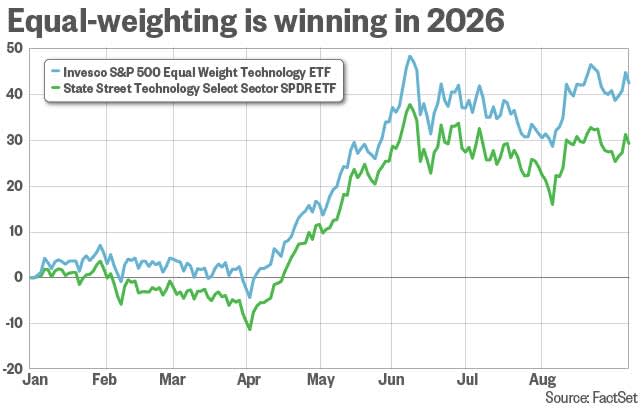
Investors are increasingly exploring equal-weighted strategies and alternative ETF combinations that aim to outperform traditional market-cap-weighted S&P 500 funds. These approaches prioritize reduced volatility and higher long-term returns compared to standard indexing models.
The Evolution of Passive Investing
For decades, the S&P 500 index fund—popularized by firms like Vanguard—has served as the bedrock of passive investing. By weighting holdings based on market capitalization, these funds provide broad exposure to the largest U.S. companies. However, the dominance of this strategy has led to a market environment where the largest firms dictate the index's performance, raising the existential question: when everyone indexes, what is the market?
The Rise of Equal-Weighted Strategies
Recent financial analysis suggests that equal-weighted strategies are increasingly outperforming traditional market-cap-weighted benchmarks. Unlike standard funds that concentrate risk in the largest companies, equal-weighting ensures that each constituent of an index contributes equally to performance. This structural shift allows investors to participate in the growth of smaller companies within the index, rather than being solely tethered to the performance of a few mega-cap stocks.
Challenging the Fund Manager Hegemony
Historically, the goal of beating the S&P 500 while managing volatility was the exclusive domain of professional fund managers who command high fees. Yet, as the provided data indicates, most of these active managers fail to consistently beat the benchmark once their management fees are factored into the equation. This realization has pushed retail investors to look for cost-effective, systematic alternatives that do not rely on expensive human intervention.
The Efficiency of the Dual-ETF Model
One compelling alternative is the use of a simple 50/50 split between two specific ETFs. Historical performance data over the last thirty years suggests that this dual-fund approach has successfully delivered higher annual returns than the S&P 500. Beyond just returns, this strategy has demonstrated lower annualized volatility and smaller maximum drawdowns, providing a smoother experience for long-term investors during periods of market stress.
Strategic Simplicity Over Complexity
Perhaps the most significant takeaway is that achieving superior risk-adjusted returns does not necessarily require complex asset allocation or frequent sector rotation. The success of a simple two-ETF portfolio highlights a growing trend: investors are favoring transparent, low-cost rules-based strategies over the opaque and often underperforming active management models of the past.
Future Outlook for Portfolio Construction
As the investment landscape matures, the reliance on traditional market-cap weighting will likely continue to be challenged by these smarter, alternative structures. While no strategy guarantees future results, the historical data supporting equal-weighting and diversified dual-ETF portfolios offers a robust framework for those seeking to optimize their exposure to the equity markets while mitigating the inherent risks of concentrated indexing.
Verification Required?