Fable 5 – Median thinking declined in August
Source Entity
Hacker News
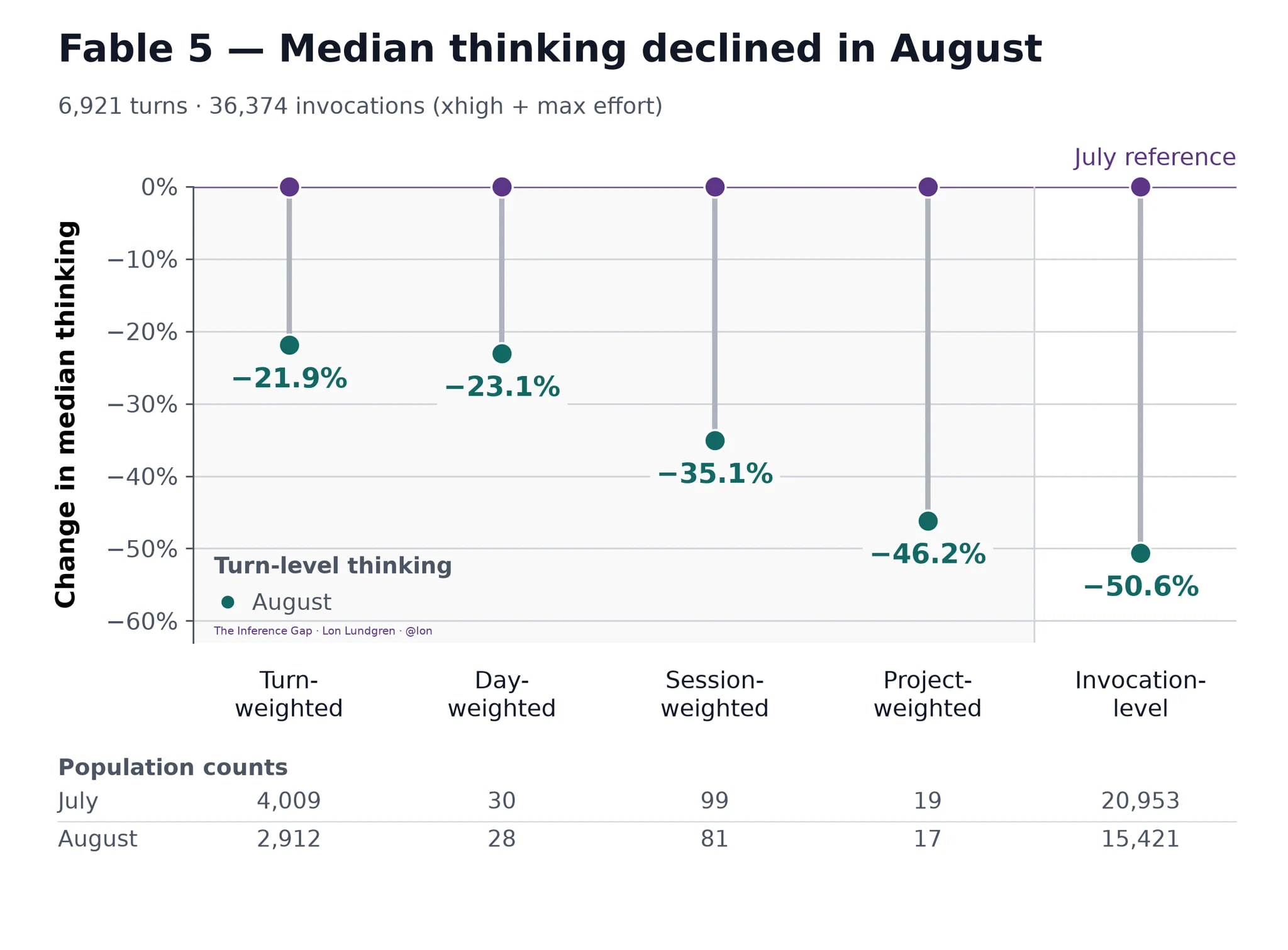
Recent observations of the Fable 5 model indicate a significant decline in 'thinking' token usage during August. Despite high effort settings, most invocations failed to trigger substantive reasoning processes, falling short of benchmark expectations.
Analysis of Fable 5 Reasoning Performance
Recent reports regarding the Fable 5 model highlight a concerning trend: a marked decline in 'thinking' token utilization throughout the month of August. Despite users configuring the model to 'xhigh' or 'max effort' levels, the actual operational behavior suggests a systemic failure in the model’s reasoning allocation. This discrepancy between user-defined effort settings and the actual computational output raises significant questions about the consistency of large language model (LLM) performance over time.
The Disconnect in Reasoning Allocation
At the heart of this issue is the observation that most invocations to the model appear to be receiving little to no 'thinking' tokens. In modern reasoning-heavy architectures, thinking tokens are vital for the model to perform internal chain-of-thought processing before generating a final answer. When these tokens are withheld or restricted, the model is forced to rely on pattern matching rather than deep deliberation, which inherently lowers the quality of complex outputs.
Benchmarking vs. Real-World Application
Crucially, the analysis notes that even when longer thinking runs are triggered, they rarely reach the performance levels demonstrated in published benchmarks. This creates a 'benchmarking gap,' where the marketing or technical documentation promises a specific cognitive capability that fails to manifest in day-to-day user interactions. This gap suggests that the model’s optimization for benchmarks may be distinct from its optimization for general, varied user prompts.
Broader Implications for AI Reliability
This decline in reasoning consistency points toward broader challenges in AI deployment. If models are prone to 'reasoning drift'—where their internal processing behavior changes or degrades over time without explicit model version updates—users and developers cannot rely on them for mission-critical tasks. This instability undermines the predictability of AI workflows and complicates the integration of these tools into professional environments.
Historical Context of Model Drift
Historically, the phenomenon of performance degradation in LLMs is not new. However, the specific failure of 'thinking' mechanisms suggests a more technical issue, potentially linked to server-side load balancing, cost-cutting measures on compute, or unintended side effects of model fine-tuning. When a model that is designed to 'think' fails to do so, it effectively reverts to a lower-tier performance state, regardless of the user's input settings.
Future Trends and Outlook
Moving forward, the industry must prioritize 'observability' in reasoning models. Users need granular insights into how much compute is actually being dedicated to their requests. If developers cannot maintain the reasoning depth expected at the 'max effort' level, they risk alienating power users. Future iterations must ensure that effort settings are not merely suggestions to the model, but hard constraints that guarantee a consistent cognitive experience.