Show HN: Firenook – Firebase emulators in Rust: 40× faster writes, 10× less RAM
Source Entity
Hacker News
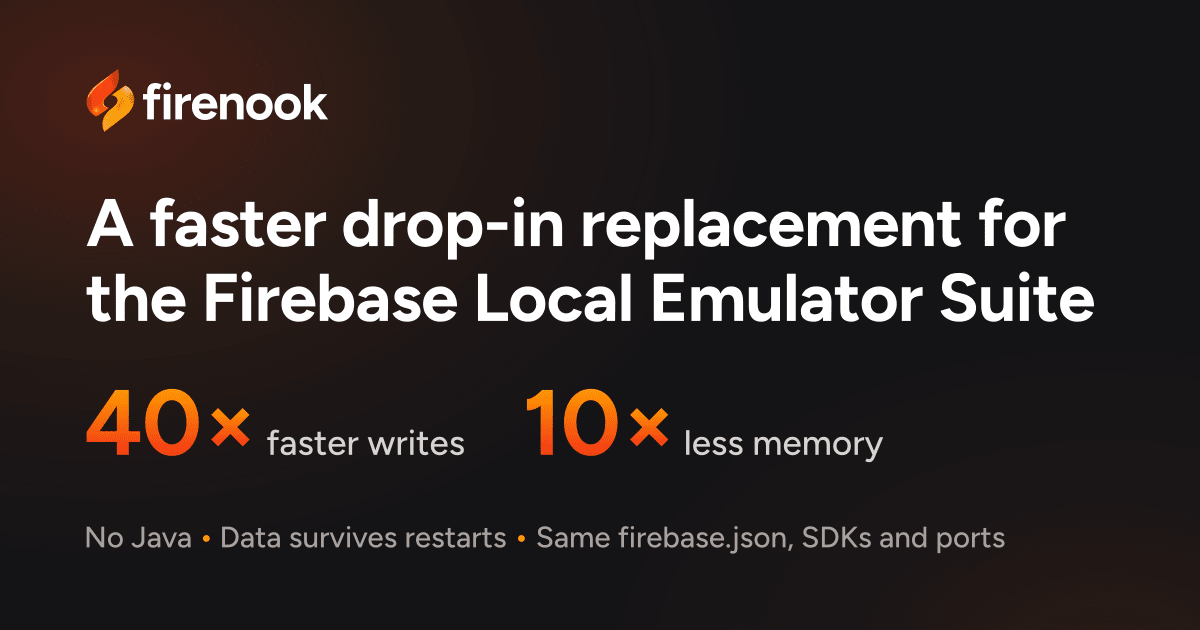
Firenook is a new Rust-based Firebase emulator that offers significant performance gains in write speed and memory efficiency. It introduces persistent data storage, ensuring faster restarts and minimizing data loss compared to official emulators.
Rethinking Local Development: The Emergence of Firenook
The introduction of Firenook as a high-performance alternative to official Firebase emulators marks a significant shift in the developer tooling landscape. By leveraging the Rust programming language, Firenook addresses the performance bottlenecks often associated with the standard emulator suite, specifically targeting write speeds and memory consumption. For developers working with large-scale datasets, the transition from standard tools to high-performance, systems-level alternatives is becoming a necessity rather than a luxury.
The Performance Advantage of Rust
At the core of Firenook's appeal is its ability to deliver write speeds 40 times faster than existing solutions while simultaneously reducing RAM usage by a factor of 10. Rust’s memory safety guarantees and zero-cost abstractions allow Firenook to handle millions of documents without the overhead typically associated with garbage-collected runtimes. This efficiency is critical for local development environments where resource constraints can often throttle developer productivity.
Persistent Data Architecture
One of the most disruptive features of Firenook is its approach to data persistence. Traditionally, Firebase emulator users have had to contend with cumbersome import/export cycles that slow down the development loop. Firenook’s --keep-data functionality effectively removes this friction by keeping data localized and accessible. By allowing Firestore, Auth, and Storage services to resume operations in approximately half a second, it drastically reduces the time spent waiting for state synchronization.
Reliability and Crash Recovery
Beyond raw speed, Firenook introduces a more robust safety model for local data. In the standard Firebase emulator, a crash often results in the loss of all data generated since the last manual export. Firenook mitigates this risk by ensuring that a crash loses at most the last second of writes. Furthermore, the tool ensures that every shutdown process closes the data files cleanly, providing a level of stability that is essential for complex integration testing.
Broader Implications for Firebase Ecosystems
This development signals a growing demand for 'community-first' tooling within the Firebase ecosystem. While official tools provide broad compatibility, niche, high-performance projects like Firenook fill the gaps left by the one-size-fits-all approach of large cloud providers. As developers continue to prioritize local-first workflows, the adoption of tools that treat local databases as persistent, high-performance assets will likely become the industry standard.
Future Trends in Developer Tooling
Looking ahead, the success of Firenook highlights a trend toward 'de-clouding' the development experience. By enabling developers to run complex, data-heavy environments locally with minimal performance penalties, tools like this empower teams to iterate faster and test more rigorously. Future iterations of such tools will likely focus on even deeper integration with cloud-native features, further blurring the line between local emulators and production-grade backends.