France equips Rafale with low-cost rockets to tackle Shahed-style drone threats
Source Entity
TOI WORLD DESK
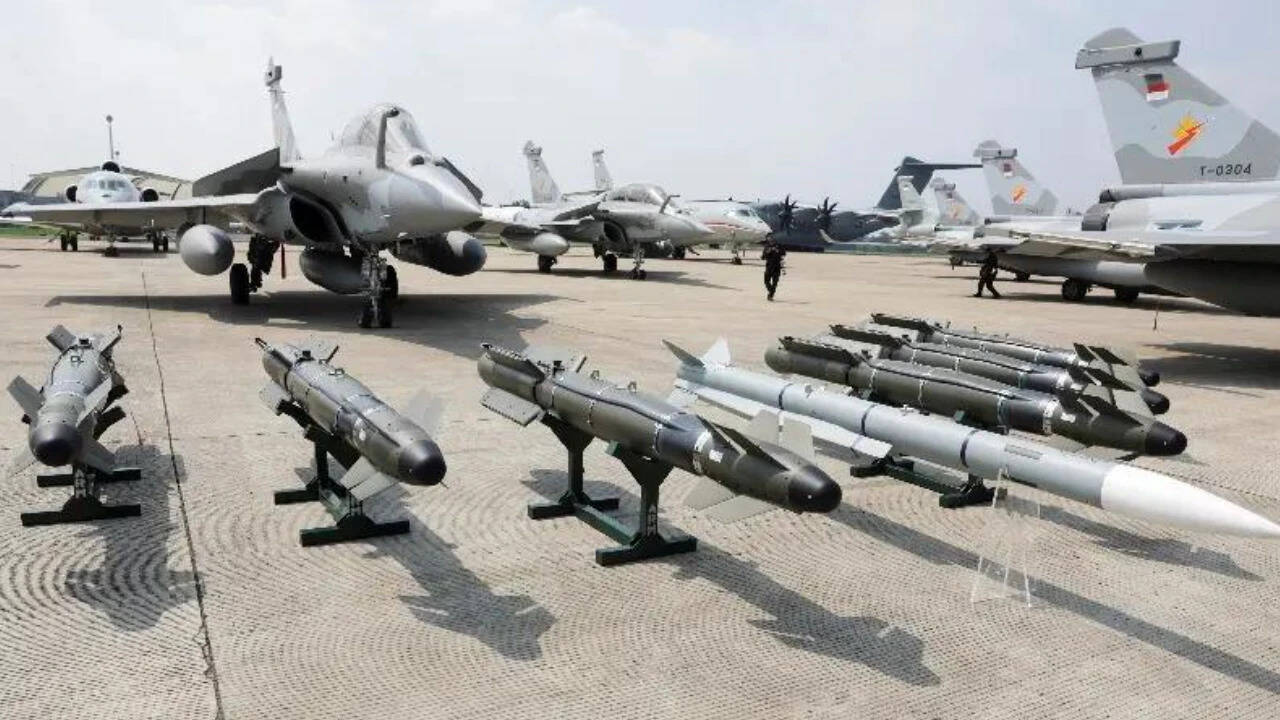
France has successfully equipped its Rafale fighter jets with advanced 68mm laser-guided rockets. This innovative weaponry offers a cost-effective means to tackle rising drone threats. Under the Ladac program, the French Air Force is enhancing its anti-drone capabilities. This swift enhancement demonstrates strategic lessons drawn from recent conflicts, while countries like the US and UK are also incorporating similar systems into their arsenals.
Strategic Adaptation: France's Response to the Drone Revolution
In a significant shift in aerial combat doctrine, France has successfully equipped its Rafale fighter jets with 68mm laser-guided rockets. This move, spearheaded under the Ladac program, is a direct response to the proliferation of "Shahed-style" drones—low-cost, long-range loitering munitions that have redefined the nature of modern conflict. By integrating these smaller, more affordable munitions, the French Air Force is attempting to solve one of the most pressing dilemmas in contemporary defense: the economic asymmetry of air defense.
The Crisis of Cost-Asymmetry in Modern Warfare
The primary driver behind this technological integration is the staggering disparity between the cost of a target and the cost of the interceptor. Traditionally, high-performance fighter jets like the Rafale rely on sophisticated air-to-air missiles (AAMs), such as the Meteor or MICA, which cost hundreds of thousands, if not millions, of dollars per unit. In contrast, loitering munitions like the Iranian-designed Shahed drones are relatively inexpensive, often costing only a few thousand dollars.
When a military uses a million-dollar missile to down a $20,000 drone, it creates an unsustainable "economic war of attrition." If an adversary launches a swarm of fifty drones, the cost of interception could bankrupt a defense budget or deplete critical missile stockpiles long before the enemy runs out of drones. The introduction of 68mm laser-guided rockets provides a middle ground, offering precision guidance at a fraction of the cost of a full-scale missile.
Technical Implementation and the Ladac Program
Under the Ladac program, the French Air Force is not merely adding a new weapon but is rethinking the loadout of its multi-role fighters. Laser-guided rockets allow the Rafale to maintain high precision while utilizing a munition that is significantly cheaper to produce and deploy. These rockets are designed to be fired in rapid succession, making them ideal for tackling multiple, slow-moving targets in a single sortie.
This capability allows the Rafale to act as a high-speed, agile platform for Counter-Unmanned Aircraft Systems (C-UAS). By using the jet's advanced sensors to designate targets and the 68mm rockets to neutralize them, France is bridging the gap between ground-based short-range air defense (SHORAD) and high-altitude air superiority missions.
Global Context and Lessons from Recent Conflicts
France's decision is not an isolated event but part of a broader global trend. Observations from the conflict in Ukraine and tensions in the Middle East have demonstrated that quantity often has a quality of its own. The ability to saturate defenses with cheap drones has forced global powers to pivot. The United States and the United Kingdom are currently pursuing similar paths, exploring the use of gun pods, smaller guided rockets, and even directed-energy weapons to counter the drone threat.
This strategic pivot indicates a realization that the "gold-plated" approach to defense—where every weapon is a high-tech masterpiece—is insufficient against low-tech, mass-produced threats. France is effectively "downscaling" its weaponry to match the threat profile of the enemy, ensuring that its air force remains viable in a high-intensity, long-duration conflict.
Future Implications for Aerial Doctrine
Looking forward, this development suggests that the role of the multi-role fighter is expanding. The Rafale is no longer just a tool for air superiority or deep-strike missions; it is becoming a critical layer in integrated air defense. We can expect to see further iterations of the Ladac program, potentially incorporating AI-driven target acquisition to allow a single pilot to engage dozens of drones simultaneously without manual laser designation for every target.
Furthermore, this move may trigger a new arms race in drone technology, where adversaries develop faster or more stealthy drones to evade these new rocket systems. However, by establishing a cost-effective interception method now, France has positioned itself to maintain aerial dominance without risking economic exhaustion.
Conclusion
France's integration of low-cost 68mm laser-guided rockets into the Rafale fleet is a pragmatic and necessary evolution of military strategy. By addressing the cost-asymmetry of the Shahed-style drone threat, the Ladac program ensures that the French Air Force can defend its airspace sustainably. This shift reflects a broader global trend toward hybrid weaponry, blending high-end performance with cost-effective munitions to survive the era of drone swarms.