Neutrino physicist wins 2026 Nobel Physics Prize
Source Entity
Jennifer Ouellette
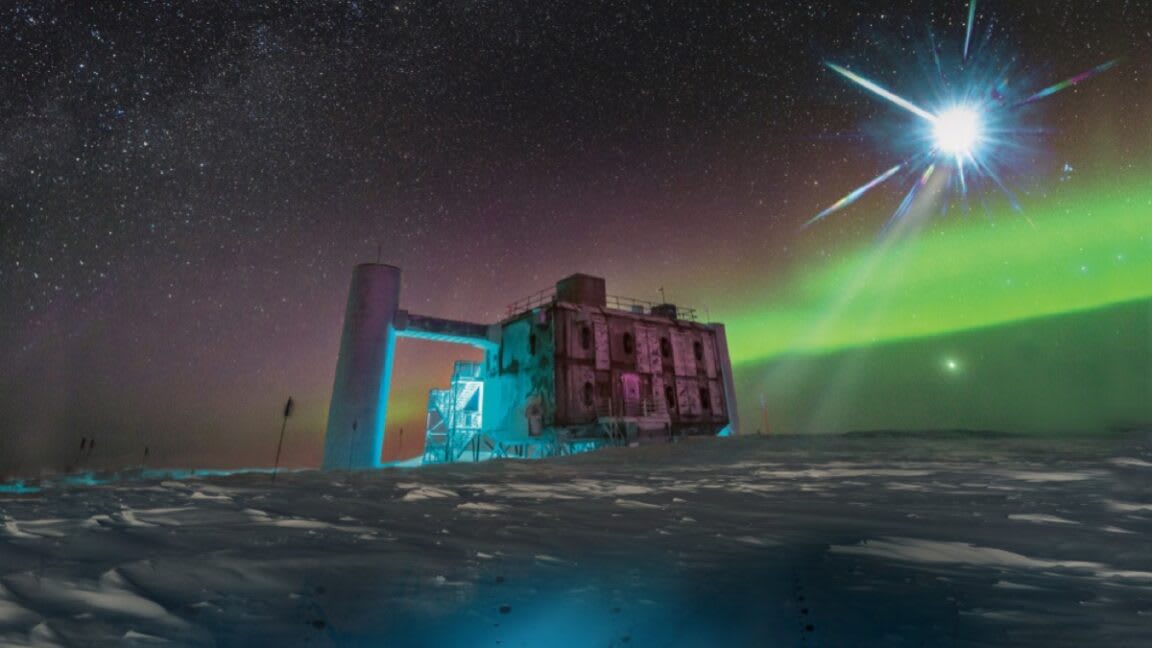
Belgian-American physicist Francis Halzen has been awarded the 2026 Nobel Prize in Physics for his leadership in developing the IceCube Neutrino Observatory. His work has enabled the detection of high-energy cosmic neutrinos, providing profound new insights into the violent processes of the universe.
A New Window into the Cosmos: The 2026 Nobel Prize in Physics
The Royal Swedish Academy of Sciences has awarded the 2026 Nobel Prize in Physics to Belgian-American physicist Francis Halzen. This prestigious recognition honors his decisive contributions to the IceCube Neutrino Observatory and his pioneering role in the discovery of high-energy neutrinos of astrophysical origin. By identifying these elusive "ghost particles," Halzen has fundamentally altered our methodology for observing the most distant and energetic phenomena in the cosmos.
The Vision of IceCube
Francis Halzen’s journey toward this achievement began long before the observatory became a reality. He first proposed his vision for detecting neutrinos at the South Pole in 1988, demonstrating remarkable foresight in instrumentation. Over the subsequent decades, he led an international team of researchers and engineers to construct IceCube, a massive scientific instrument that utilizes a full cubic kilometer of Antarctic ice. By embedding light sensors deep within the ice, the observatory captures the faint signals produced when neutrinos interact with matter, effectively turning the South Pole into a giant telescope.
Understanding 'Ghost Particles'
Neutrinos are often referred to as "ghost particles" because they possess almost no mass and rarely interact with ordinary matter, allowing them to travel vast distances across the universe unobstructed. Because they are not deflected by magnetic fields, they travel in straight lines from their sources, acting as cosmic messengers that carry information about high-energy processes. Halzen’s work has enabled scientists to trace these particles back to their origins, shedding light on violent events in the distant universe that were previously hidden from traditional electromagnetic telescopes.
Scientific Leadership and Global Collaboration
The Royal Swedish Academy of Sciences emphasized that Halzen’s vision and scientific leadership were fundamental to the success of IceCube. As a professor at the University of Wisconsin–Madison, Halzen has been a central figure in the field of neutrino physics, guiding a complex, multi-national collaboration. This award of 12 million Swedish kronor—approximately $1.2 million—serves as a testament to the importance of his long-term dedication to building infrastructure capable of pushing the boundaries of particle astrophysics.
Broader Implications and Future Trends
The discovery of high-energy astrophysical neutrinos marks the beginning of a new era in multi-messenger astronomy. By combining data from neutrino detectors with traditional light-based telescopes and gravitational wave detectors, researchers can now gain a more comprehensive understanding of the universe's most extreme environments, such as active galactic nuclei and gamma-ray bursts. Moving forward, the success of the IceCube model is likely to inspire further investment in deep-ice and deep-sea neutrino detection arrays, as the field seeks to map the high-energy sky with increasing precision.
Conclusion
The awarding of the Nobel Prize to Francis Halzen solidifies his place in the history of physics. His persistence in pursuing an unconventional method of observation has paid off in the form of ground-breaking cosmic data. As the scientific community continues to analyze the signals captured by IceCube, the legacy of Halzen’s work will continue to shape our understanding of the fundamental mechanics of the universe for generations to come.
Multiple Citing Sources