Gemini Robotics 2.5 accelerates real-world general dexterity
Source Entity
Google DeepMind News
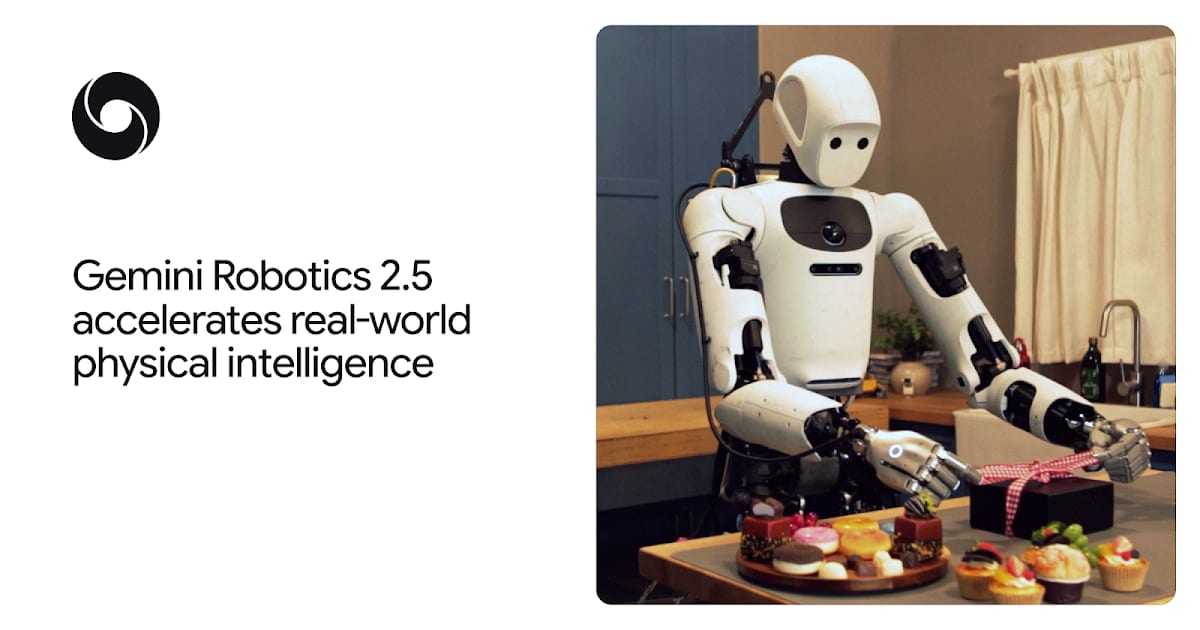
Google DeepMind has unveiled Gemini Robotics 2.5, a sophisticated vision-language-action model designed to enhance robotic dexterity and real-world task performance. The update includes an open-source safety benchmark called ASIMOV-jailbreak to ensure reliable human-robot collaboration.
The Evolution of Physical AI: Gemini Robotics 2.5
Google DeepMind has officially unveiled Gemini Robotics 2.5, a significant leap forward in the field of vision-language-action (VLA) models. By bridging the gap between digital reasoning and physical execution, this update aims to move robotics from highly controlled laboratory settings into the unpredictable, unstructured environments of the real world. This transition is essential for the next generation of automation, where machines must process visual input and human instructions to perform complex physical tasks with human-like proficiency.
Enhanced Dexterity and Learning Speed
The core strength of Gemini Robotics 2.5 lies in its ability to accelerate the learning curve for robotic systems. By leveraging the computational power of the Gemini 4 Argon architecture, the model allows robots to acquire new skills at an unprecedented speed. This increased dexterity is not merely a quantitative improvement; it represents a fundamental change in how robots perceive and interact with their surroundings, moving beyond rigid, pre-programmed movements toward adaptive, intelligent action.
Real-World Integration and Industrial Application
A testament to the platform's maturity is its current deployment in industrial settings. Reports indicate that Gemini-powered robots are already being utilized within Mercedes-Benz factories, performing actual work alongside human counterparts. This move from theory to industrial practice highlights the model's reliability and its capacity to handle the nuanced demands of a factory floor, where safety and precision are paramount.
The Architecture of Embodied Reasoning
DeepMind’s approach relies on a multi-layered computational stack. At the heart of this is 'Gemini Embodied Reasoning,' a vision-language model that acts as the robot's brain. It synthesizes live video feeds with user instructions to formulate actionable plans. This is coupled with the VLA component, which translates these high-level plans into granular, physical movements, allowing the robot to navigate and manipulate objects effectively in real time.
Prioritizing Safety with ASIMOV-jailbreak
As robots become more integrated into human spaces, safety remains the primary concern. To address this, Google DeepMind has introduced the 'ASIMOV-jailbreak' open-source safety benchmark. By establishing a rigorous framework for testing and validation, the team is proactively working to prevent the erratic behavior often associated with autonomous systems. This open-source approach encourages collaboration and transparency, which are necessary for public trust in humanoid and industrial robotics.
Future Trends and Concluding Thoughts
Looking ahead, the successful deployment of Gemini Robotics 2.5 suggests a future where robots will no longer be confined to cages or repetitive tasks. Instead, we are entering an era of 'whole-body intelligence,' where machines can assist humans across a vast range of environments. By continuing to refine the synergy between vision, language, and physical action, DeepMind is setting the standard for the next decade of robotics, effectively narrowing the performance gap between artificial systems and human physical capability.