40 years ago August 17, 1986: Art 249 extended to J&K
Source Entity
The Indian Express
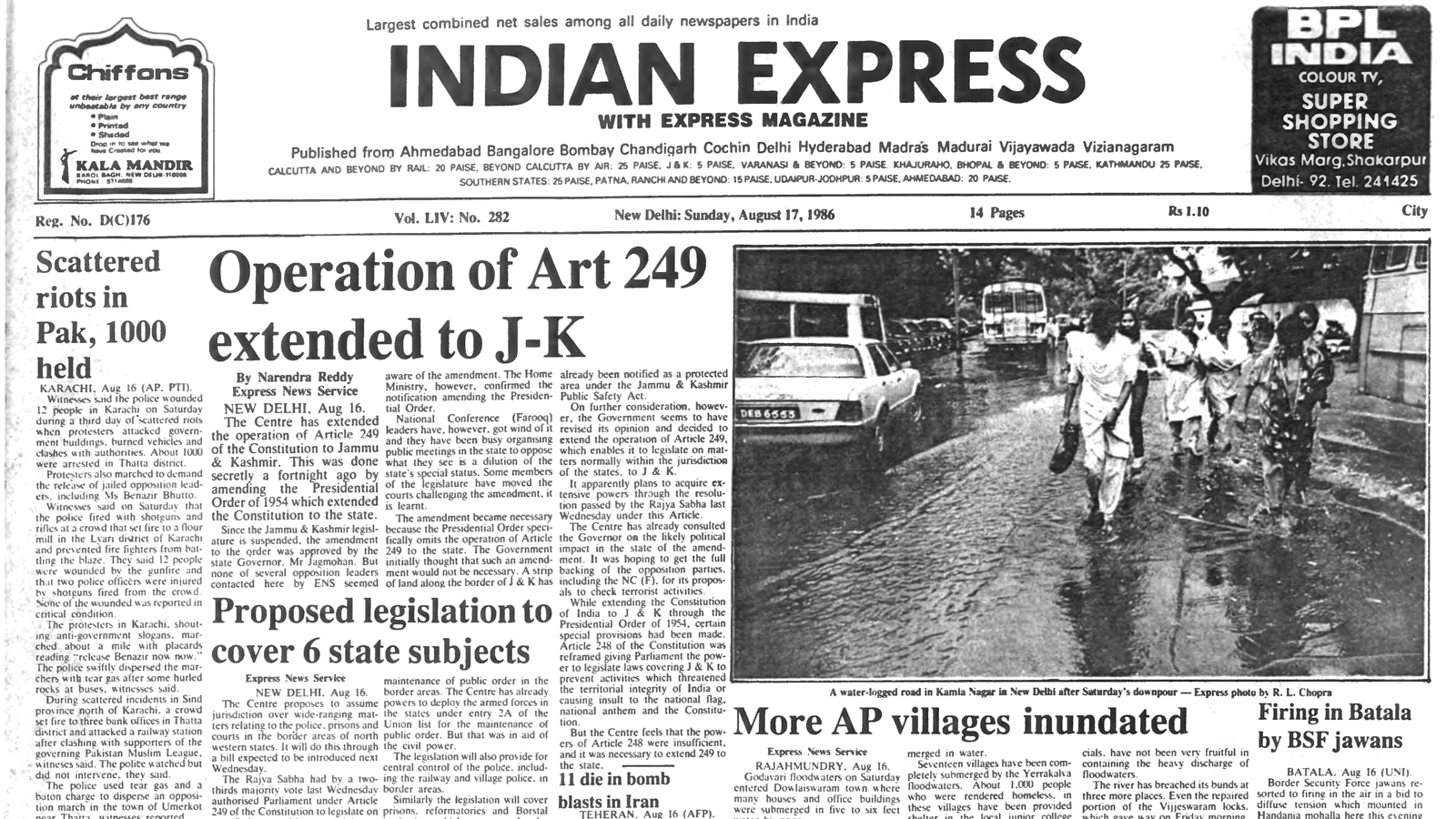
Historical reports from August 1986 detail the extension of Article 249 to Jammu and Kashmir, civil unrest in Pakistan, and a deadly car-bombing in Qom, Iran. These events reflect a period of significant regional instability and constitutional shifts.
A Retrospective on the Geopolitical Landscape of August 1986
Constitutional Shifts in Jammu and Kashmir
On August 17, 1986, the political landscape of Jammu and Kashmir underwent a significant transformation when the Centre extended the operation of Article 249 to the state. This constitutional adjustment, executed via an amendment to the Presidential Order of 1954, was conducted while the state legislature remained suspended. Governor Jagmohan’s approval of this measure effectively broadened the legislative powers of the Indian Parliament regarding the state, marking a pivotal moment in the governance structure of the region during a period of heightened administrative oversight.
Civil Unrest and Political Protests in Pakistan
Simultaneously, Pakistan faced severe internal instability as riots erupted across the country. In Karachi, the situation escalated into a third day of violence, with witnesses reporting that police wounded 12 individuals during clashes involving attacks on government infrastructure and the burning of vehicles. The unrest was fueled by widespread public dissatisfaction, manifesting in protests demanding the release of jailed opposition leaders, most notably Benazir Bhutto. The scale of the government response was evident in the Thatta district, where approximately 1,000 people were arrested, highlighting the intense friction between the state and the opposition movement.
The Tragedy in Qom, Iran
Beyond the South Asian theater, the Middle East witnessed a brutal act of violence in the holy city of Qom, Iran. A devastating car-bomb explosion claimed the lives of 11 people and left roughly 100 others injured. This attack in a city of deep religious and cultural significance served as a grim reminder of the volatility gripping the region during the mid-1980s, occurring amidst a broader climate of conflict that characterized the era.
Analyzing the Interconnectedness of Regional Instability
While these events occurred in distinct geographic theaters, they collectively underscore a mid-1980s geopolitical climate defined by volatile domestic policies and civil friction. The extension of Article 249 represented a centralized effort to streamline governance in Jammu and Kashmir, while the protests in Pakistan were symptomatic of a democratic struggle against entrenched authority. The bombing in Iran further illustrates the pervasive threat of violence that challenged state stability across the broader region.
Historical Implications and Legacy
The events of August 1986 serve as a historical benchmark for understanding the evolution of the Indian constitutional framework concerning Jammu and Kashmir and the subsequent trajectory of political dissent in Pakistan. The actions taken by Governor Jagmohan and the reactions of the Pakistani public to the detention of opposition figures like Benazir Bhutto provided early indicators of the long-term political trajectories these nations would follow in the decades that followed.
Conclusion
In summary, the reports from August 1986 depict a world in flux. From the quiet, decisive constitutional amendments in India to the loud, chaotic streets of Karachi and the tragic violence in Qom, these incidents provide a comprehensive look at the historical forces at play forty years ago. Analyzing these records offers essential context for the modern geopolitical landscape, reflecting the enduring nature of these regional challenges.