These giant deep-sea spiders glow blue, and scientists aren’t sure why
Source Entity
The Indian Express
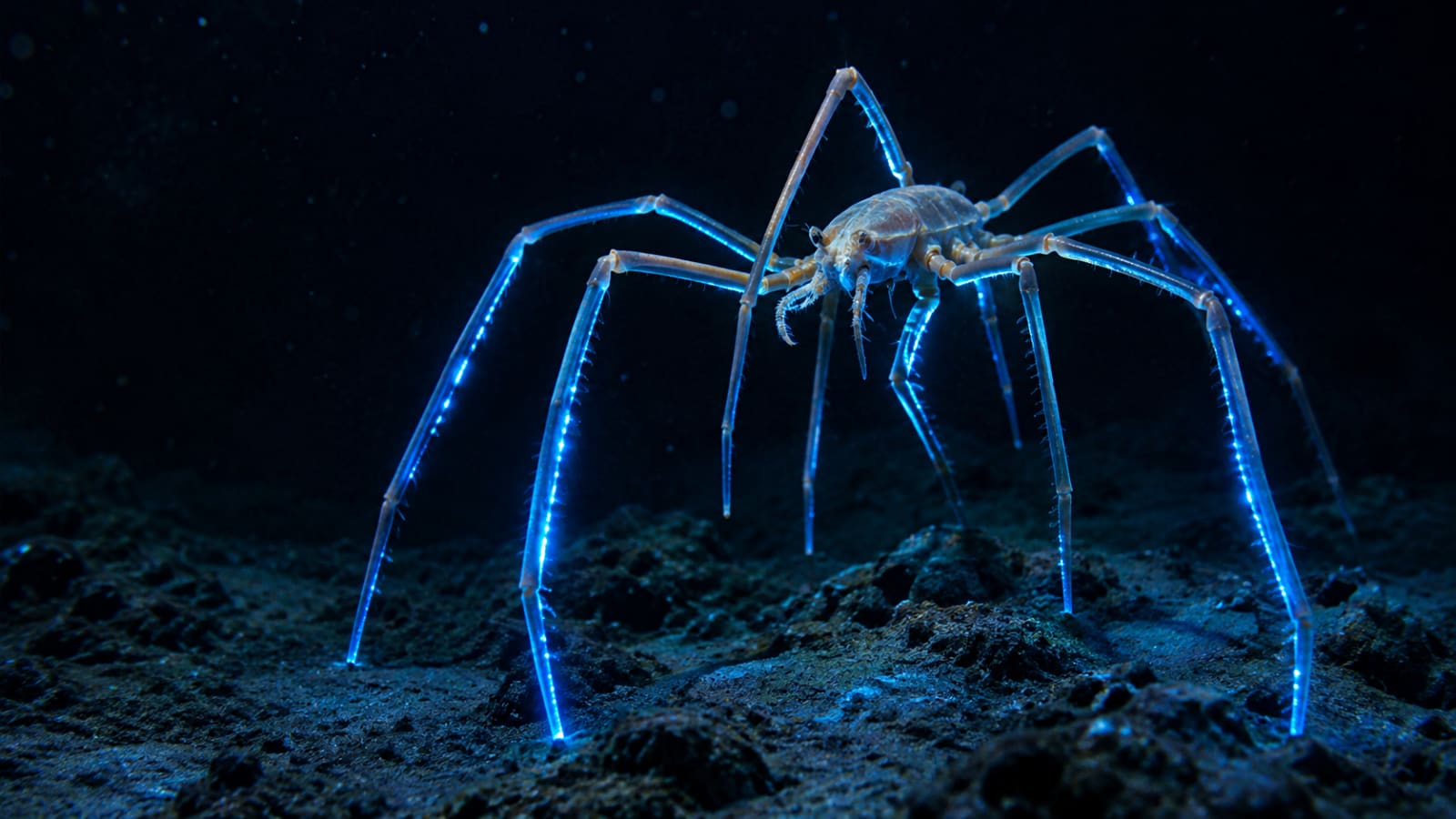
Researchers have discovered that giant sea spiders found 5,000 meters deep off the coast of Australia exhibit blue bioluminescence. This unexpected finding challenges current understanding of deep-sea survival mechanisms.
The Mystery of the Abyssal Glow
Recent scientific observations have unveiled a striking phenomenon in the deep-sea ecosystems off the coast of southeastern Australia: giant sea spiders that exhibit blue bioluminescence. While bioluminescence is a well-documented trait in various marine organisms, its presence in these specific arachnids—collected from depths of nearly 5,000 meters—presents a compelling new puzzle for marine biologists. The discovery, initially documented during a 2017 expedition to the Australian Abyss, highlights how little we still understand about the adaptive strategies required to survive in the extreme pressures of the deep ocean.
Understanding Bioluminescence in the Abyss
Bioluminescence is a chemical process wherein living organisms generate light, typically through the oxidation of a luciferin molecule catalyzed by a luciferase enzyme. In the pitch-black environment of the midnight zone, where sunlight cannot penetrate, this ability serves various evolutionary purposes, such as attracting prey, finding mates, or deterring predators. The fact that these giant sea spiders, which can reach leg spans of up to 25 centimeters, possess this capability suggests that light production plays a critical, yet currently undefined, role in their life cycle at extreme depths.
The 2017 Australian Abyss Expedition
Marine biologist Jérôme Mallefet and his research team were instrumental in identifying this trait during their exploration of the Australian Abyss. By examining thousands of specimens, the researchers were able to confirm that these creatures were not merely reflecting light but were actively producing a blue glow from their elongated limbs. This finding is significant because it provides a rare glimpse into the physiological intricacies of deep-sea fauna that are rarely accessible for study due to the immense technical challenges of deep-sea exploration.
Evolutionary and Environmental Implications
The discovery of bioluminescence in giant sea spiders raises fundamental questions about the evolutionary pressures present at 5,000 meters below the surface. In an environment defined by crushing pressure and freezing temperatures, the energy expenditure required to produce light must offer a distinct survival advantage. Scientists are currently investigating whether this blue light serves as a form of communication or a defense mechanism against potential threats in an ecosystem that remains largely mysterious to modern science.
Future Research and Scientific Outlook
As researchers continue to analyze the data collected during the Australian Abyss expeditions, the focus will shift toward understanding the chemical composition of the spiders' bioluminescence. By mapping the genetic and biochemical pathways involved, the scientific community hopes to gain broader insights into how deep-sea life adapts to the most remote corners of our planet. This ongoing research underscores the importance of continued investment in oceanographic exploration, as every expedition brings us closer to mapping the complex biological map of the deep-sea floor.