Govt debunks claims of MiG-29 crash, blames Pak accounts: ‘Footage from video game’
Source Entity
Latest News: Todays Latest News Headlines from India & World | Hindustan Times | Hindustan Times
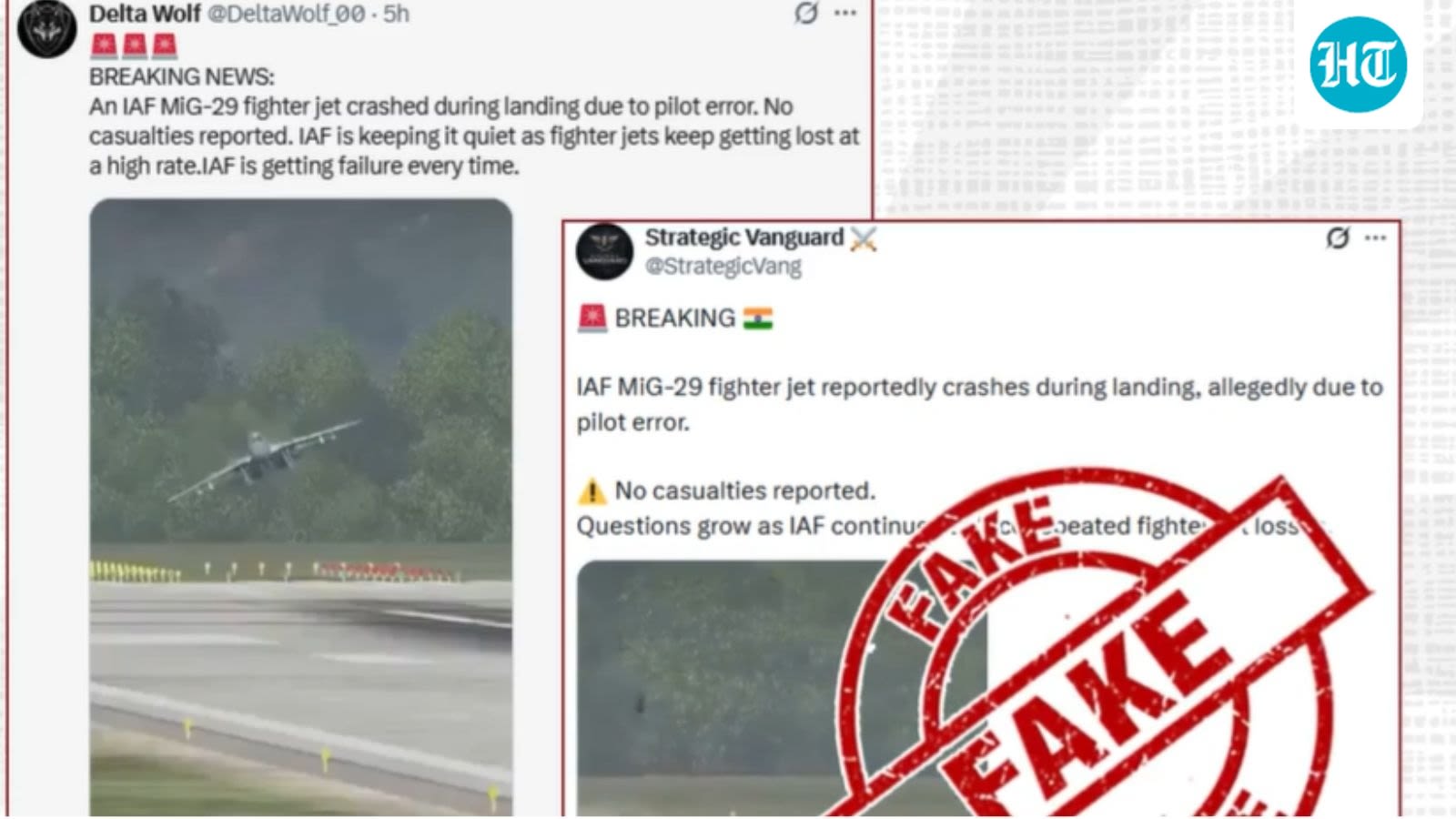
The Indian government's fact-check unit has debunked viral social media claims of an IAF MiG-29 crash. The footage, circulated by Pakistani propaganda accounts, was identified as clips from the video game War Thunder.
The Weaponization of Digital Disinformation
In an era defined by rapid information exchange, the boundary between reality and digital simulation is increasingly being exploited for geopolitical maneuvering. Recently, the Indian government’s Press Information Bureau (PIB) fact-checking unit issued a formal rebuttal against viral claims suggesting that an Indian Air Force (IAF) MiG-29 fighter jet had suffered a catastrophic crash during landing due to pilot error. This incident highlights the growing trend of utilizing hyper-realistic gaming footage to manufacture false narratives and incite public alarm.
Dissecting the Source of the Fabrication
The investigation conducted by the PIB identified that the viral video, which purported to show a military aviation disaster, was in fact captured from the popular combat simulation video game, War Thunder. By utilizing high-fidelity graphics, bad actors are able to bypass the scrutiny of casual viewers who may not immediately recognize the artificial origins of the footage. The government explicitly attributed the propagation of this misinformation to Pakistani propaganda accounts, signaling a coordinated effort to undermine the perceived reliability and operational competence of the Indian Armed Forces.
The Strategic Intent Behind Fake News
Beyond simple mischief, the dissemination of such videos serves a calculated strategic purpose. By spreading footage of a "crashed" MiG-29, the perpetrators aim to demoralize the public, damage the reputation of the Indian Air Force, and create a false sense of vulnerability within the national security apparatus. This type of psychological operation is designed to persist even after debunking, as the visual impact of a "crash" often leaves a more lasting impression on social media users than the subsequent correction.
The Role of Fact-Checking Units
As digital literacy struggles to keep pace with technological advancement, the role of government-led fact-checking units has become paramount. The PIB’s intervention serves as a necessary firewall against the erosion of truth in the digital space. By providing direct evidence—such as links to the original gaming footage—the government effectively neuters the narrative before it can gain enough traction to influence broader public sentiment or diplomatic discourse.
Broader Implications for Information Warfare
The exploitation of War Thunder footage is not an isolated incident but part of a wider trend in modern information warfare. In previous international conflicts, similar tactics have been employed to depict non-existent battlefield successes or disasters. This incident serves as a stark reminder that the digital battlefield is now as critical as the physical one. As we move forward, the ability for platforms and users to distinguish between simulated reality and actual events will define the stability of the global information environment.
Conclusion: A Call for Digital Vigilance
Ultimately, the debunking of the MiG-29 crash claim underscores the necessity for skepticism in the age of social media. While the government has successfully identified this instance as a fabrication, the speed at which such misinformation spreads remains a significant challenge. Moving forward, a combination of robust institutional fact-checking and enhanced public digital literacy will be the only effective defense against the persistent threat of state-sponsored propaganda.
Multiple Citing Sources
Verification Required?