UPSC Mains Answer Practice — GS 3: Himalayan region’s natural hazards and typhoid control in India (Week 170)
Source Entity
Nitendra Pal Singh
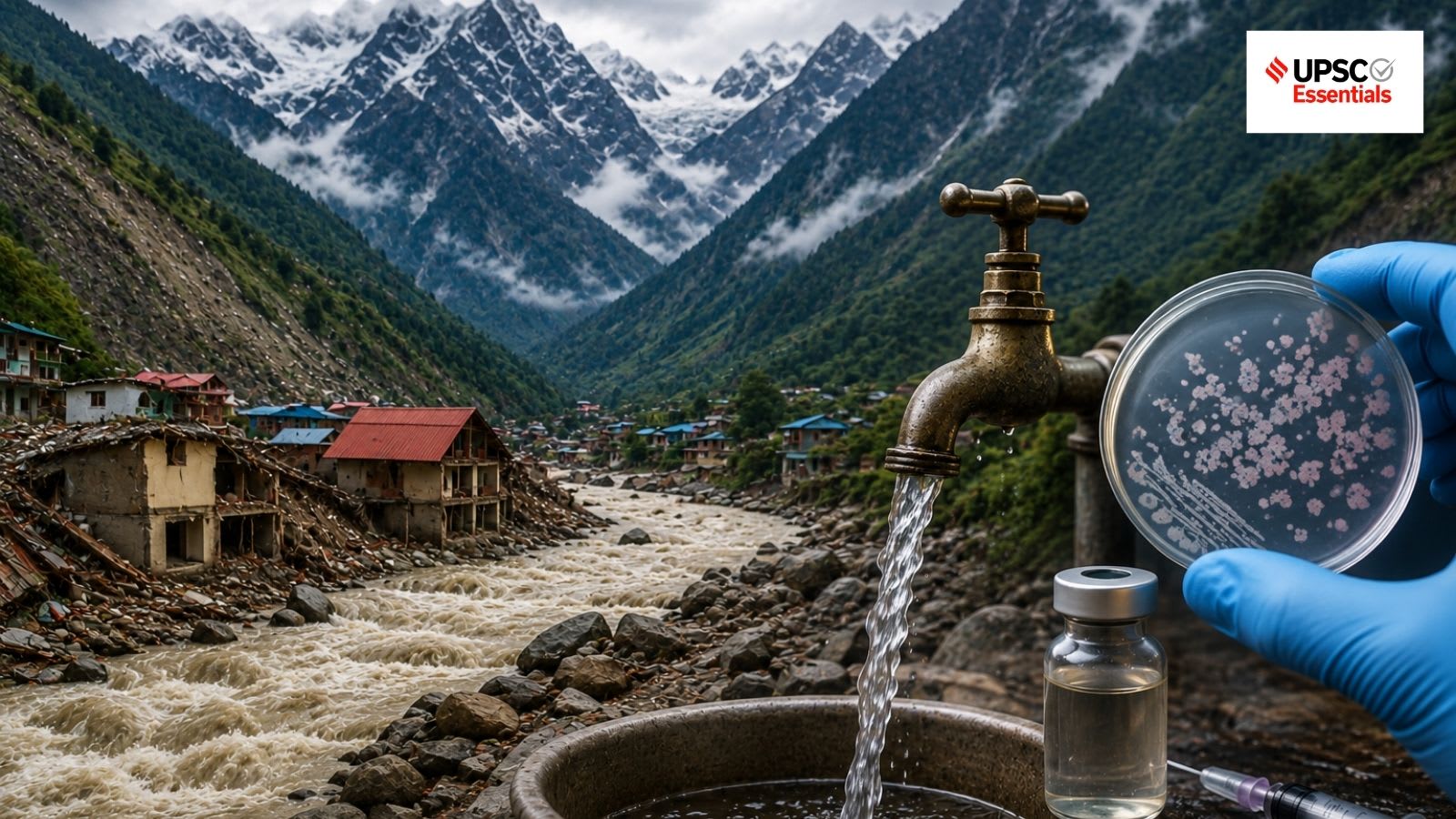
This report highlights the urgent need to shift from reactive disaster management to proactive anticipation in the warming Himalayan region. It also introduces educational resources for UPSC aspirants focusing on natural hazards and public health.
The Himalayan Crisis: From Reaction to Anticipation
The Himalayan region is currently facing an existential challenge as climate change accelerates the destabilization of ice and rock formations. Recent events, particularly in Nepal, have served as a grim reminder that traditional disaster management strategies—which are largely reactive—are no longer sufficient. Experts like Anshuman Bhardwaj, Head of the Department of Planetary Sciences at the University of Aberdeen, emphasize that the warming of the Himalayas is creating widespread instability, necessitating a paradigm shift toward predictive disaster preparedness.
Scientific Imperatives for Disaster Mitigation
Research published in Nature Sustainability underscores this urgency. The study, titled ‘Rock-ice avalanches in a warming Himalaya indicate pathways toward effective preparedness,’ provides a critical framework for understanding how rising temperatures directly contribute to catastrophic slope failures. By analyzing past events where massive walls of ice and rock collapsed, scientists are identifying patterns that can help authorities anticipate future avalanches, thereby saving lives through early warning systems and better land-use planning.
The Role of Education in Policy Formulation
Beyond the physical science of disaster mitigation, there is a parallel need for informed governance and public awareness. Initiatives like the UPSC Essentials program play a vital role in this ecosystem by integrating these complex environmental challenges into the discourse for future civil servants. By including topics such as the Himalayan region’s natural hazards in the GS-3 syllabus, the educational framework ensures that the next generation of policy leaders is equipped to handle the intersection of climate science and administrative decision-making.
Integrating Public Health and Environmental Risk
While disaster management remains a primary focus, the broader syllabus also highlights the importance of public health, such as typhoid control in India. This reflects a holistic approach to governance, where environmental hazards and health crises are viewed as interconnected threats. For aspirants, mastering these topics is not merely an academic exercise but a preparation for real-world scenarios where climate change exacerbates both physical infrastructure damage and public health vulnerabilities.
Conclusion: A Path Forward
The convergence of scientific research and academic preparation marks a significant step toward a more resilient India. As the Himalayan ecosystem becomes increasingly volatile, the ability to anticipate hazards will remain the cornerstone of effective policy. By fostering a culture of preparedness—both through rigorous scientific study and comprehensive civil service training—the nation can better navigate the unpredictable challenges posed by a warming climate.