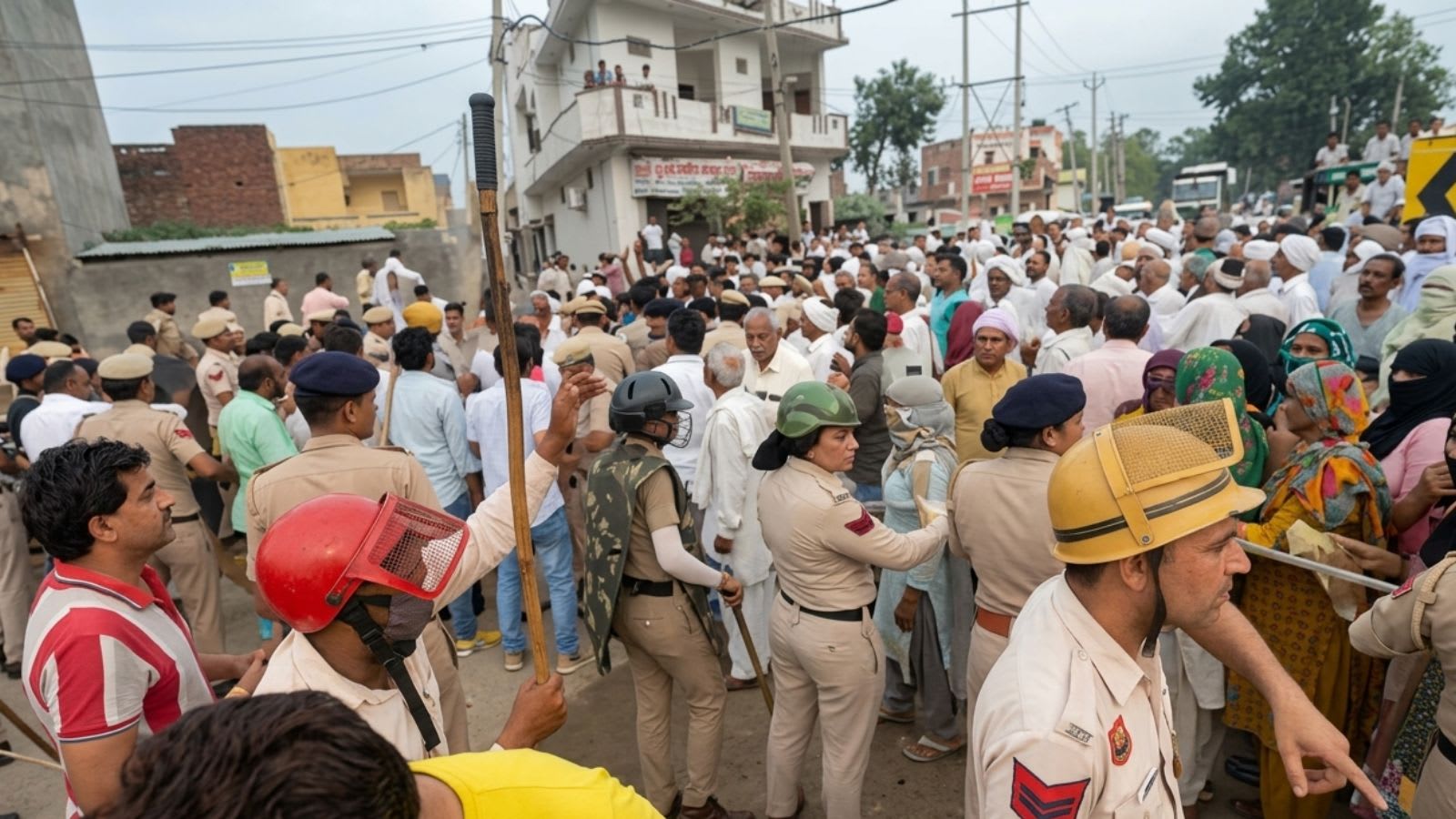
Villagers, police clash ahead of Haryana CM’s I-Day event; video shows cops throwing stones
Source Entity
Sukhbir Siwach
On Independence Day, political leaders across the spectrum addressed the nation, with Punjab CM Bhagwant Mann warning against communal disharmony. Meanwhile, RSS chief Mohan Bhagwat and Congress President Mallikarjun Kharge offered contrasting perspectives on India's global aspirations and historical legacy.
Independence Day Reflections: A Nation at a Crossroads
Independence Day in India serves as a critical juncture for political discourse, where leaders reflect on the nation's past and project visions for its future. This year, the rhetoric from various political spheres highlighted a preoccupation with national identity, historical legacy, and the preservation of social cohesion. The statements from Punjab Chief Minister Bhagwant Mann, RSS chief Mohan Bhagwat, and Congress President Mallikarjun Kharge illustrate the diverse and often competing narratives that define contemporary Indian politics.
Punjab’s Stance on Communal Harmony
Punjab Chief Minister Bhagwant Mann utilized his Independence Day address to adopt a statesman-like tone, notably avoiding direct partisan attacks. By emphasizing that the "seeds of hatred can never germinate" in Punjab, Mann framed the state as a resilient bulwark against communal discord. His focus on Punjab's historical contribution to the freedom struggle and the trauma of Partition serves to anchor current governance within the state's long-standing tradition of sacrifice and unity. By warning against forces attempting to disturb peace, Mann is attempting to consolidate his administration's image as a protector of secular values in a region with a complex socio-political history.
The 'Vishwaguru' Ambition and Global Standing
Parallel to state-level concerns, national discourse was dominated by the vision of India’s global trajectory. RSS chief Mohan Bhagwat’s assertion that "many forces" oppose India’s ascension to the status of Vishwaguru (world teacher) underscores a narrative of external skepticism and internal resilience. This framing suggests that India's path to global leadership is fraught with geopolitical resistance, a theme that has become a cornerstone of the current ideological framework. This perspective prioritizes a strong, unified national identity capable of overcoming perceived international hurdles.
Historical Legacies and Political Arrogance
Contrasting this vision of the future, Congress President Mallikarjun Kharge’s comments focused on the historical contributions of India's first Prime Minister, Jawaharlal Nehru. By explicitly praising Nehru’s work while noting his lack of "arrogance," Kharge provides a counter-narrative to current political trends. This emphasis on historical figures serves as a critique of modern political styles, suggesting that the foundation of India’s democracy was built on humility and collaborative governance rather than the assertive, often polarizing, political culture observed today.
Implications for Future Political Trends
These disparate statements reflect a broader trend in Indian politics where history is actively being repurposed to serve modern agendas. While the AAP government in Punjab seeks to project stability and localized peace, the national debate remains tethered to the interpretation of historical figures and the projection of global power. The divergence between the focus on communal harmony, the ambition of global leadership, and the defense of democratic legacies indicates that the upcoming political season will likely remain heavily contested over the definition of the 'Indian project.'
Conclusion
Ultimately, the Independence Day speeches highlight a nation grappling with its identity. Whether through the lens of Punjab’s internal peace, the RSS's vision of global standing, or the Congress's defense of historical democratic norms, these leaders are attempting to set the tone for the national narrative. As India moves forward, the synthesis—or collision—of these varied ideologies will continue to shape the country's social fabric and political landscape.
Multiple Citing Sources