'Swastika connects India and Azerbaijan': Indian diplomat invokes ancient symbol amid strained ties
Source Entity
Latest News: Today's Latest News Headlines from India & World | Hindustan Times | Hindustan Times
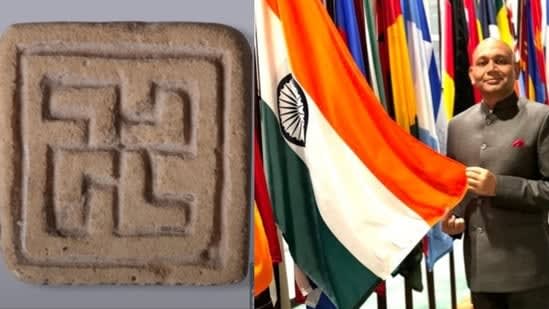
Indian diplomat Abhay Kumar has invoked the ancient Swastika symbol to highlight cultural and spiritual links between India and Azerbaijan, an effort seen as a soft-power move to mitigate diplomatic strains caused by Azerbaijan's close alliance with Pakistan.
Cultural Symbolism Amidst Diplomatic Friction
In a notable attempt to leverage cultural diplomacy, Indian diplomat Abhay Kumar recently invoked the Swastika—an ancient symbol of prosperity and peace in Dharmic traditions—to emphasize a spiritual connection between India and Azerbaijan. This gesture comes at a critical juncture where bilateral relations between the two nations have been characterized by underlying tension and strategic misalignment. By pivoting away from formal political discourse and toward shared ancient symbols, the move represents a strategic attempt to find common ground in a geopolitical landscape often dominated by hard-power rivalries.
The Role of the Swastika as a Diplomatic Bridge
The use of the Swastika in this context is a deliberate appeal to the symbol's original meaning of 'well-being' and 'good fortune.' In the Indian context, the Swastika is omnipresent in religious and social ceremonies, symbolizing the sun and the cyclical nature of life. By presenting this symbol to an Azerbaijani audience, Kumar is attempting to bypass contemporary political grievances and instead anchor the relationship in a broader, more timeless human experience. This approach suggests that when formal diplomatic channels are strained, 'soft power'—the use of culture, art, and spirituality—can serve as a vital lubricant to prevent a total freeze in communications.
Analyzing the Roots of the Bilateral Strain
To understand why such a gesture is necessary, one must examine the current state of India-Azerbaijan relations. The relationship has faced significant strain primarily due to Azerbaijan's exceptionally close strategic and military ties with Pakistan. As India and Pakistan remain locked in a long-standing conflict over Kashmir, Azerbaijan's support for Pakistan's stance has often created friction in New Delhi. Conversely, India has maintained a supportive relationship with Armenia, Azerbaijan's primary rival in the South Caucasus. This 'proxy' tension has effectively mirrored the South Asian rivalry in the Caucasus region, making direct diplomatic breakthroughs difficult to achieve.
Soft Power vs. Hard Realities
The invocation of an ancient symbol is a sophisticated diplomatic tool, but it operates against a backdrop of hard security realities. While the Swastika may evoke a sense of peace and shared heritage, it does not resolve the fundamental security dilemmas regarding arms sales, territorial disputes, and international voting blocs. However, the significance of the post lies in its ability to signal a desire for de-escalation. By framing the connection as 'ancient' and 'spiritual,' the diplomat is effectively reminding Azerbaijan that the relationship between their peoples transcends the temporary political alignments of the current era.
Future Trends in India's Caucasian Outreach
Looking forward, this event suggests that India may increasingly employ cultural and spiritual diplomacy to diversify its influence in the South Caucasus. As India seeks to expand its footprint in Central Asia and the Caucasus to secure energy resources and counter-balance regional rivals, the use of 'civilizational links' will likely become a recurring theme. We can expect more initiatives focusing on shared history, yoga, and traditional philosophy to create a positive public perception in Baku, even while the government in New Delhi continues to navigate the complex security triangle involving Armenia and Pakistan.
Conclusion
Abhay Kumar's reference to the Swastika is more than a social media post; it is a calculated diplomatic maneuver designed to humanize a strained political relationship. While the deep-seated geopolitical tensions fueled by the Pakistan-Azerbaijan alliance remain a formidable obstacle, the shift toward cultural connectivity provides a necessary alternative pathway for dialogue. Whether such symbolic gestures can translate into tangible policy shifts remains to be seen, but they serve as a critical reminder that cultural heritage often provides the only stable bridge when political bridges have been burned.
Verification Required?