JIT bitmap text rendering for microcontrollers
Source Entity
Hacker News
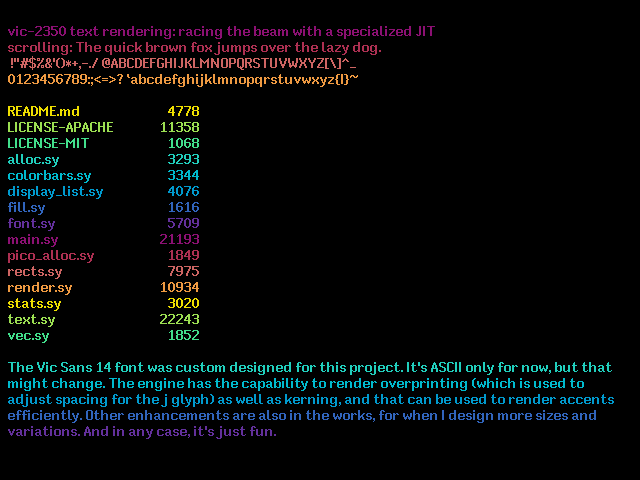
Raph Levien has developed a JIT bitmap text rendering technique for the RP2350 microcontroller. This project aims to bring efficient, proportional, and kerned typography to low-resolution embedded systems.
Revitalizing Retro Aesthetics: JIT Bitmap Rendering for Microcontrollers
The Intersection of Retro Design and Modern Hardware
Raph Levien’s recent work on the 'vic-2350' project highlights a fascinating trend in modern embedded systems development: the conscious choice to revisit 1980s computing aesthetics. By utilizing the RP2350 microcontroller to emulate the feel of vintage home computers, Levien demonstrates that modern silicon is not just about pushing higher resolutions, but about enabling creative, low-level control over display outputs. This project serves as a bridge between the historical constraints of early home computing and the high-performance capabilities of current microcontroller architectures.
Why Bitmap Fonts Still Matter
In an era dominated by smooth, antialiased, and vector-based typography, Levien makes a compelling argument for the return of bitmap fonts. While often dismissed as legacy technology, bitmap fonts offer distinct advantages in low-resolution environments. By avoiding the 'blurry mush' that often accompanies antialiasing on small, low-pixel-density displays, bitmap fonts maintain a sharp, intentional, and readable appearance. This efficiency is crucial for microcontrollers where memory and processing power are limited, allowing for high-quality text rendering without the heavy overhead of modern font engines.
Overcoming the Proportional Spacing Challenge
A significant hurdle in this project is the implementation of proportional spacing and kerning. Most microcontroller-based text rendering relies on fixed-width character cells because they are computationally inexpensive and simple to manage. Levien, however, is pushing for a more sophisticated typographic experience reminiscent of the early Macintosh. Achieving this requires precise control over character positioning, which is notoriously difficult to maintain at high speeds on constrained hardware.
The Role of Just-In-Time (JIT) Techniques
The core innovation presented by Levien is the use of Just-In-Time (JIT) rendering techniques for bitmap text. By generating or assembling character data dynamically, the system can handle the complexities of proportional spacing and kerning without sacrificing the performance of the RP2350. This approach suggests a future where embedded devices can offer a significantly higher caliber of user interface design, moving away from rigid, blocky text toward elegant, readable, and aesthetically pleasing typography.
Broader Implications for Embedded UI
This development holds significant implications for the future of embedded UI design. As developers continue to build interactive displays for IoT devices, smart home appliances, and wearable technology, the ability to render crisp, beautiful text efficiently will become a key differentiator. Levien’s work proves that we do not need to sacrifice aesthetic quality for the sake of hardware efficiency. By blending vintage design philosophies with modern JIT optimization, developers can create interfaces that are both lightweight and visually professional.
Future Trends in Microcontroller Graphics
Looking forward, we can expect to see a resurgence in 'retro-modern' design patterns. As communities continue to explore the capabilities of the RP2350 and similar boards, there will likely be increased demand for libraries that support advanced typography, custom kerning, and dynamic layout engines. Levien’s project provides a roadmap for future engineers to follow, proving that the constraints of microcontrollers are not limitations, but rather catalysts for creative and efficient software engineering solutions.