Several coaches of Sairang-Kolkata Express train derails at Digaru in Assam
Source Entity
India Latest News: Top National Headlines Today & Breaking News | The Hindu
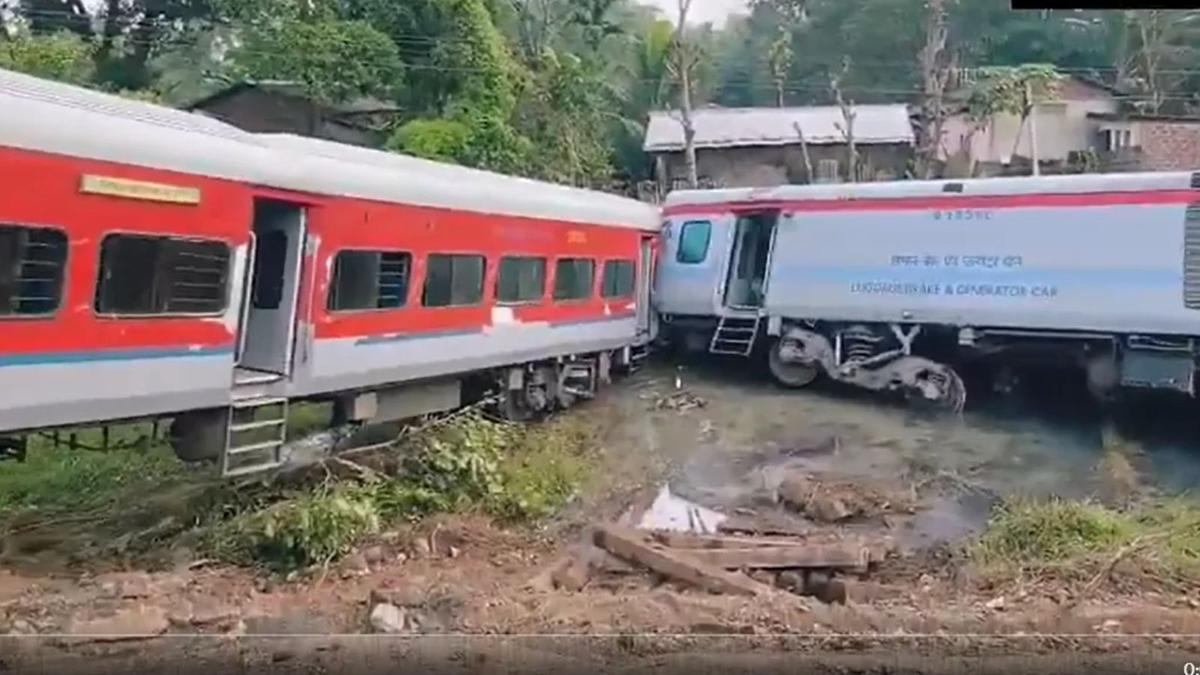
The Kolkata-Sairang Express derailed at Digaru railway station in Assam after the loco pilot reportedly failed to control the train's speed. Fortunately, no casualties were reported, and relief operations were immediately launched to assist passengers.
Analysis of the Kolkata-Sairang Express Derailment in Assam
On the morning of November 11, 2026, the Kolkata-Sairang Express (Train No. 13125) experienced a significant operational failure at Digaru railway station in the Kamrup district of Assam. The incident involved the derailment of the locomotive and five passenger carriages. According to official statements from the Northeast Frontier Railway (NFR), the accident occurred at approximately 6:54 a.m. while the train was being maneuvered to allow another service to pass, a standard procedure known as 'precedence.'
Official Reports vs. Emerging Concerns
Initial reports from NFR officials, including CPRO Kapinjal Kishore Sharma, emphasize that no casualties occurred during the event. While the railway authority maintains that all passengers are safe, there is a discrepancy between official narratives and local accounts. Some reports suggest that passengers may have sustained minor-to-moderate injuries, and viral footage purportedly taken from inside the train has sparked public debate regarding the functionality of the emergency braking systems. These allegations remain unverified and are expected to be a focal point of the subsequent official inquiry.
The Mechanics of the Incident
Technical analysis suggests that the primary cause of the derailment was a loss of speed control by the loco pilot. In railway operations, managing the momentum of a locomotive while approaching a station for a loop line movement requires precise braking applications. If a pilot is unable to decelerate effectively, the kinetic energy of the train can cause the wheels to jump the tracks, especially during transitions between main lines and loop lines. The NFR has confirmed that the train was specifically being received at the station to facilitate a precedence maneuver, which is a high-risk window for operational errors.
Infrastructure and Safety Implications
This incident highlights the ongoing challenges of rail safety in India’s Northeast region, a geographically complex area where track maintenance and pilot training are critical. Precedence maneuvers are routine, yet they require highly synchronized communication between the station master and the loco pilot. The failure to control speed at Digaru raises questions about whether this was a result of mechanical failure, as suggested by some passengers, or human error during the approach phase.
Future Trends and Safety Protocols
Looking forward, the investigation into this derailment will likely lead to a review of speed-control protocols for trains entering Digaru station. The Indian Railways typically conducts a 'Statutory Inquiry' following such derailments to determine if safety mechanisms—such as the Automatic Train Protection (ATP) systems—were active and functioning correctly. If the claims regarding the failed emergency brakes are substantiated, it could necessitate a fleet-wide inspection of braking components on similar locomotive classes operating in the NFR zone.
Conclusion
While the outcome of the Kolkata-Sairang Express derailment was fortunate in terms of human life, the incident serves as a reminder of the critical importance of operational precision. As relief and rescue operations conclude and passengers are transported to their destinations via alternative means, the focus must now shift to a transparent technical audit. Ensuring the reliability of braking systems and reinforcing pilot training for station maneuvers remain the most effective ways to prevent such occurrences in the future.
Multiple Citing Sources
Verification Required?