The lattice of sets of natural numbers is rich
Source Entity
Hacker News
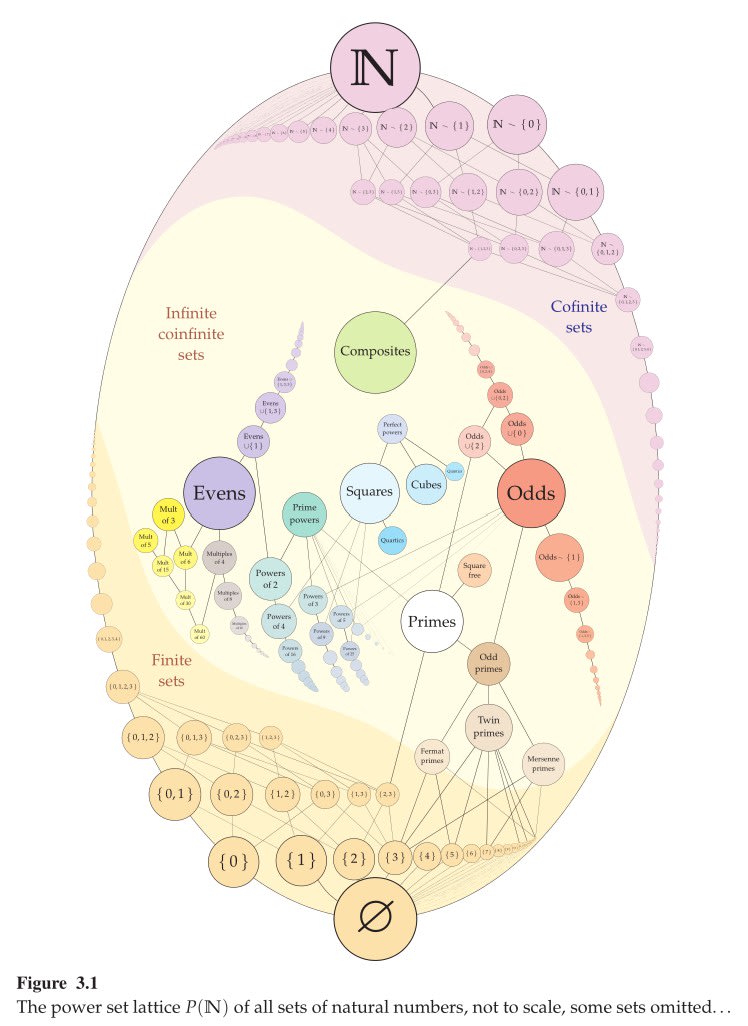
The power set of natural numbers forms a rich, distributive lattice under the subset relation. This mathematical structure allows for the rigorous study of set interactions via unions and intersections.
Exploring the Lattice of Natural Numbers
The mathematical structure defined by the power set of natural numbers, denoted as $\mathcal{P}(\mathbb{N})$, represents a fundamental object in set theory and order theory. By organizing every possible subset of natural numbers under the subset relation ($A \subseteq B$), we construct a lattice that serves as a cornerstone for understanding inclusion, combination, and logical boundaries within infinite sets.
The Mechanics of the Lattice
In this lattice, the relationship between any two sets is governed by the partial ordering of inclusion. This structure is defined by two primary binary operations: the union ($A \cup B$) acts as the least upper bound, while the intersection ($A \cap B$) functions as the greatest lower bound. These operations ensure that for any two subsets of $\mathbb{N}$, there is a well-defined supremum and infimum, satisfying the requirements for a lattice.
Distributivity and Structural Richness
One of the most critical properties of the power set lattice $\langle \mathcal{P}(\mathbb{N}), \subseteq \rangle$ is its distributivity. This means that the union and intersection operations distribute over each other, a characteristic that simplifies complex set-theoretic proofs and allows for the application of Boolean algebra principles to infinite collections of numbers. The richness of this lattice arises from the uncountable nature of the power set of natural numbers, which has the cardinality of the continuum, $2^{\aleph_0}$.
Theoretical Implications
By analyzing this lattice, mathematicians can explore the density and distribution of subsets within $\mathbb{N}$. Because $\mathbb{N}$ is a countably infinite set, its power set provides a vast landscape for studying measure theory, topology, and the hierarchy of subsets. The structure acts as a workspace for defining filters, ideals, and various algebraic properties that are essential for higher-level analysis.
Future Trends in Set Theory
As we look toward the future of research in this field, the study of $\mathcal{P}(\mathbb{N})$ remains vital for understanding the foundations of mathematics. The interplay between the subset relation and the arithmetic properties of natural numbers continues to provide insights into the behavior of infinite structures. Modern research often leverages this lattice to investigate independence results and the consistency of various axioms within Zermelo-Fraenkel set theory.
Conclusion
The power set lattice of natural numbers is not merely an abstract construction; it is a robust framework that underpins much of modern analysis. Its distributive nature and the complexity of its subset relationships make it an essential subject for ongoing mathematical inquiry, ensuring its relevance in both theoretical research and applied logic.