China’s Moonshot AI Releases Model to Challenge Top U.S. Systems
Source Entity
Latest News: Today's Latest News Headlines from India & World | Hindustan Times | Hindustan Times
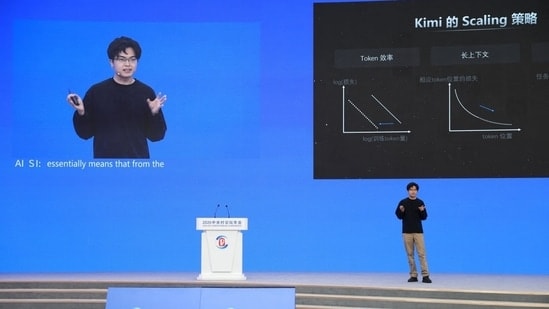
Moonshot AI has launched Kimi K3, a 2.8 trillion-parameter model that challenges leading U.S. AI systems in coding and reasoning benchmarks. As the first open 3T-class model, it signals a significant closing of the performance gap between Chinese and Western AI development.
The Rise of Kimi K3: A New Frontier in Global AI
Moonshot AI has officially unveiled Kimi K3, a massive 2.8 trillion-parameter model that marks a pivotal moment in the global artificial intelligence race. By positioning itself as the world’s first open 3T-class model, Kimi K3 represents a significant leap in architectural scale for the Chinese tech sector. Its deployment across Kimi.com, Kimi Work, Kimi Code, and the Kimi API indicates an aggressive strategy to integrate advanced frontier intelligence into practical, high-stakes workflows.
Benchmarking Against Global Leaders
The performance metrics of Kimi K3 are particularly noteworthy. Moonshot AI reports that while the model trails the absolute peak of proprietary systems like Claude Fable 5 and GPT 5.6 Sol, it consistently outperforms earlier iterations such as GPT 5.5 and Claude Opus 4.8. This suggests that the performance gap between Chinese innovations and Silicon Valley’s leading offerings is narrowing rapidly. The model's success in specialized tasks like coding and general agentic reasoning demonstrates that pre-training scaling, paired with sophisticated architectures like Kimi Delta Attention, can yield high-tier results even amidst regional compute constraints.
Architectural Innovation and Efficiency
Central to Kimi K3’s development is its reliance on 'Kimi Delta Attention' and 'Attention Residuals,' allowing it to process a massive 1-million-token context window. This technical foundation is not merely theoretical; the company confirmed that an early version of the model was utilized to handle the majority of the team's internal kernel optimization tasks during the development phase. This 'dogfooding' approach suggests that the model is already battle-tested for complex software engineering environments, further validated by its ability to generate infographic-style presentations and editable heatmaps.
The Shift Toward Visual and Persistent Interaction
The introduction of 'Widgets' and 'Dashboard' features in Kimi Work marks a shift toward making AI interactions more persistent and visual. By enabling users to run Kimi K3 directly in their terminals via the /model command, Moonshot AI is prioritizing developer accessibility. This utility-focused design aims to solve the problem of ephemeral AI interactions, favoring a persistent workspace where complex data visualization—such as annual reports—can be generated and refined in real-time.
Geopolitical and Economic Implications
The emergence of Kimi K3 occurs against a backdrop of increasing scrutiny from U.S. lawmakers regarding the adoption of Chinese AI by Western companies. As Chinese models demonstrate increased capability and cost-effectiveness compared to their American counterparts, the global market may face a fragmentation of AI supply chains. The success of Kimi K3 suggests that despite hardware limitations in China, the efficiency of training scaling is allowing domestic firms to remain highly competitive.
Future Trends in the AI Arms Race
Looking forward, the launch of Kimi K3 signals a transition from models that simply 'chat' to those that act as comprehensive work partners. With the promise of adjustable thinking effort modes, the model is designed to scale its computational intensity based on the complexity of the prompt. As these tools become more deeply embedded in enterprise workflows, the focus will likely shift from raw parameter counts to the reliability of long-horizon reasoning and the seamless integration of visual data analysis into everyday business intelligence.
Multiple Citing Sources
Verification Required?