Nasa images show just 2% of Indonesia's Puncak Jaya glacier ice left by 2025
Source Entity
TOI SCIENCE DESK
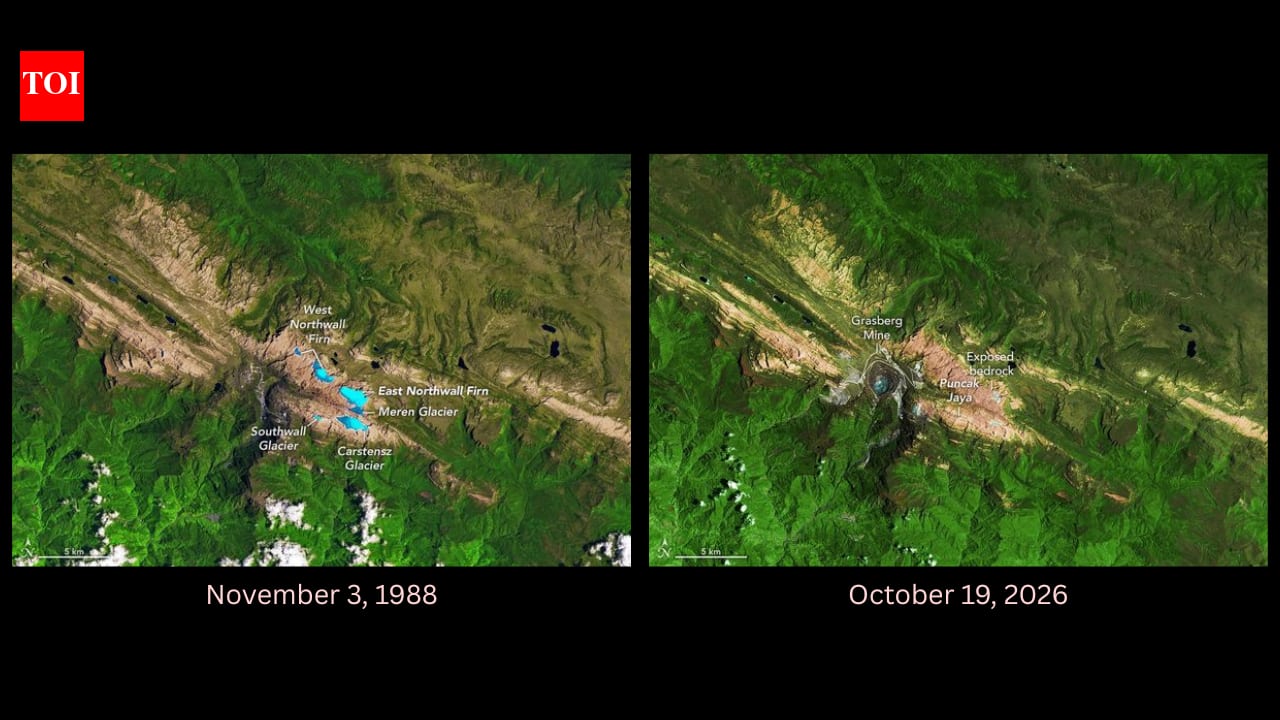
NASA satellite imagery confirms that Indonesia's Puncak Jaya glacier has effectively vanished, with only 2% of its 1988 ice mass remaining by 2025. This near-total loss, driven by rising temperatures, marks a significant environmental milestone and the permanent erasure of vital climate history.
The Vanishing Ice: Puncak Jaya's Environmental Collapse
Recent satellite imagery released by NASA has provided a definitive and sobering look at the environmental trajectory of Indonesia's Puncak Jaya glacier. By comparing high-resolution data sets captured 38 years apart, researchers have confirmed that the glacier has undergone a near-total collapse. According to these findings, only 2% of the ice area recorded in 1988 remained by 2025, with the most recent 2026 imagery confirming the exposure of bare rock where massive ice sheets once stood.
The Drivers of Rapid Deglaciation
This drastic reduction is not an isolated phenomenon but a direct consequence of shifting global climate patterns. Rising temperatures and altered weather cycles have accelerated the ablation process, making it impossible for the glacier to maintain its mass. Puncak Jaya, being located in a tropical region, is particularly sensitive to these shifts; the lack of consistent cooling mechanisms has rendered the ice field unsustainable in the face of modern climatic pressures.
Loss of Scientific Heritage
Beyond the visible loss of landscape, the melting of Puncak Jaya represents a significant blow to the scientific community. Glaciers act as natural archives, trapping layers of ice that contain chemical indicators of past climates, atmospheric composition, and historical weather events. As the remaining 2% of the ice disappears, the opportunity to study this localized climate history vanishes with it, leaving a permanent gap in our understanding of tropical climate cycles.
Broader Implications for Tropical Ecosystems
While the Puncak Jaya glacier is small in total global volume compared to the polar ice sheets, its disappearance serves as a critical indicator of broader systemic issues. The loss of such glaciers affects local micro-climates and hydrological cycles that support surrounding biodiversity. This event highlights that the impacts of rising temperatures are not limited to high-latitude environments but are actively reshaping the physical geography of the tropics.
Future Trends and Environmental Stewardship
The trajectory of Puncak Jaya serves as a bellwether for other high-altitude tropical ice structures. As these glaciers continue to decline, the focus of the scientific community must shift toward documenting what remains and analyzing the immediate environmental impact on local ecosystems. The exposure of rock in 2026 is a stark reminder of the rapid pace of change, signaling that the era of glacial presence in this region has effectively concluded.
Conclusion: A Final Milestone
In summary, the transition of Puncak Jaya from a glaciated peak to a barren rock face is a profound environmental milestone. The data provided by NASA provides an undeniable record of this transformation. As we look to the future, this loss underscores the urgent need to monitor climate-sensitive regions and underscores the reality that some environmental features are being permanently altered by the current climate trajectory.