Pareto Front
Source Entity
Hacker News
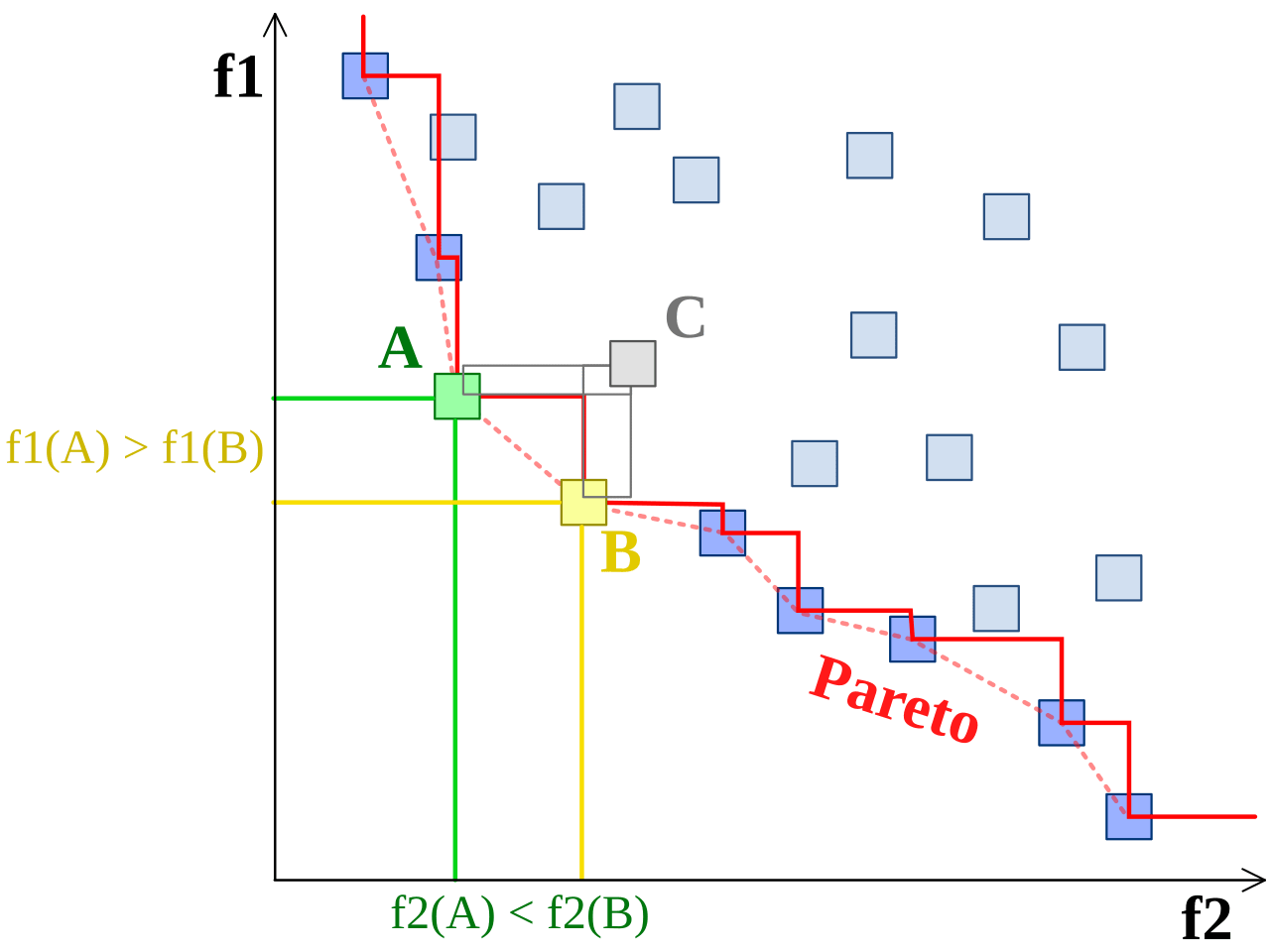
The Pareto front is a mathematical framework used to identify optimal trade-offs in multi-objective problems. This concept is increasingly applied to gaming, such as optimizing vehicle builds in Mario Kart 8 to balance performance metrics.
Understanding the Pareto Front: Optimization Beyond Luck
In the realm of complex decision-making, the Pareto front—also known as the Pareto frontier or curve—serves as a critical mathematical framework. It defines the set of all Pareto efficient solutions in multi-objective optimization. A solution is considered Pareto efficient if no other available option can improve one objective without simultaneously degrading another. Essentially, the Pareto front represents the 'best of the best' choices where trade-offs are unavoidable, filtering out inferior options that are outperformed in every metric.
Engineering Applications and Efficiency
Historically, the concept stems from the work of economist Vilfredo Pareto. In engineering, it has become an indispensable tool for designers and analysts. By identifying the Pareto front, professionals can restrict their focus to a manageable set of efficient choices. This process eliminates the noise of sub-optimal parameters, allowing for more strategic decision-making. Instead of attempting to optimize every variable simultaneously—which is often impossible—designers navigate the established trade-offs within this frontier to reach their desired goals.
Gaming as a Multi-Objective Laboratory
Modern applications of this economic theory have extended into unexpected domains, such as competitive gaming. In titles like Mario Kart 8, players face a classic multi-objective optimization problem: selecting a driver, kart body, tires, and glider. Each component carries distinct statistics, such as speed, acceleration, and handling. Players must decide whether to prioritize raw top speed or the ability to recover quickly through acceleration after a collision. The sheer volume of combinations—reaching into the thousands—makes manual selection daunting.
Navigating the Build Complexity
When players analyze their kart builds, they are effectively performing a Pareto analysis. Many configurations in the game may be stylistically different but statistically identical, which simplifies the search. However, once those duplicates are removed, the remaining options form a complex decision space. By applying the Pareto front, a player can identify which builds are objectively superior based on their specific priorities, removing the element of 'luck' and replacing it with data-driven selection.
Future Trends in Decision Optimization
As games and software continue to increase in complexity, the use of optimization models like the Pareto front will likely become standard for power users. Whether in high-stakes engineering projects or competitive digital environments, the ability to visualize trade-offs allows for a deeper understanding of system performance. As we move forward, we can expect more community-driven tools to leverage these mathematical principles to help users navigate massive datasets and optimize their performance in real-time.
Conclusion: The Value of Strategic Trade-offs
The Pareto front teaches us that perfection in every category is rarely attainable. Instead, success lies in understanding the inherent limitations of our choices and selecting the optimal balance that fits our specific objectives. By applying these century-old economic principles to modern challenges, we can turn overwhelming complexity into a structured path toward efficiency.