Polyedergarten: Garden of Paper Polyhedron Models
Source Entity
Hacker News
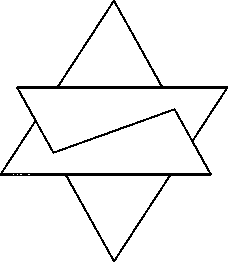
Polyedergarten serves as a digital repository and platform dedicated to the construction and display of paper polyhedron models. It provides enthusiasts with the resources to explore geometric structures through paper-folding and assembly techniques.
Exploring the Geometry of Polyedergarten
The Intersection of Mathematics and Craft
Polyedergarten functions as a specialized digital archive and instructional platform centered on the intricate world of paper polyhedron models. By focusing on the structural integrity and aesthetic complexity of geometric shapes, the platform bridges the gap between abstract mathematical theory and tactile physical construction. This niche interest highlights a growing trend in educational hobbyism where users engage with complex polyhedral forms through the accessible medium of paper.
Structural Complexity and Design
At its core, the study of polyhedra involves the classification of 3D shapes defined by flat polygonal faces, straight edges, and sharp corners. Polyedergarten facilitates the exploration of these forms by providing the necessary blueprints for users to assemble models of varying complexity. From simple Platonic solids to more advanced Archimedean or Kepler-Poinsot solids, the platform acts as a bridge for hobbyists to visualize mathematical concepts that often remain confined to textbooks.
Educational and Cognitive Implications
Engaging with paper modeling serves as a highly effective cognitive exercise that enhances spatial reasoning and fine motor skills. By deconstructing a 3D object into a 2D net and subsequently folding it back into a volumetric structure, participants gain a profound understanding of spatial orientation. This practice is increasingly utilized in STEM education to teach geometry and architectural principles in a way that is both intuitive and rewarding.
The Digital Evolution of Papercraft
The existence of platforms like Polyedergarten underscores the shift toward digital-physical hybrid learning. In an era dominated by screens, the ability to download, print, and physically construct geometric models provides a tactile relief that is essential for deep learning. The digital nature of the distribution allows for a global community of enthusiasts to share techniques, troubleshoot assembly challenges, and push the boundaries of paper-based structural design.
Future Trends in Geometric Modeling
Looking ahead, the integration of paper polyhedron modeling with emerging technologies such as augmented reality (AR) or laser-cutting precision could further revolutionize the field. While traditional paper folding remains the primary method, the principles found in these models are increasingly relevant to modern engineering and material science. As we continue to seek efficient ways to manufacture complex structures, the lessons learned from paper-based polyhedral assembly will remain a foundational skill for designers and engineers alike.
Conclusion
Polyedergarten stands as a testament to the enduring appeal of geometry as both an art form and a scientific discipline. By providing the tools and resources for enthusiasts to engage with polyhedral models, it fosters a deeper appreciation for the mathematical laws that govern our physical world. Whether for educational purposes or personal enrichment, the practice of building these paper models remains a vital intersection of creativity and logic.