'Casteist male chauvinists’: Rahul shares Ardhanareshwar image to target BJP-RSS
Source Entity
ROHITASHWA RANJAN
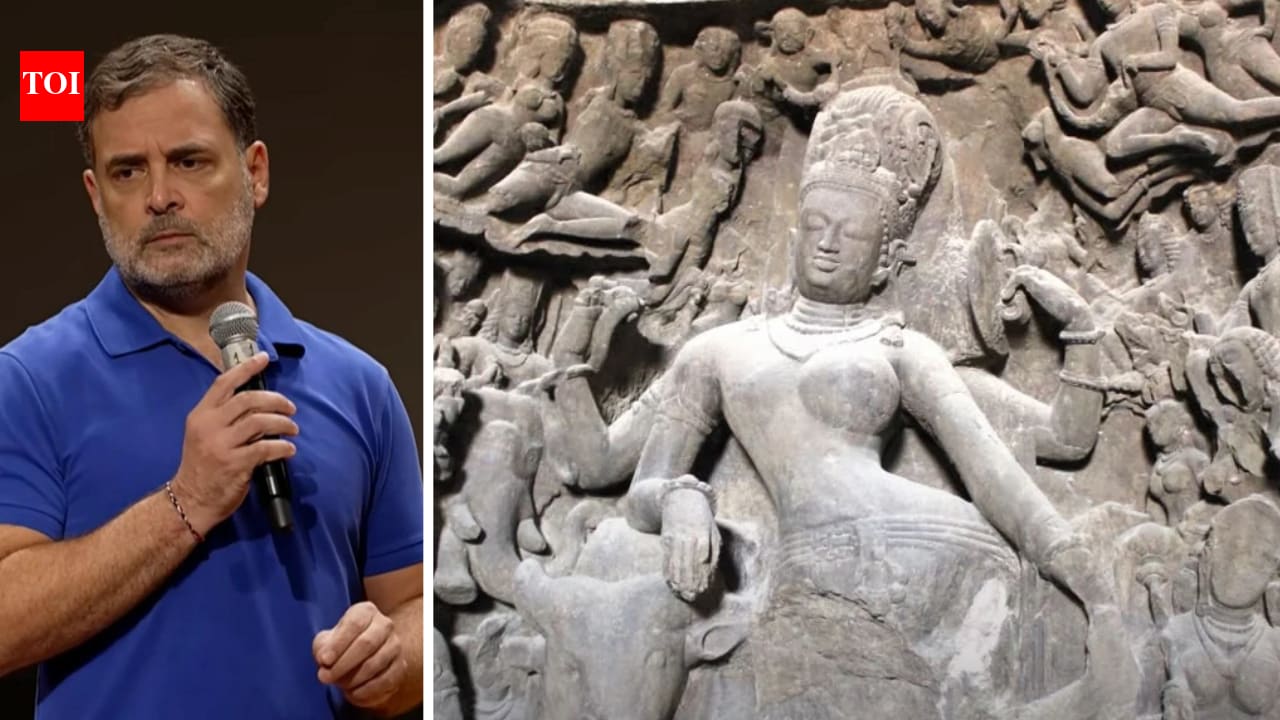
Rahul Gandhi has utilized the Ardhanareshwar imagery to criticize the BJP and RSS, labeling them as 'casteist male chauvinists.' This move highlights the ongoing ideological conflict between the opposition and the ruling party regarding social hierarchies and gender dynamics.
The Political Symbolism of Ardhanareshwar
Congress leader Rahul Gandhi has recently employed the powerful imagery of Ardhanareshwar—the composite androgynous form of the Hindu deities Shiva and Parvati—to launch a sharp critique against the Bharatiya Janata Party (BJP) and the Rashtriya Swayamsevak Sangh (RSS). By invoking this icon, which represents the perfect synthesis of masculine and feminine energies, Gandhi seeks to challenge the ideological foundations of his political rivals, whom he has explicitly characterized as 'casteist male chauvinists.'
Deconstructing the 'Casteist Male Chauvinist' Narrative
The choice of the term 'casteist male chauvinist' is a calculated political maneuver designed to paint the BJP-RSS ecosystem as regressive. By framing his opponents within this specific lexicon, Gandhi is attempting to consolidate a narrative that pits his vision of an inclusive, egalitarian society against what he perceives as a hierarchical and patriarchal worldview. This rhetoric is aimed at voters who are increasingly concerned with social justice, gender equality, and the preservation of secular democratic values.
The Intersection of Religion and Political Strategy
In the Indian political landscape, the appropriation of religious iconography is a well-established tradition. However, Gandhi’s focus on the Ardhanareshwar form indicates an attempt to reclaim the narrative on cultural identity. By highlighting a deity that embodies gender duality, he is challenging the BJP’s often narrow interpretation of traditional Hindu values, suggesting that true spirituality encompasses balance and equality rather than exclusionary, patriarchal structures.
Historical Context and Ideological Polarization
This confrontation is not merely about a social media post but reflects a deeper, long-standing ideological chasm. The RSS, which serves as the ideological fountainhead of the BJP, has long been criticized by opposition figures for its emphasis on traditional social structures. Rahul Gandhi’s recent commentary marks a continuation of his efforts to frame the national discourse around the 'caste census' and social representation, using cultural symbols to make complex socio-political arguments more accessible to the electorate.
Broader Implications for Future Discourse
As the political climate in India intensifies, the use of such potent imagery suggests that the next phase of campaigning will likely focus heavily on ideological alignment. If the opposition continues to link social hierarchy and gender inequality to the ruling party's core beliefs, the BJP will be forced to defend its cultural stance more vigorously. This cycle of accusation and counter-argument is set to define the upcoming electoral battles, as both sides vie to define the 'true' nature of Indian cultural identity.
Conclusion
Ultimately, Rahul Gandhi’s invocation of the Ardhanareshwar image serves as a strategic bridge between ancient mythology and modern political grievances. By branding his opponents as 'casteist male chauvinists,' he is seeking to mobilize a coalition of voters around the themes of equality and social progress. Whether this strategy will successfully sway the electorate or merely deepen existing polarizations remains to be seen in the unfolding political arena.