At IAF commanders' meet, Rajnath calls for sharper surveillance, 'element of surprise'
Source Entity
India Latest News: Top National Headlines Today & Breaking News | The Hindu
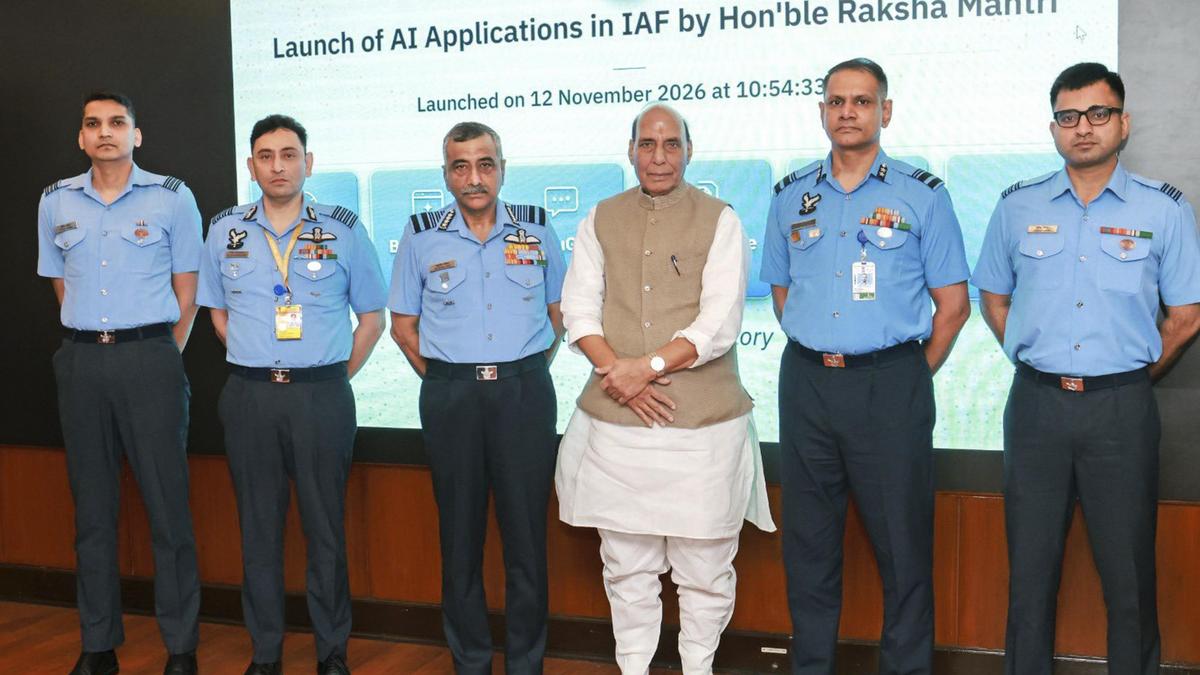
Defence Minister Rajnath Singh has directed the Indian Air Force to prioritize electronic, cyber, and space warfare capabilities. He emphasized the necessity of intelligence-led surveillance and maintaining the 'element of surprise' to counter evolving modern security threats.
Strengthening India's Aerial Dominance: The 2026 IAF Commanders' Directive
Strategic Imperatives in Modern Warfare
Defence Minister Rajnath Singh’s address at the November 2026 Air Force Commanders' Conference marks a pivotal shift in India’s military doctrine. By explicitly calling for the development of dedicated architectures for electronic, cyber, and space domains, the Minister is signaling a transition from traditional air power to a multi-domain operational framework. This evolution acknowledges that modern battlefields are no longer confined to physical airspace but are increasingly fought through data, signal interference, and satellite-linked assets.
The Doctrine of the 'Element of Surprise'
At the heart of the Minister’s directive is the concept of the 'element of surprise.' In an era where real-time satellite imagery and global connectivity make total secrecy difficult, Singh’s emphasis on offensive and defensive surprise suggests a focus on rapid deployment, unconventional tactical maneuvers, and technological superiority. By ensuring that the IAF can strike or respond before an adversary has time to react, India is looking to neutralize threats before they escalate into protracted conflicts.
Intelligence and Surveillance as a Force Multiplier
Bolstering intelligence and surveillance capabilities remains a cornerstone of the Minister’s vision. The emphasis on identifying potential threats before they unfold suggests a shift toward predictive analytics and enhanced situational awareness. By integrating deep-space monitoring and cyber-intelligence into the IAF’s standard operational procedures, the command structure aims to create a 'persistent gaze' over India’s borders, ensuring that no conventional or asymmetric threat goes undetected.
Adapting to a Rapidly Shifting Security Environment
The Minister’s call for a 'forward-looking approach' is a direct response to the volatile geopolitical climate facing India. As conventional threats from neighbors evolve to include hybrid warfare tactics—such as cyber-attacks on critical infrastructure and electronic jamming—the IAF must remain agile. This adaptation requires not just new hardware, but a fundamental change in training and command-and-control structures to handle high-speed, high-tech engagement scenarios.
Future Trends and Strategic Outlook
Looking ahead, the integration of these emerging domains will likely lead to a more tech-heavy procurement cycle for the Indian Air Force. Future defense budgets are expected to prioritize signal intelligence, autonomous systems, and space-based communication networks over legacy platforms. The mandate for commanders is clear: the future of Indian aerial superiority lies in the seamless synthesis of human tactical expertise and advanced digital warfare capabilities, ensuring that the IAF remains a decisive force in the Indo-Pacific region.
Verification Required?