Show HN: Offrun – manage every coding agent from one workspace
Source Entity
Hacker News
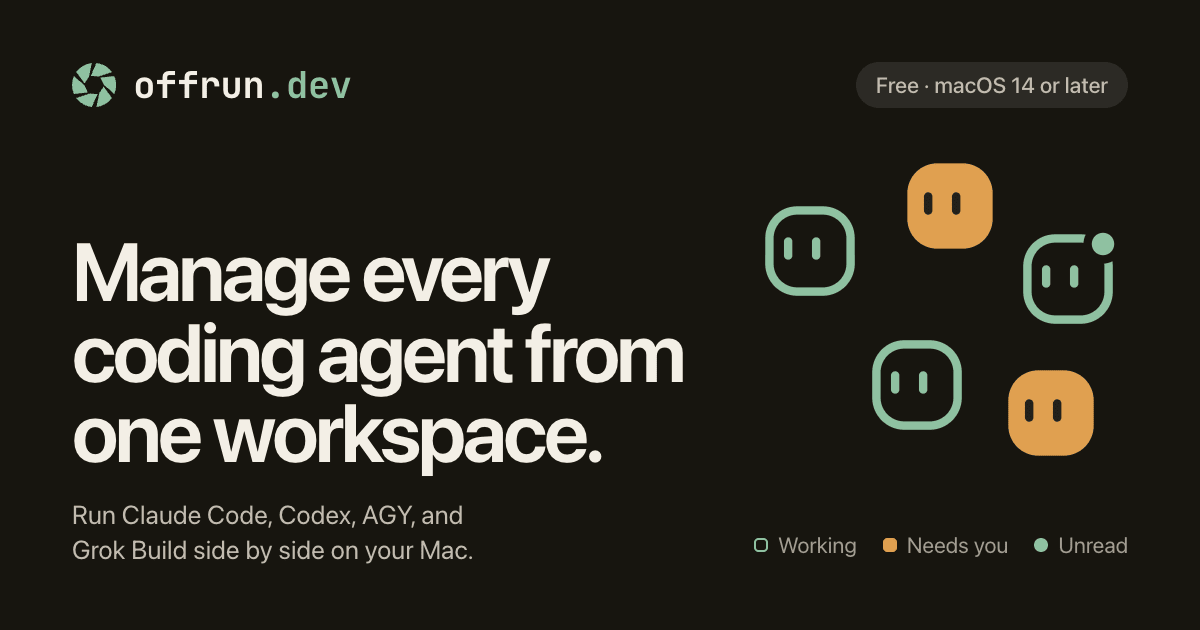
Recent Show HN submissions reveal a growing developer interest in self-hosted, customizable AI coding agent environments. These tools, such as Offrun and Pi pod, prioritize user control and open-source flexibility over proprietary AI platform lock-in.
The Rise of Sovereign AI Development Workspaces
The landscape of AI-assisted software engineering is currently undergoing a significant shift toward user-controlled, local-first environments. Recent 'Show HN' submissions, including 'Offrun' and 'Pi pod', highlight a developer community increasingly focused on managing AI coding agents within their own infrastructure. These tools represent a reaction against the restrictive ecosystems of large AI providers, offering developers a way to integrate automation without sacrificing data privacy or architectural control.
Debugging the Race Conditions of Automation
The development of 'Offrun' provides a practical case study in the challenges of building reliable agentic workflows. As noted in the project's technical updates, initial failures in file upload testing were traced to race conditions where the system attempted to verify files before the network operation had concluded. By replacing fixed-timer checks with event-driven logic that waits for the actual upload, the developers have addressed a fundamental hurdle in automated agent coordination: synchronization. This technical maturation is essential for the transition of AI agents from experimental toys to robust engineering tools.
The Philosophy of Simple, Elegant Software
'Pi pod' has garnered attention for its adherence to a minimalist design philosophy. Proponents of the software argue that its craftsmanship allows for deep customization, a stark contrast to the opaque 'black box' nature of many commercial AI coding assistants. By hosting these agents on personal servers, developers are effectively mitigating the risks of vendor lock-in, ensuring that their proprietary workflows and data remain within their own sovereign control. This shift signifies a broader trend where engineers prioritize 'tinkerability' over the convenience of all-in-one proprietary solutions.
Defining the Minimal Agentic Engineering Environment
Community discussions surrounding these tools have begun to coalesce around a definition of what a functional 'agentic engineering environment' requires. Enthusiasts argue that for an agent to be truly useful in a professional context, it must include specific capabilities: agent sandboxing, native client support, role-based access control (RBAC) for session sharing, and surface-level automation for both web and native applications. This framework suggests that the next generation of coding tools will be judged by their modularity rather than their out-of-the-box features.
Future Trends and Community-Driven Innovation
As the community continues to build tooling to fill the gaps in minimalist frameworks like Pi, we can expect to see a surge in open-source components designed for interoperability. The reliance on community-driven development ensures that these tools evolve rapidly to meet the actual needs of software engineers rather than the marketing goals of AI corporations. Moving forward, the success of these agent management platforms will likely depend on their ability to simplify complex orchestration while maintaining the low-level access that power users demand.