Roblox launches an AI-powered game creation feature in its mobile app
Source Entity
Lauren Forristal
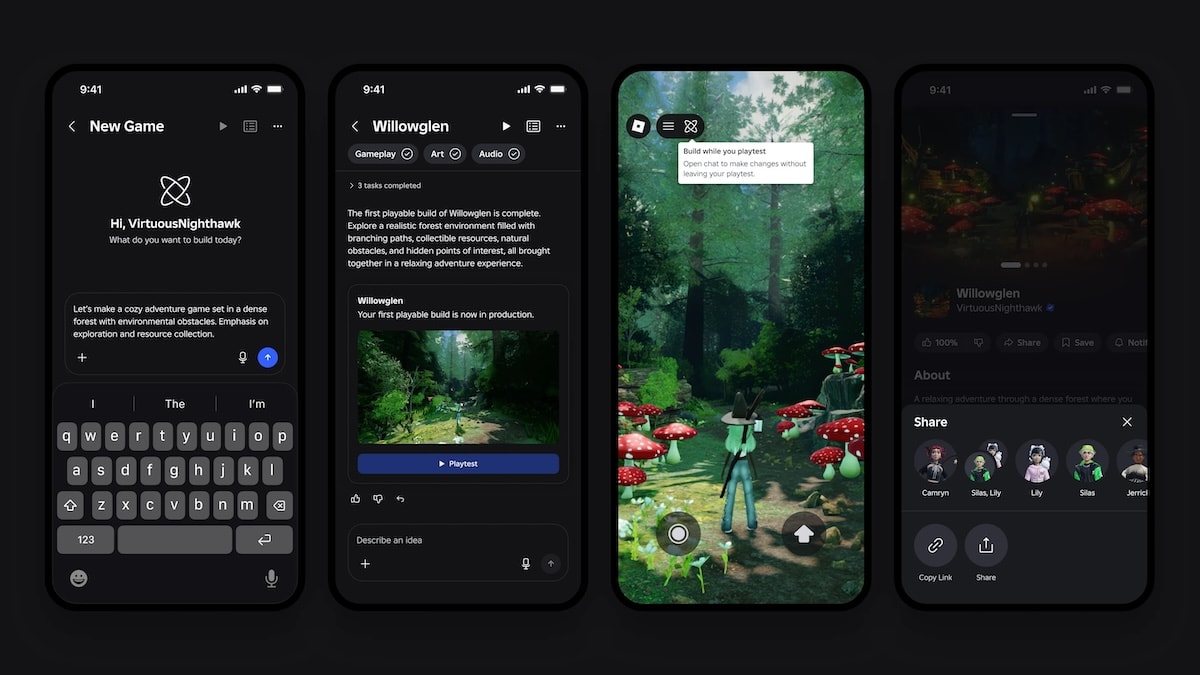
Roblox has introduced a new AI-powered 'Build' feature in its mobile app, allowing users to generate basic games through simple text prompts, significantly lowering the barrier to game creation.
Revolutionizing User-Generated Content: Roblox Brings AI Creation to Mobile
Roblox has announced the launch of a groundbreaking "Build" feature within its mobile application, marking a pivotal shift in how users interact with the platform. By integrating generative AI directly into the mobile experience, Roblox now allows users to create basic games and environments using simple text prompts. This move effectively transitions the platform from a consumption-heavy mobile experience to a creation-capable hub, empowering millions of users who may not have access to a PC or the technical knowledge required for traditional game development.
Democratizing Game Development through Generative AI
For years, the core of Roblox's ecosystem has been Roblox Studio, a powerful but complex tool primarily available on desktop that requires knowledge of the Lua programming language. While Roblox Studio allowed for deep customization and professional-grade game design, it created a steep learning curve for the average user. The new "Build" feature dismantles this barrier. By leveraging large language models (LLMs) and generative AI, Roblox is democratizing the creative process, allowing a child or a casual hobbyist to manifest an idea—such as "a lava-themed obstacle course" or "a futuristic city with floating islands"—into a playable reality without writing a single line of code.
The Strategic Shift to Mobile-First Creation
This update is a strategic masterstroke in terms of user retention and ecosystem growth. A vast majority of Roblox's global user base accesses the platform via mobile devices. Previously, these users were largely consumers of content created by a smaller percentage of "power users" on desktop. By enabling creation on mobile, Roblox is tapping into a massive, dormant creative potential. This shift not only increases the volume of content on the platform but also fosters a more inclusive creator economy where the tool of creation is as accessible as the device used for play.
Implications for the Creator Economy and UGC
The introduction of AI-powered creation fundamentally alters the landscape of User-Generated Content (UGC). We are likely to see an explosion of "micro-games"—small, experimental experiences that can be iterated upon in seconds. While these AI-generated games are described as "basic," they serve as an essential entry point. This creates a new funnel where users can start with text prompts, become interested in the mechanics of their creation, and eventually migrate toward the more complex tools of Roblox Studio. However, this also raises questions about content saturation and the potential for a flood of low-effort, AI-generated experiences that could clutter the platform's discovery algorithms.
Future Trends: Toward a Fully Autonomous Metaverse
Looking ahead, the "Build" feature is likely the first step toward a fully autonomous, real-time generative metaverse. As the AI evolves, we can expect these prompts to move beyond basic environment generation to complex logic, NPC behavior, and dynamic storytelling. The ability to modify a game world in real-time via voice or text commands while playing would represent the ultimate evolution of interactive entertainment. Roblox is positioning itself not just as a gaming platform, but as an AI-driven engine for imagination.
Conclusion
Roblox's integration of AI-powered game creation into its mobile app is more than just a feature update; it is a paradigm shift in digital creativity. By removing the technical friction of coding and the hardware limitation of the PC, Roblox is accelerating the transition toward a world where the gap between imagination and execution is nearly zero. While the current output is focused on "basic" games, the trajectory points toward a future where every user is a developer, and the metaverse is shaped in real-time by the collective prompts of its community.