SOL Strategies Evolving Into Broader Blockchain Platform – Quarterly Update Report
Source Entity
Yahoo Finance
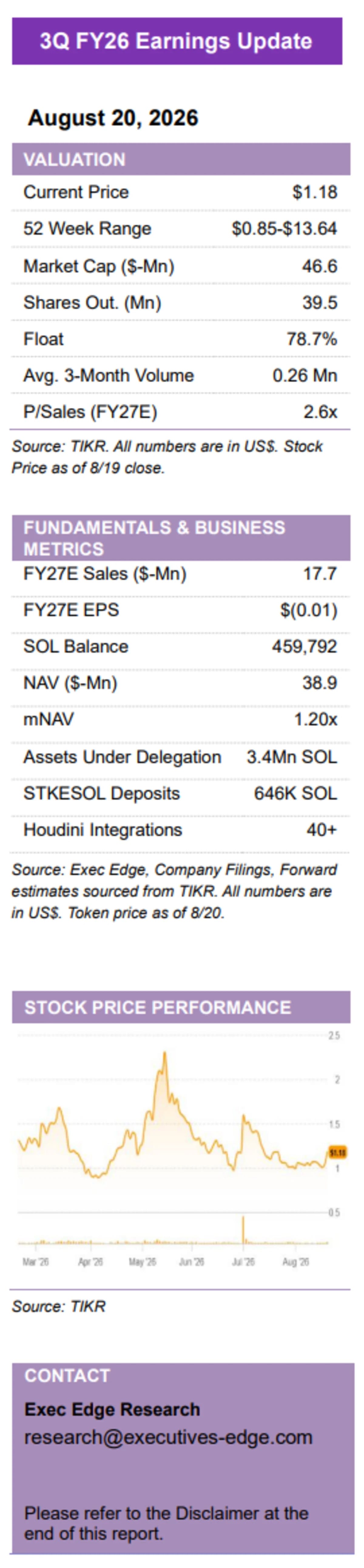
SOL Strategies is pivoting its business model toward MEV and transaction-driven monetization following a significant decline in traditional staking and validation income. The firm is adapting to reduced protocol issuance by diversifying its revenue streams beyond standard validator rewards.
Strategic Pivot: SOL Strategies Navigates a Changing Blockchain Landscape
The Decline of Traditional Validator Income
SOL Strategies has reported a significant contraction in its traditional revenue streams, highlighting the volatile nature of proof-of-stake ecosystems. According to the latest quarterly update, staking income plummeted by 59% year-over-year, falling to C$530,000 from C$1.29 million. Even more pronounced was the decline in validation service income, which saw a 95% drop to approximately C$92,000. These figures, when combined, paint a stark picture: total income reached only C$622,000 compared to C$3.04 million in the same period last year.
Impact of Reduced Protocol Issuance
The root cause of this downturn is attributed to lower protocol issuance, which directly impacts the reward structure for network participants. Gross validator rewards fell sharply from 8,789 SOL to 2,531 SOL, while staking rewards decreased from 6,271 SOL to 4,295 SOL. With net validator income settling at 2,156 SOL after fees, the total combined income of 6,451 SOL represents a 57% decrease from the 15,060 SOL generated a year prior. This data underscores how sensitive validator profitability is to shifts in network-level supply dynamics.
Embracing MEV and Transaction-Driven Revenue
In response to these headwinds, SOL Strategies is evolving into a broader blockchain platform. The company is accelerating a strategic shift toward Maximal Extractable Value (MEV) and transaction-driven validator monetization. By moving away from a reliance on simple staking yields, the firm aims to capture value through the technical efficiencies and transactional activity inherent in the blockchain, rather than relying solely on inflationary protocol rewards.
Market Context and Historical Comparisons
This transition marks a departure from the previous quarter, where revenue challenges were largely attributed to SOL-price pressure. While token price fluctuations previously masked operational resilience, the current environment has forced a deeper look at the underlying mechanics of validator operations. The shift toward Audit (AuD) and transaction-based fees indicates a maturation of the business model, as the firm seeks to decouple its financial performance from the broader market volatility of crypto assets.
Future Trends in Validator Economics
The move by SOL Strategies reflects a broader industry trend where infrastructure providers must diversify their revenue stacks to remain competitive. As protocols continue to adjust their issuance schedules to manage inflation, validators can no longer rely on passive yield. Future growth for such platforms will likely be defined by their ability to optimize MEV extraction and scale transaction-driven services, transforming from simple node operators into sophisticated financial technology entities within the blockchain ecosystem.