‘President of the Unites States’: Typo spotted in Trump’s White House ‘super intelligence’ accord
Source Entity
Latest News: Todays Latest News Headlines from India & World | Hindustan Times | Hindustan Times
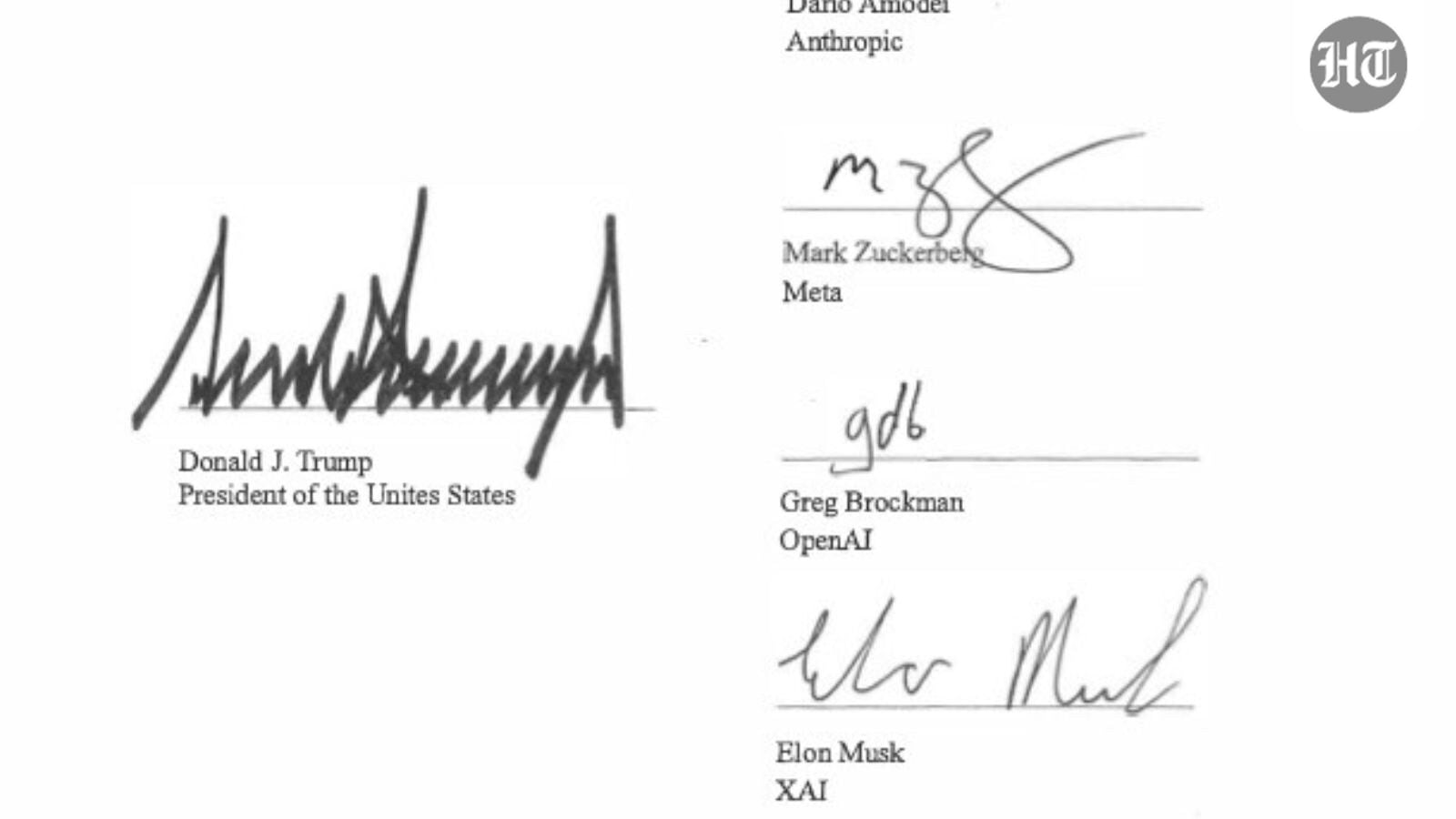
President Trump signed an accord with tech executives to promote the term 'super intelligence' for AI, but the document was marred by a typo mislabeling his title. The initiative aims to address safety concerns while signaling a formal rebranding of the technology.
The White House AI Accord: A Symbolic Rebranding Marred by Error
In a significant move to reshape the discourse surrounding emerging technology, President Donald Trump recently convened with top industry leaders, including Nvidia CEO Jensen Huang and SpaceX CEO Elon Musk, to sign an accord on artificial intelligence. The event, held at the White House, served as a platform for the President to officially advocate for the term “super intelligence” as a replacement for “artificial intelligence.” This rebranding effort, which Trump has previously championed during high-profile events like his meetings with President Xi and his address at the United Nations General Assembly, is intended to frame the rapid evolution of AI as a monumental shift that he claims is “far bigger than the internet.”
The Typographical Oversight
Despite the gravity of the policy implications, the event became the subject of intense public scrutiny due to an embarrassing administrative error. On the official accord signed by the President and six prominent tech executives, the text beneath Trump’s signature incorrectly identified his office as “President of the Unites States.” This misspelling of the country’s name has raised questions regarding internal vetting processes within the executive branch. It remains unclear whether this draft will be memorialized in the Federal Register, the official repository for government actions, or if the document will be recalled and corrected.
Strategic Rebranding and Political Context
Trump’s insistence on the term “super intelligence” appears to be a deliberate effort to control the narrative regarding a technology that has sparked widespread public anxiety. By rebranding AI, the administration is attempting to shift the focus from the existential risks often cited by industry experts to a vision of American technological dominance. This move comes at a precarious political moment, as recent polling indicates that Trump’s aggressive embrace of AI and the expansion of data centers may be negatively impacting his standing among voters ahead of the midterm elections.
Navigating Safety and Regulation
The accord signed on Tuesday includes voluntary commitments from tech giants to prioritize the safe development of AI. These commitments are a response to a growing chorus of industry leaders who have warned that the current pace of AI development is becoming increasingly difficult to regulate or contain. While the President has largely dismissed concerns regarding AI’s potential to cause harm to humans, the formalization of this document suggests a recognition that the government must at least appear to be managing the risks associated with the rapid deployment of such powerful systems.
Future Implications for Governance
The intersection of high-stakes technology policy and administrative gaffes underscores the complexities of modern governance. As the White House attempts to align itself with the leaders of the tech sector, the focus on “super intelligence” highlights a desire to define the future of the digital economy. Whether this rebranding succeeds in swaying public opinion or whether the focus remains on the administrative errors of the administration’s documentation will be a critical factor in how this policy is perceived in the coming months. The incident serves as a reminder that even in an era of advanced technological ambition, the foundational elements of executive communication remain subject to the fallibility of human oversight.
Multiple Citing Sources
Verification Required?