Transformers Explained Visually
Source Entity
Hacker News
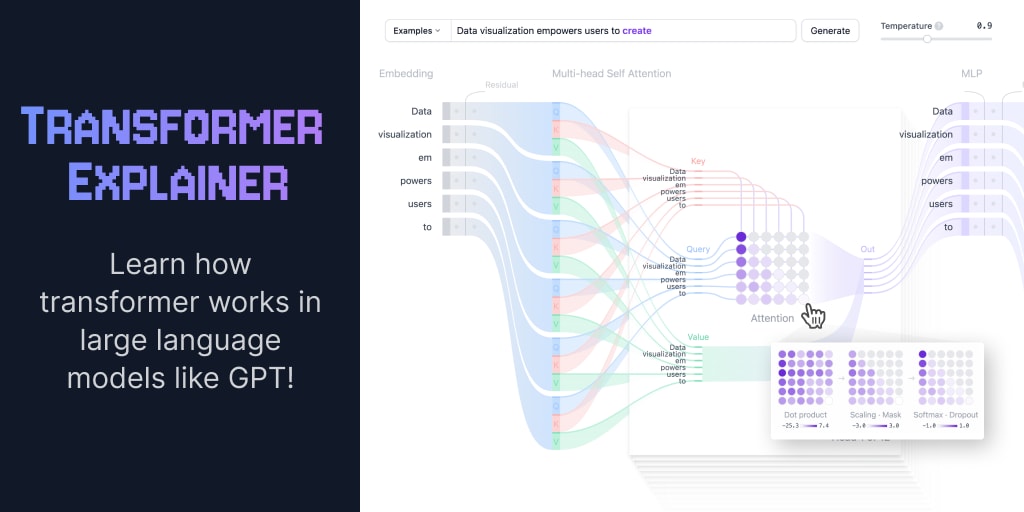
The Transformer architecture, introduced in 2017, has revolutionized AI by enabling advanced models like GPT and Gemini. Its mechanism of next-token prediction has expanded from text generation to diverse fields including biology and computer vision.
The Architectural Revolution: Understanding Transformers
The landscape of artificial intelligence underwent a seismic shift in 2017 with the publication of the seminal research paper, "Attention is All You Need." This work introduced the Transformer architecture, a neural network design that effectively moved the industry away from the limitations of previous models like Recurrent Neural Networks (RNNs) and Long Short-Term Memory (LSTM) networks. By replacing sequential processing with a parallelized attention mechanism, the Transformer allowed for significantly more efficient training and a deeper understanding of long-range dependencies in data.
The Core Mechanism: Next-Token Prediction
At its foundation, a text-generative Transformer operates through the principle of next-token prediction. When a user provides an input prompt, the model calculates the probability distribution for the subsequent token—whether that be a word or a sub-word unit. By iteratively predicting these tokens based on the context provided by all preceding tokens, the model constructs coherent, human-like responses, forming the backbone of prominent systems such as OpenAI's GPT, Meta's Llama, and Google's Gemini.
Beyond Language: The Versatility of Attention
While the Transformer is most famous for its role in Large Language Models (LLMs), its utility extends far beyond text generation. The self-attention mechanism is inherently data-agnostic, allowing it to identify complex patterns in various formats. Today, the architecture is successfully applied in audio generation, computer vision for image recognition, and even scientific breakthroughs like protein structure prediction. This versatility underscores the architecture's status as a general-purpose engine for modern machine learning.
Historical Context and Industry Impact
Before the Transformer, deep learning models often struggled with memory constraints and the "vanishing gradient" problem when processing long sequences of information. The Transformer solved these issues by enabling the model to "attend" to all parts of the input simultaneously, regardless of their distance from one another. This breakthrough effectively democratized high-level AI research, as the architecture's modularity allowed developers to scale models to unprecedented sizes.
Future Trends and Implications
As we look toward the future, the dominance of the Transformer architecture appears secure, though researchers are actively exploring ways to make it more computationally efficient. Because these models require massive amounts of data and processing power, future iterations will likely focus on reducing the energy footprint while maintaining the high-fidelity outputs the architecture is known for. The transition from text-only models to multimodal systems—where a single Transformer processes text, images, and audio concurrently—is already well underway.
Conclusion
In summary, the Transformer is more than just a passing trend; it is the fundamental infrastructure upon which the current generative AI boom is built. By mastering the art of next-token prediction and leveraging the power of attention, this architecture has enabled machines to interact with human information in ways that were previously thought to be decades away. Its influence continues to grow, shaping the trajectory of both commercial technology and scientific discovery.