Union Cabinet approves new railway lines at a cost of ₹9,889 crore in Andhra Pradesh
Source Entity
India Latest News: Top National Headlines Today & Breaking News | The Hindu
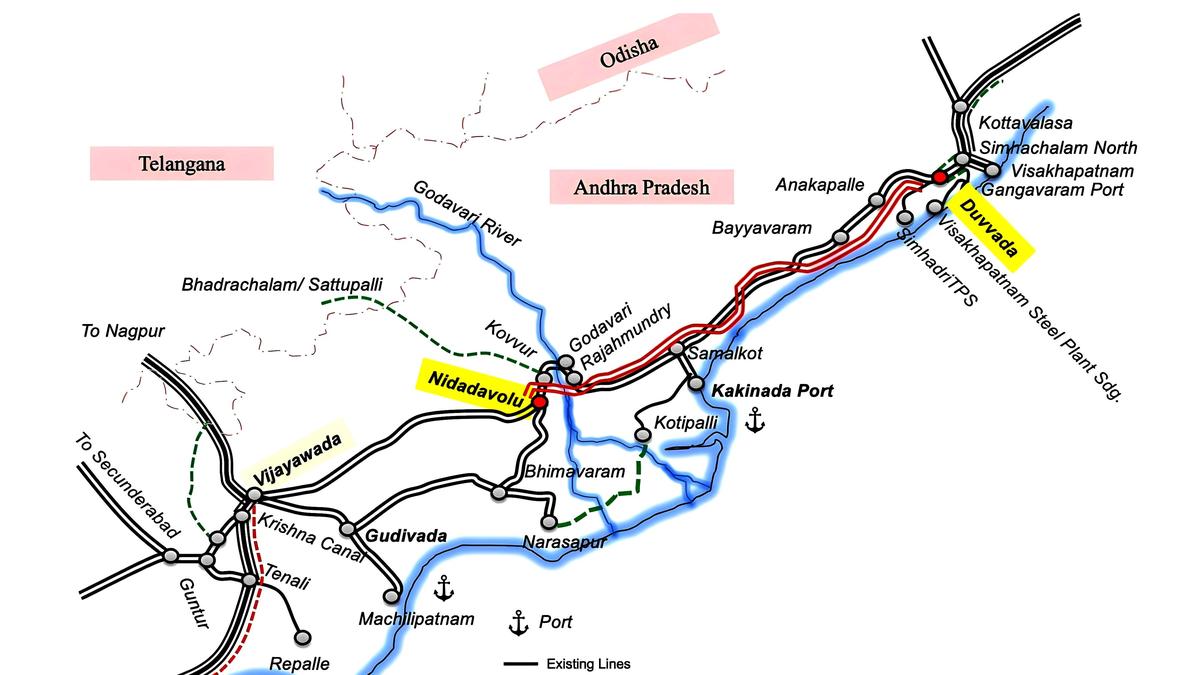
The Union Cabinet has approved major multi-tracking rail projects worth ₹24,815 crore in Andhra Pradesh and Uttar Pradesh. These expansions aim to reduce severe congestion on key high-density corridors and enhance freight and passenger connectivity by 2031.
Strengthening India’s Rail Infrastructure
The Union Cabinet has taken a significant step toward modernizing India’s logistics framework by approving multi-tracking rail projects totaling ₹24,815 crore. Spanning 15 districts across Andhra Pradesh and Uttar Pradesh, these initiatives are designed to increase the national rail network by approximately 601 km. By focusing on high-density corridors, the government aims to address long-standing capacity constraints that have historically hindered the efficient movement of both goods and passengers.
Alleviating Congestion in Andhra Pradesh
One of the primary focal points of this approval is the 198-km route between Nidadavolu (near Rajahmundry) and Duvvada (near Visakhapatnam). Currently operating at a staggering 130% capacity, this corridor is one of the most congested in the country. The addition of third and fourth lines, involving a total track length of 458 km, is expected to drastically reduce transit delays. Beyond simple passenger relief, the project is strategically aimed at supporting the burgeoning industrial and port activities along the East Coast, with projections indicating an additional freight traffic capacity of 29.04 million tonnes per annum.
Connecting Northern and Eastern India
In Uttar Pradesh, the Cabinet approved the construction of third and fourth lines on the 403-km stretch between Ghaziabad and Sitapur. As a vital segment of the Delhi-Guwahati high-density network, this section is essential for seamless connectivity between the northern and eastern regions of the country. With an investment of ₹14,926 crore, this project seeks to streamline operations, reduce the bottlenecks currently plaguing this major artery, and ensure that the rail infrastructure keeps pace with India’s growing economic demands.
Strategic Economic Implications
These projects are part of a broader national strategy to prioritize the quadrupling of High Density Network (HDN) routes. The economic implications are profound; by mitigating congestion, the Indian Railways can ensure faster turnaround times for freight, which is critical for lowering logistics costs—a major goal for domestic manufacturing competitiveness. Furthermore, the inclusion of regions like Konaseema, Kakinada, and Anakapalle underscores a commitment to regional development by integrating these areas more effectively into the national supply chain.
Future Outlook and Timeline
With a target completion date set for 2030-31, these infrastructure developments represent a long-term commitment to enhancing the country’s transport backbone. The successful execution of these 601 km of new tracks will necessitate rigorous project management, particularly given the complexities of laying new lines through diverse terrains. As industrial demand continues to rise, the ability of the railways to evolve from a congested, over-utilized system to a high-efficiency network will be the defining factor in India's industrial growth trajectory over the next decade.
Verification Required?