China built robots that can do backflips – but can they make money?
Source Entity
US Top News and Analysis
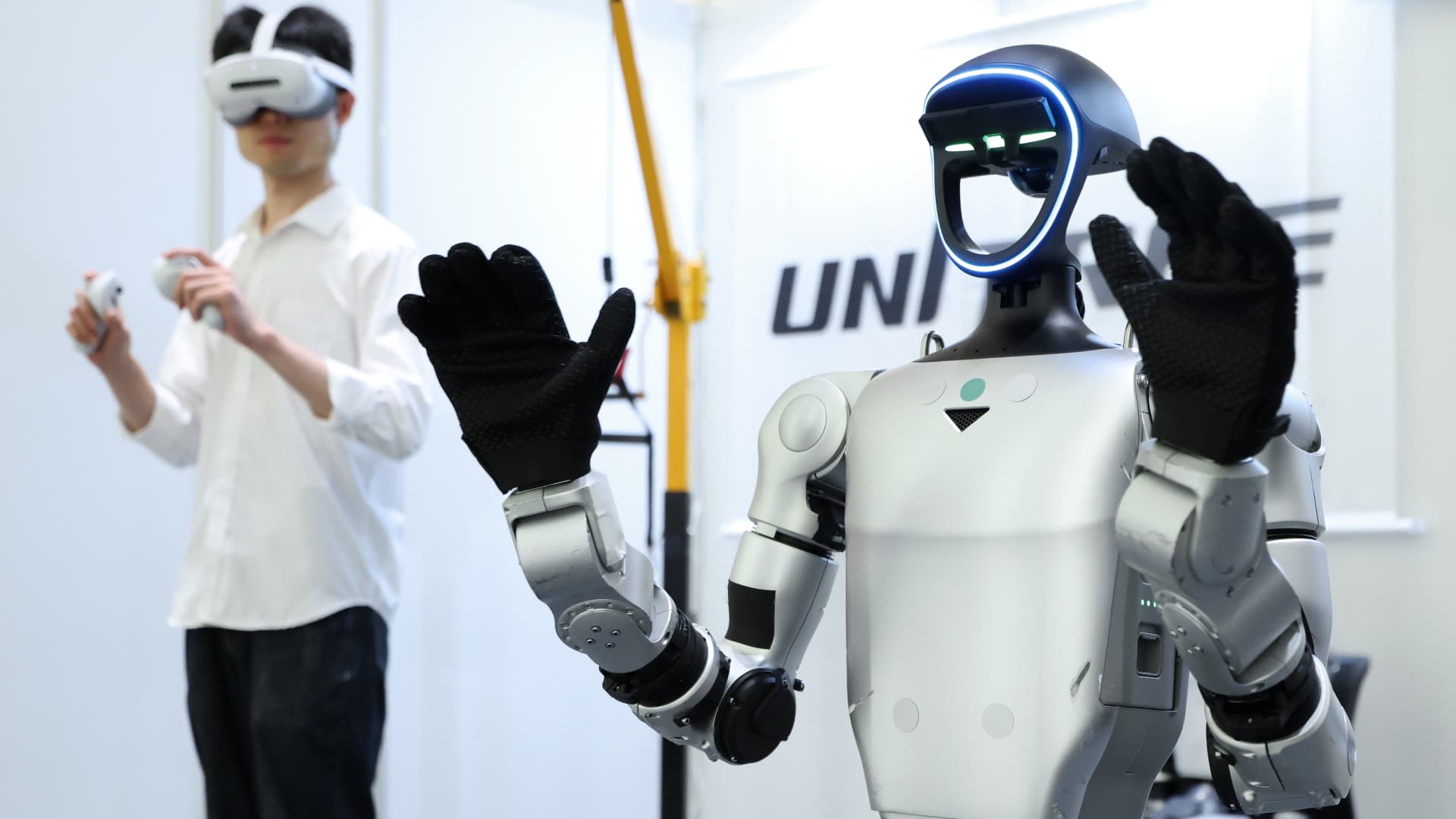
Unitree Robotics has launched a $900 million IPO in China, highlighting the country's dominance in humanoid robot production. Meanwhile, American entrepreneurs like Teddy Haggerty face significant hurdles in attempting to establish domestic manufacturing to compete with these established capabilities.
The Humanoid Robotics Arms Race
The landscape of humanoid robotics is currently undergoing a seismic shift, defined by a stark contrast between China’s manufacturing dominance and the burgeoning, yet challenging, domestic ambitions of the United States. As Teddy Haggerty, a former distributor for China's Unitree Robotics, pivots to establishing his own firm, Robo Inc., on Long Island, the industry is grappling with the reality that China currently possesses a massive head start in both production scale and real-world deployment.
The Chinese Advantage
China’s leadership in the sector is not merely theoretical; it is embedded in the infrastructure of its urban environments. With companies like Unitree Robotics, which has recently priced its IPO at 150.8 yuan ($22.4) per share to raise $900 million, the nation has moved beyond laboratory prototypes. These robots are already a visible presence in Chinese cities, providing manufacturers with an invaluable feedback loop of real-world operational data that Western firms have yet to replicate.
Challenges for Domestic Manufacturing
For entrepreneurs like Haggerty, the goal is to localize production in the United States. However, the barrier to entry is immense. The Chinese model benefits from a mature supply chain and an ability to produce humanoids at a cost point that American startups currently find difficult to match. Haggerty’s attempt to manufacture in a suburban Long Island warehouse underscores the 'quixotic' nature of this effort, as the U.S. industry seeks to overcome a lack of comparable experience and established manufacturing pipelines.
Market Skepticism and Commercial Viability
Despite the excitement surrounding Unitree’s $9 billion valuation and its upcoming listing on Shanghai's STAR market, the industry faces a critical question: can these machines move past the 'acrobatic' phase? While Unitree’s robots are famous for backflips and agility, investors and industry analysts are increasingly focused on whether these robots can perform genuinely useful, revenue-generating work. The IPO will serve as a bellwether for investor appetite in a sector that is still proving its economic utility.
Geopolitical and Economic Implications
This industrial competition is happening against a backdrop of intensifying geopolitical tensions. The race to develop humanoid robots has become a matter of national technological strategy. As the U.S. attempts to build a domestic supply chain from the ground up, China’s ability to scale quickly puts pressure on Western firms to innovate rapidly or risk being permanently sidelined by more cost-effective, mass-produced alternatives.
Future Trends
Moving forward, the success of companies like Unitree will likely dictate the pace of global robotics adoption. If the market demonstrates that these robots can transition from exhibition pieces to essential labor tools, we can expect a massive influx of capital. Conversely, if commercial viability remains elusive, the industry may face a period of consolidation. For American firms like Robo Inc., the road ahead requires not just technical innovation, but a fundamental rethinking of how to scale production in a high-cost labor market.