Unreal Agent
Source Entity
Hacker News
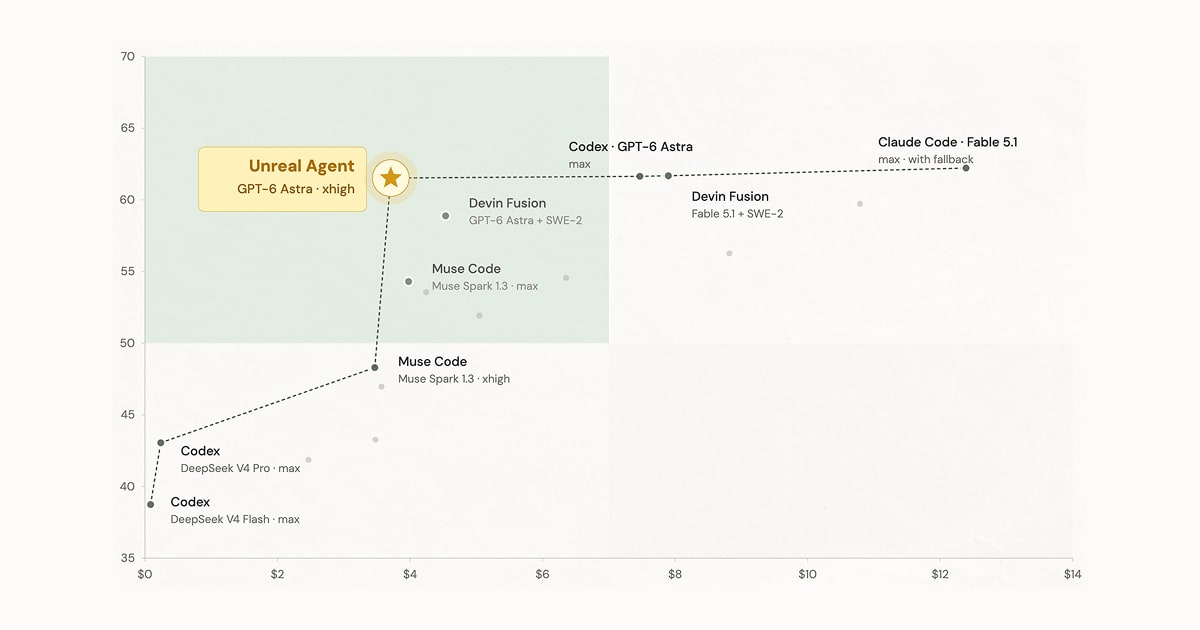
Unreal Labs has introduced Unreal Agent, a new harness designed to optimize AI performance by reducing tool-management overhead. The system claims to deliver up to 40% cost savings on production workloads compared to Codex.
The Emergence of Unreal Agent
In the rapidly evolving landscape of artificial intelligence, efficiency has become the primary bottleneck for scaling autonomous systems. Unreal Labs has recently unveiled 'Unreal Agent,' a specialized harness designed to optimize the execution of AI agents in production environments. By focusing on the reduction of operational costs, this development addresses a critical pain point for enterprises attempting to deploy large-scale AI solutions without incurring prohibitive token consumption.
Addressing the Tool-Management Overhead
The core innovation behind Unreal Agent lies in its approach to tool management. Traditionally, AI agents frequently waste valuable computational tokens and latency cycles managing complex tool calls, which include waiting for responses, polling for status updates, and maintaining heartbeats. Unreal Labs identified that these administrative tasks consume a disproportionate amount of a model's 'thinking' capacity, thereby driving up costs and slowing down user-facing performance.
Architectural Asynchronicity
Unreal Agent shifts this burden away from the underlying Large Language Model (LLM) by implementing a fully asynchronous harness. By decoupling the tool-invocation layer from the primary reasoning engine, the system ensures that the model is no longer required to manage the lifecycle of a tool call. This architectural shift is reported to deliver up to 40% cost savings compared to traditional frameworks like Codex, specifically when applied to coding and scientific benchmarks.
Benchmarking and Performance
Importantly, the developers have stated that these financial efficiencies are achieved without any negative impact on performance. In the context of production workloads, where every millisecond of latency and every token counts, maintaining high-fidelity output while slashing overhead is a significant technical milestone. This suggests that the harness is optimized to handle the intricate, multi-step reasoning required in professional coding and research environments.
Broader Implications for AI Deployment
This release highlights a broader industry trend: the shift from 'model-centric' development to 'infrastructure-centric' optimization. As frontier models become increasingly powerful, the challenge for developers is no longer just the intelligence of the model itself, but how effectively that intelligence can be deployed in the real world. By focusing on the 'harness'—the software layer that surrounds the model—Unreal Labs is targeting the practical, day-to-day viability of AI agents.
Future Outlook
Looking ahead, the success of Unreal Agent will likely depend on its integration capabilities across various LLM architectures. If the platform can maintain its 40% cost-saving metric across diverse use cases, it may set a new standard for how AI agent frameworks are built. As businesses continue to prioritize cost-efficiency alongside performance, tools that minimize technical debt and token waste will be essential for the next generation of autonomous AI adoption.