'Falcon Strike': US launches first-ever multinational attack-drone task force
Source Entity
TOI DEFENCE DESK
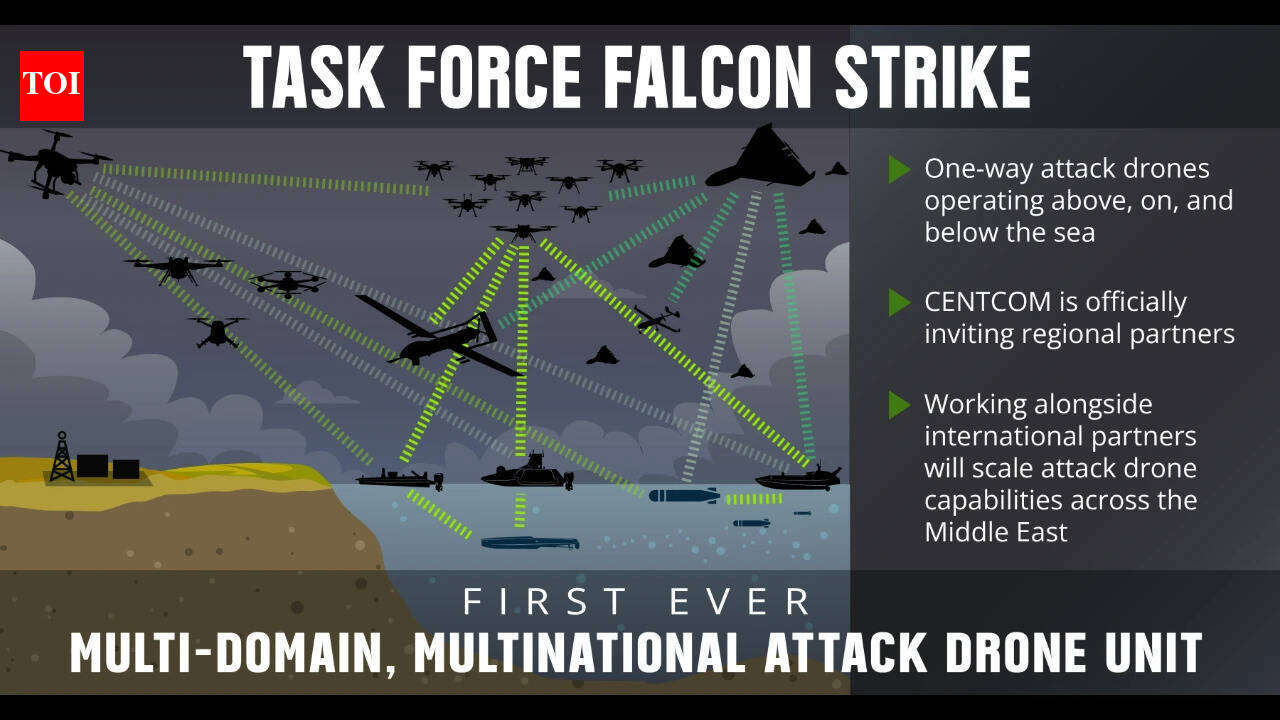
US Central Command has launched Task Force Falcon Strike, a new multinational task force dedicated to integrating one-way attack drones across air, land, and maritime domains. This initiative builds on the success of Task Force Scorpion Strike, signaling a shift toward unmanned, multi-domain warfare in the Middle East.
The Emergence of Task Force Falcon Strike
US Central Command (Centcom) has officially announced the formation of Task Force Falcon Strike, a landmark initiative described as the first-ever multinational, multi-domain attack-drone task force. This strategic move represents a significant evolution in modern military engagement, moving beyond traditional air-to-air or air-to-ground platforms to embrace a more integrated, unmanned approach to security in the Middle East. By bringing together regional military partners, the US is creating a cohesive architecture for the deployment of one-way attack drones.
Expanding the Multi-Domain Scope
The defining characteristic of Task Force Falcon Strike is its reach across air, land, and maritime domains. Centcom’s mandate includes the operation of unmanned systems that function above, on, and below the sea surface. This multi-domain approach addresses the growing complexity of regional threats, where adversaries increasingly leverage low-cost, high-impact drone technology. By integrating these systems into a single task force, Centcom aims to create a more responsive and versatile defensive and offensive capability.
The Legacy of Task Force Scorpion Strike
Falcon Strike does not exist in a vacuum; it is the direct successor to Task Force Scorpion Strike, which was established by Centcom nine months prior. Scorpion Strike served as the military's first dedicated one-way attack-drone squadron in the Middle East, acting as an experimental proving ground for these technologies. Its success, particularly the landmark achievement in December involving the first launch of an aerial attack drone from a US Navy warship, provided the necessary operational proof-of-concept to justify the broader, multinational scope of the new Falcon Strike initiative.
Strategic Implications for Regional Security
The shift toward multinational cooperation in drone warfare underscores a broader trend in US defense strategy: burden-sharing and interoperability. By involving regional partners, the US is not only expanding its sensor and strike coverage but also ensuring that allied nations are equipped to handle modern threats using standardized, unmanned systems. This collaborative framework is designed to deter aggression and provide rapid, precision-strike capabilities that were previously difficult to coordinate across disparate national military units.
Future Trends in Unmanned Warfare
The launch of Falcon Strike signals that the era of 'drone-centric' warfare is now firmly institutionalized within US military operations. Future trends will likely see an increased reliance on autonomous and semi-autonomous systems that can operate in contested environments where GPS or communication might be jammed. As these systems become more sophisticated, the role of task forces like Falcon Strike will be to manage the swarm-like complexity of these assets, ensuring they function as a unified force rather than as isolated tools.
Conclusion
In summary, the establishment of Task Force Falcon Strike marks a pivotal moment in the modernization of Centcom’s operational capabilities. By building on the operational milestones of Scorpion Strike and expanding the mandate to include maritime and underwater domains, the US is positioning itself to better navigate the challenges of 21st-century warfare. As these technologies continue to evolve, the emphasis on multi-domain, multinational integration will remain the cornerstone of regional stability efforts.