WorldClaw Agentic 3D open-world generation at scale
Source Entity
Hacker News
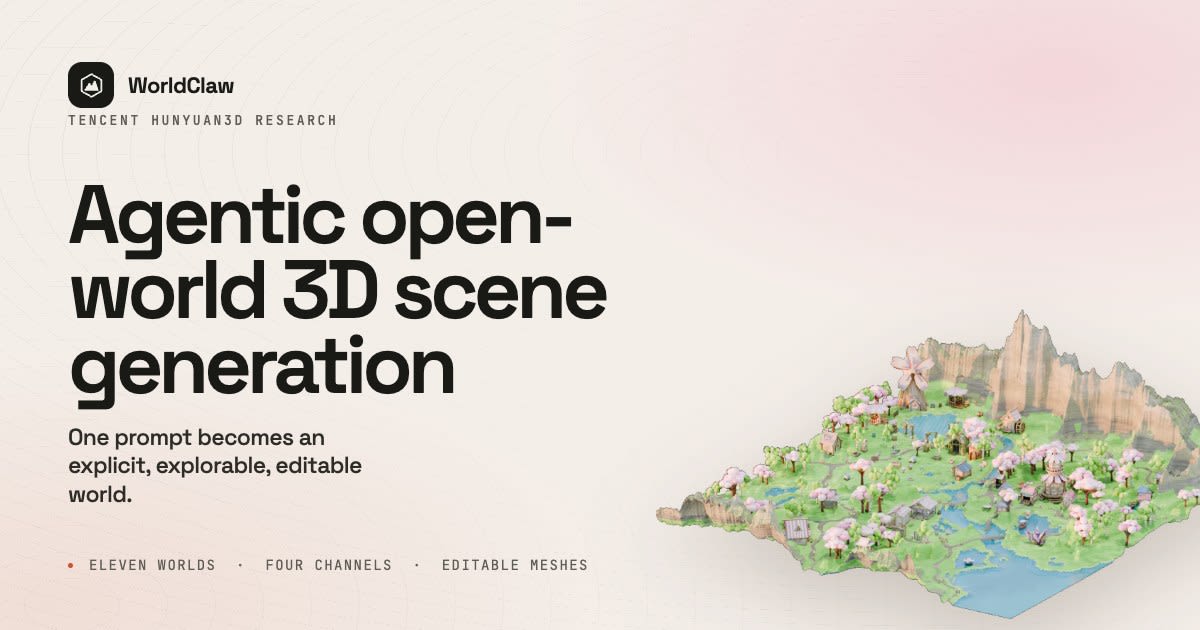
WorldClaw has unveiled an advanced agentic 3D open-world generation platform designed for large-scale environment creation. This technology leverages autonomous agents to streamline the complex process of building expansive, interactive virtual worlds.
The Evolution of Agentic 3D Generation
The emergence of WorldClaw’s agentic 3D open-world generation platform marks a significant shift in how developers and creators approach the construction of expansive digital environments. By utilizing autonomous agents to handle the heavy lifting of spatial design, terrain generation, and object placement, the system addresses the historic bottleneck of manual 3D modeling. This transition from static, human-led design to agent-driven procedural generation allows for unprecedented scale, enabling the creation of complex, reactive worlds that were previously too labor-intensive to produce.
Scaling Complexity Through Autonomy
At the core of this technology is the concept of 'agentic' workflows. Unlike traditional procedural generation, which relies on rigid algorithms or randomized seeds, agentic systems utilize intelligent models capable of understanding context, physics, and aesthetic consistency. These agents act as digital architects, making thousands of micro-decisions to ensure that a generated open world feels cohesive rather than repetitive. This level of autonomy is essential for developers tasked with building massive, high-fidelity environments for gaming, simulation, and enterprise metaverse applications.
Impact on Industry Workflows
For the game development and simulation sectors, WorldClaw’s capabilities represent a major reduction in overhead. Historically, building a massive open-world map required hundreds of artists and months of iterative testing. With an agentic approach, the time-to-market for complex environments is drastically shortened. By automating the foundational layout and asset integration, human designers are liberated to focus on higher-level narrative design, gameplay mechanics, and unique creative details that differentiate a specific project from standard generated content.
Broader Implications for Virtual Worlds
Beyond just gaming, the ability to generate 3D environments at scale has profound implications for fields like urban planning, disaster simulation, and architectural visualization. The capacity to rapidly prototype entire city blocks or geographic regions using agentic systems allows stakeholders to test infrastructure viability or environmental impact scenarios in a virtual space before committing to physical construction. This creates a bridge between digital modeling and real-world application, fundamentally changing how we interact with and analyze spatial data.
Future Trends in Synthetic Environments
As WorldClaw and similar technologies mature, we can expect the barrier to entry for high-quality 3D content creation to continue to drop. Future trends will likely favor 'co-creation' models, where human intent guides the agentic system in real-time, resulting in a hybrid style of development. As these agents become more sophisticated, the distinction between human-authored and AI-generated environments will blur, leading to a new era of 'infinite' virtual spaces that are dynamically updated based on user interactions and evolving environmental parameters.
Conclusion
The introduction of WorldClaw’s agentic generation platform is a pivotal moment in the trajectory of 3D technology. By shifting the burden of world-building to intelligent autonomous systems, the industry is entering a phase of rapid expansion. While challenges regarding consistency and asset optimization remain, the core promise of this technology—the ability to generate vast, living worlds at scale—is set to redefine the boundaries of digital creativity and simulation efficiency.