Robots could be doing household chores in just 1-2 years, Chinese EV firm says
Source Entity
US Top News and Analysis
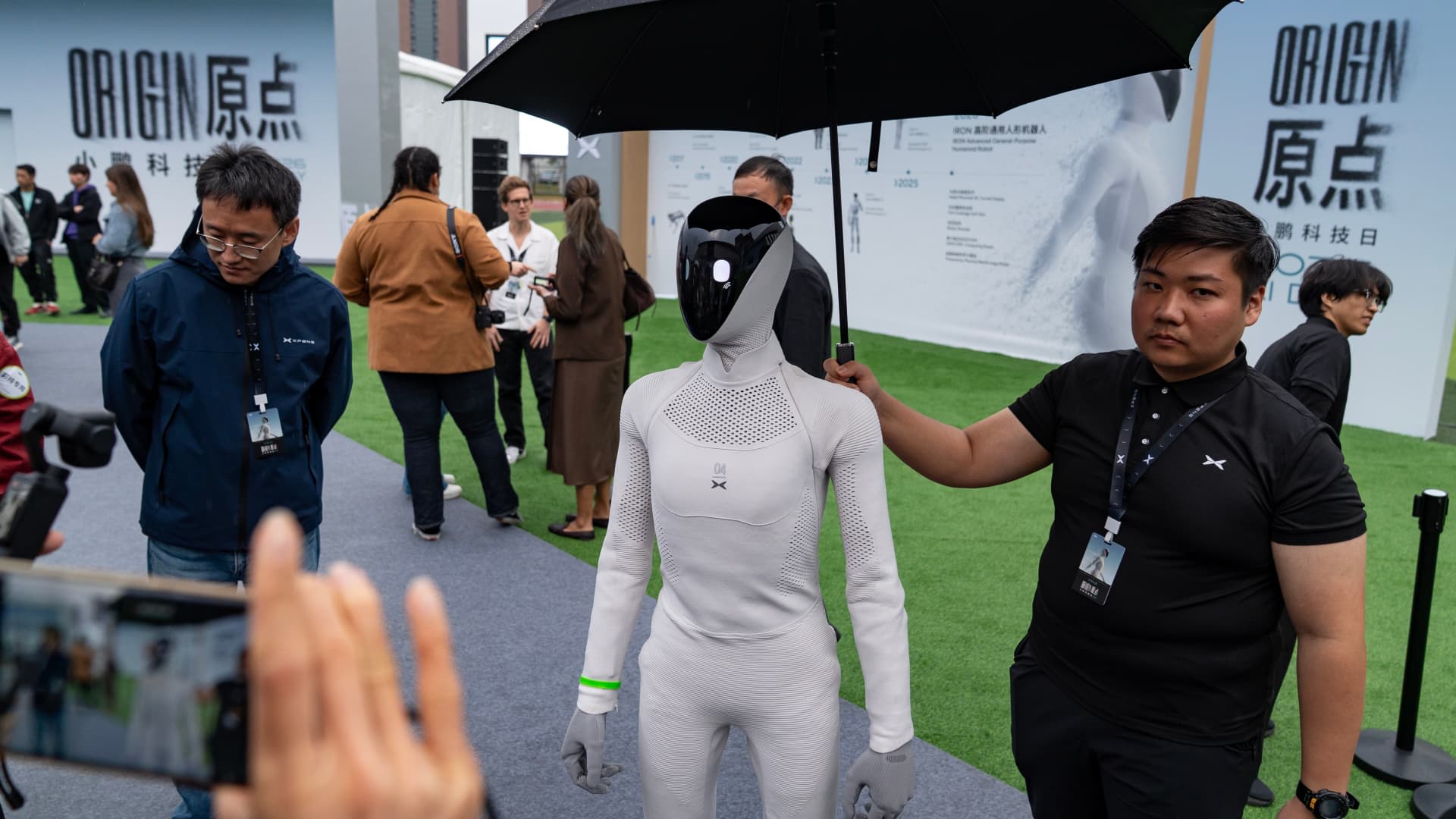
Xpeng has unveiled its new IRON humanoid robot, with plans for commercial deployment in retail settings by early 2025. Co-President Brian Gu projects that these robots could transition to household use within one to two years following successful commercial testing.
The Dawn of Household Robotics: An Analysis of Xpeng’s IRON
Recent developments from Chinese electric vehicle manufacturer Xpeng signal a significant pivot in the robotics industry. By unveiling their general-purpose humanoid robot, 'IRON,' during their AI Day in Guangzhou, the company is bridging the gap between automotive manufacturing and domestic automation. Co-President Brian Gu’s recent comments to CNBC suggest that the integration of advanced robotics into everyday life is no longer a distant sci-fi trope, but a looming technological reality slated for the next 24 months.
Scaling from Commercial to Domestic
The strategic roadmap outlined by Xpeng involves a phased deployment approach. Rather than jumping directly into the unpredictable environment of a private home, the company intends to utilize its own retail car locations as testing grounds. By training IRON robots to function as store assistants starting in the first quarter of 2026, Xpeng creates a controlled, high-traffic environment to refine the robot's artificial intelligence and physical dexterity. This deliberate transition from commercial settings to residential ones is a critical step in ensuring safety and reliability before mass-market consumer adoption.
The Acceleration of AI and Hardware
Brian Gu’s assertion that technology is moving at a 'much faster clip' reflects a broader industry trend where advancements in large language models and neural networks are being rapidly integrated into physical hardware. The IRON robot represents a convergence of Xpeng’s expertise in autonomous driving systems—which require sophisticated spatial awareness and decision-making—and the growing demand for humanoid form factors capable of interacting with human-centric environments. This cross-pollination of automotive tech and robotics is fundamentally lowering the barrier to entry for general-purpose automation.
Manufacturing and Market Readiness
With mass production of the IRON robot scheduled to commence in January 2026, the company is positioning itself as a leader in the race to industrialize humanoid manufacturing. The move toward commercial sales by the second quarter underscores a serious commitment to scaling the product. By tackling the manufacturing challenges early, Xpeng is attempting to achieve the economies of scale necessary to eventually lower the price point for household consumers, a factor that has historically hindered the widespread adoption of domestic robots.
Broader Implications and Future Trends
If Xpeng successfully navigates the transition from retail assistants to household helpers, the implications for the global labor market and domestic lifestyle will be profound. The ability for humanoid robots to perform repetitive household chores could redefine home management, mirroring the impact that early domestic appliances like the dishwasher or vacuum cleaner had on household productivity. As the competition in the humanoid sector intensifies, we can expect a rapid cycle of innovation, where iterative software updates and hardware refinements become the primary drivers of market share in the coming decade.
Conclusion
Xpeng's aggressive timeline for the IRON robot marks a pivotal moment in the evolution of robotics. While the transition from a store assistant to a home companion remains complex, the company’s focus on structured commercial deployment provides a realistic framework for success. As we look toward 2026 and beyond, the integration of such technology into the domestic sphere seems increasingly inevitable, provided the company can maintain its current pace of technological advancement and operational execution.