The Linguistic Fallacy
Language is a lie. Humans assume that any complex communication must mirror our own grammatical structures, but the oceanic depths operate on an entirely different set of rules. We are blind to it. Logic is the key. By applying unsupervised machine learning to thousands of hours of recordings, we can finally see the patterns that escape the human ear. The data reveals a hidden order.
Whales do not speak. They utilize highly structured sequences of clicks known as codas which carry social information across vast oceanic distances through acoustic channels. This is not a conversation as we know it. Math is the driver. While traditional biologists searched for a word-for-word dictionary, modern machine learning models analyze the probabilistic distribution of clicks to find structural repetitions. The dictionary approach is dead.
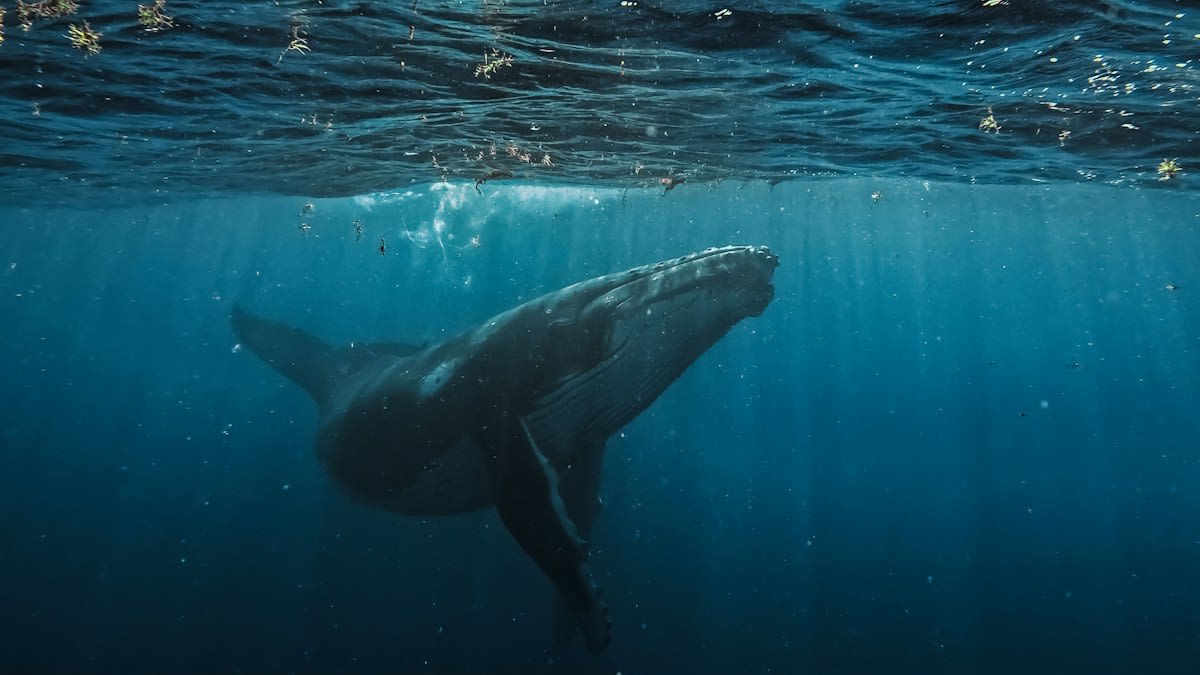
Consider the data. Project CETI has collected over 100,000 hours of acoustic data to map the vocalizations of sperm whales (Source: Project CETI, 2023). This is immense. Instead of looking for nouns and verbs, researchers are finding phonetic units that function like a biological binary code. It is a digital web. These units combine to form codas that signal clan identity and social hierarchy across the Caribbean and Atlantic (Source: Nature Communications, 2023).
"We are not looking for a translation of words, but a translation of meaning through the lens of information theory and combinatorial patterns."— David Gruber, Founder of Project CETI
The hardware matters. The spermaceti organ acts as a biological acoustic lens that focuses sound into a beam of incredible precision. This is a mechanical marvel. By controlling the air sacs within this organ, the whale can modulate the timing of clicks to create a rhythmic signature. The signal is a coordinate. This allows a whale to transmit its internal state and social position without needing a formal grammar.
Listen to the clicks. When a pod moves through the Caribbean waters of Dominica, their codas synchronize in a way that suggests a collective consciousness. The rhythm is the key. This synchronization occurs in real-time, allowing the pod to act as a single organism during deep-sea hunts. It is a shared logic. The variance in timing between distinct social clans is approximately 15%, which serves as a biological password for group entry (Source: Nature Communications, 2023).
| Coda Type | Acoustic Characteristic | Social Function |
|---|---|---|
| Regular | Fixed intervals, low variance | Clan identity and group cohesion |
| Variable | Shifting tempo, high jitter | Individual emotional state or alert |
| Complex | Nested patterns, recursive clicks | Long-range coordination and navigation |
The lab is tense. While the biologists insist on mapping clicks to specific emotional states like fear or hunger, the machine learning engineers dismiss this as anthropomorphic fantasy. This conflict boils down to a fight over the definition of meaning itself, where one side wants a dictionary and the other wants a probability map. The funding usually goes to the dictionary. This creates a hollow pursuit of truth that ignores the actual mathematics of the signal.
Meaning is relative. If a whale uses a specific rhythmic sequence to signal the presence of a giant squid, that sequence is not a word for squid but a trigger for a behavioral response. This is functional logic. We must stop asking what the whale is saying and start asking what the signal is doing. The answer is action. By treating the vocalizations as a series of state-changes in a social system, we bypass the need for human language entirely.

Data is expanding. ML models have already identified 40 distinct phonetic units in whale vocalizations that serve as the building blocks for more complex messages (Source: Marine Mammal Science, 2022). This is a start. These units are not random but follow a strict set of combinatorial rules that vary by region. The terrain is vast. This suggests that whales possess a cultural evolution that mirrors human dialect shifts over centuries.
Fact-Check & Accuracy Note
The debate centers on the distinction between communication and language. Communication is the transfer of information; language requires recursion and a generative grammar. While Project CETI uses AI to find patterns, the academic community remains split on whether whales possess 'language' in the Chomskyan sense or a highly advanced system of signal-response.
Adaptation is mandatory. We are moving toward a future where humans can interface with non-human intelligences through mathematical bridges rather than linguistic translation. This is a hard turn. Instead of teaching whales English, we are learning to perceive the world as a series of acoustic probabilities. The shift is real. This approach gives the project more staying power than the romanticized quest for a whale-to-human dictionary.
The goal is clarity. By mapping the latent space of whale communication, we can identify the universal constants of intelligence that exist outside of human biology. This is the prize. We are no longer looking for a mirror of ourselves in the ocean but a window into a different kind of mind. The window is open. The logic of the deep is not a puzzle to be solved but a system to be mapped.
Editorial Note
Editorial Note: This analysis argues that the pursuit of a 'dictionary' for whale language is a cognitive bias. The author posits that the only viable path to understanding cetacean communication is through information theory and pattern recognition, treating the audio as data rather than speech.