The Fragility of the Physical Web
The modern internet is an illusion of weightlessness. We speak of the cloud and wireless signals, but the reality is a claustrophobic network of glass tubes resting on the ocean floor. Currently, over 99% of intercontinental data traffic travels through subsea cables. These cables are the silent, rusted arteries of global commerce, yet they are terrifyingly vulnerable. A single seismic shift in the Pacific or a stray ship anchor in the Red Sea can isolate entire nations in seconds. Why do we continue to trust the stability of our global economy to threads of glass lying in the dark, under immense pressure, and subject to the whims of tectonic plates?
This vulnerability isn't merely a technical glitch; it is a systemic failure of architecture. The current model relies on landing stations—physical points where the cable emerges from the sea to connect to terrestrial networks. These stations are the ultimate geopolitical choke points. To move data from London to Singapore, the signal must physically touch land in various jurisdictions, making it subject to the laws, surveillance, and political stability of every host nation along the route. We have built a digital civilization on a foundation of physical dependencies that are increasingly incompatible with a world of volatile geopolitics.
The Optical Leap: Beyond the Bent Pipe
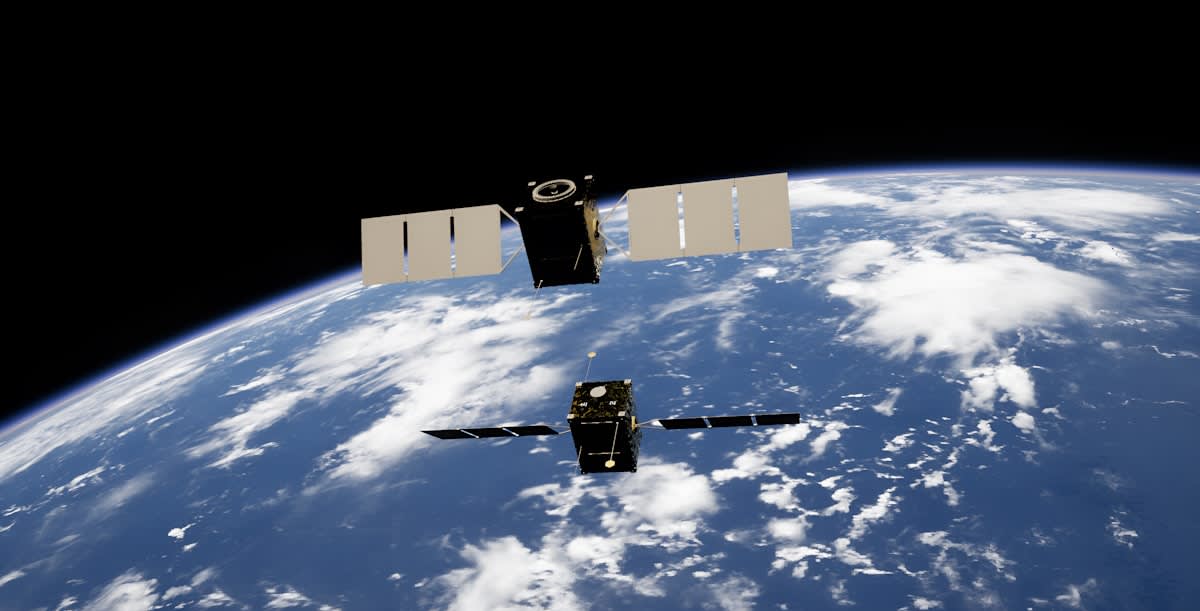
For decades, satellite internet was a clumsy workaround. It operated on a bent-pipe architecture: a signal traveled from a user to a satellite, which then bounced it immediately back down to a local ground station. This required a dense network of ground stations, meaning you still needed a cable in the ground nearby to get your data anywhere. It was a relay race where the satellite was just a very expensive mirror. The game changes entirely with the introduction of Optical Inter-Satellite Links (OISLs), or laser meshes. Instead of bouncing signals back to Earth, satellites now talk to each other using high-precision lasers.
Lasers offer a bandwidth density that radio frequencies simply cannot match. By utilizing the near-infrared spectrum, these systems can move terabits of data across the vacuum of space with minimal attenuation. When satellites form a mesh, they create a dynamic, self-healing web of connectivity. If one node fails or is decommissioned, the network automatically reroutes the laser beam to the next available satellite. The result is a network that doesn't just bypass the ocean floor—it renders the very concept of a landing station obsolete for long-haul transit.
"The transition to laser meshes is not an incremental upgrade in speed; it is a structural divorce from the earth's geography."— Strategic Analyst, Orbital Infrastructure Group
This architectural shift allows data to travel the shortest possible path between two points on the globe. In a traditional fiber network, cables follow the contours of coastlines and avoid deep-sea trenches, creating a zigzag pattern that adds unnecessary distance. A laser mesh, operating in the vacuum of Low Earth Orbit (LEO), allows for a more direct, geodesic route. The network becomes a living organism, constantly optimizing its paths in real-time based on traffic load and satellite position.
This isn't just a speed upgrade; it's a structural divorce from the earth.
Geopolitical Decoupling and the End of Landing Rights
The most profound impact of the laser mesh is the erasure of the landing right. For a century, the power to control the internet was the power to control the shore. Nations could demand exorbitant fees, insist on surveillance backdoors, or simply deny a cable landing to isolate a rival. With a laser mesh, the transit happens in the vacuum of space. A signal from Nairobi to Sao Paulo can traverse the orbital mesh without ever touching a third-party nation's soil. This decouples connectivity from territorial sovereignty.
Consider the implications for the Global South. Landlocked nations in Central Africa or remote island chains in the South Pacific have historically been at the mercy of their neighbors' infrastructure. They paid a premium for connectivity that was often unstable and easily throttled. A laser mesh provides these regions with an autonomous gateway to the global economy. The network doesn't care about borders, mountains, or the political stability of a neighboring regime; it only cares about the line of sight between two lasers.
| Metric | Subsea Fiber Optics | Orbital Laser Mesh |
|---|---|---|
| Propagation Speed | ~200,000 km/s (in glass) | ~300,000 km/s (in vacuum) |
| Deployment Timeline | Years (Survey, Lay, Permit) | Months (Launch and Sync) |
| Primary Failure Point | Physical Cable Cut/Seismic | Node/Satellite Hardware Failure |
| Geopolitical Control | High (Landing Station Rights) | Low (Orbital Slot/Spectrum) |
| Routing Logic | Static/Fixed Paths | Dynamic/Self-Healing Mesh |
The data reveals a stark contrast in efficiency. The vacuum of space is not just a convenient place to put satellites; it is a superior medium for light. Light travels roughly 30% faster in a vacuum than it does through the silica glass of a fiber optic cable. Over long distances, such as a trip from London to Singapore, this difference is not negligible. It is the difference between a lagging video call and a seamless real-time interaction.
But the shift isn't merely about where the data lives; it's about how fast it moves.
The Latency Arbitrage: Vacuum vs. Glass
In the world of high-frequency trading and real-time remote robotics, milliseconds are the only currency that matters. This is where the laser mesh creates a massive competitive advantage. By eliminating the refractive index of glass and the circuitous routing of terrestrial cables, orbital networks can achieve lower latency than the fastest fiber on Earth. We are entering an era of latency arbitrage, where those who control the orbital mesh can execute transactions and commands faster than those tied to the ground.
Imagine a surgeon in Tokyo operating on a patient in rural Brazil via a robotic arm. In a cable-based world, the signal might travel through five different countries, each adding a few milliseconds of delay. In a laser mesh, the signal leaps across the sky in a straight line. This reduction in lag isn't just a convenience; it's a safety requirement. The systemic shift here is the transition from best-effort connectivity to guaranteed, physics-limited speed.
The Physics of Speed
The Vacuum Advantage: Because light in a vacuum travels at c (approximately 299,792 km/s), while light in fiber optic cable is slowed by the refractive index of glass (typically around 1.46), the laser mesh is fundamentally faster by design.
While the technical promise is immense, the transition won't be a clean break.
The Contrarian Reality Check
It would be naive to suggest that subsea cables will vanish overnight. Fiber optics still hold a massive advantage in raw volumetric capacity for short-haul, high-density traffic. A single cable can carry more total data than a small constellation of satellites. However, the strategic value of cables is plummeting. They are becoming the freight trains of the internet—useful for moving massive amounts of bulk data—while the laser mesh becomes the nervous system, handling the critical, time-sensitive, and geopolitically sensitive traffic.
We must also acknowledge the new risks. We are trading the risk of a cable cut for the risk of orbital debris. The Kessler Syndrome—a chain reaction of satellite collisions—could potentially shred a laser mesh in a matter of days. Furthermore, the energy requirements for maintaining precise laser alignment at orbital speeds are staggering. The challenge is no longer about laying a cable; it is about managing a chaotic, high-velocity environment where a millimeter of misalignment means a total loss of signal.
Yet, the resilience of a mesh outweighs the fragility of a line. A cable is a single point of failure. A mesh is a thousand points of redundancy. If you cut a cable, the network dies. If you destroy a satellite, the network reroutes. This shift from linear to mesh topology is the ultimate insurance policy for a global civilization that can no longer afford to go offline.
The New Orbital Nervous System
The next internet will not be defined by where the cables are laid, but by how the lasers are aligned. We are moving toward a world where connectivity is a global utility, as omnipresent and indifferent to borders as the air we breathe. The decoupling of data from geography is the final step in the digitalization of the human experience. By moving the backbone of the internet into the vacuum of space, we are finally stripping away the physical anchors that have limited the speed and freedom of information since the first telegraph cable was dropped into the Atlantic.