A $500 RL fine-tune of a 9B open model beat frontier models on catalog review
Source Entity
Hacker News
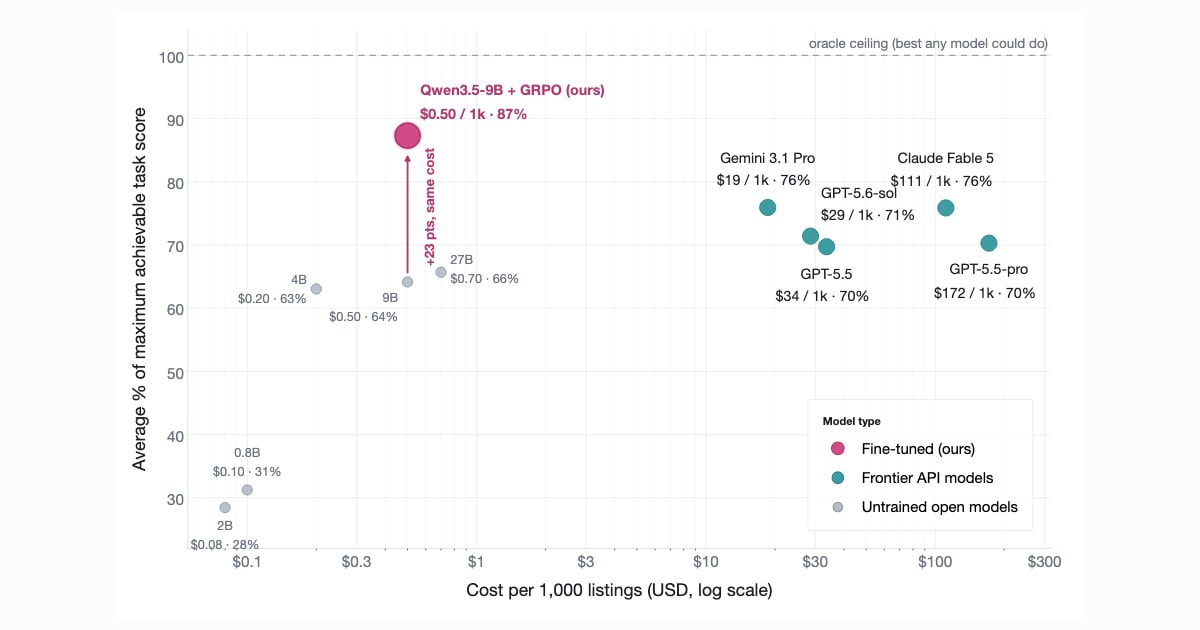
A small-scale, $500 reinforcement learning fine-tuning of a 9B parameter open model has outperformed massive frontier models in catalog review tasks. This shift highlights a growing trend toward specialized, cost-effective AI solutions over general-purpose systems.
The Rise of Specialized AI Efficiency
The recent demonstration that a 9B parameter open-source model, fine-tuned with a mere $500 investment using reinforcement learning (RL), can outperform industry-standard frontier models in catalog review tasks marks a pivotal moment in artificial intelligence. For years, the prevailing narrative in the tech industry has been that 'bigger is better.' Companies have spent millions training massive general-purpose models, assuming that scale was the only path to superior performance. This new development challenges that assumption, proving that targeted, efficient training can deliver high-value outcomes at a fraction of the cost.
Moving Beyond General-Purpose Models
Since the launch of ChatGPT in 2022, the business world has been grappling with how to integrate generative AI effectively. Initially, adoption was limited to low-risk administrative tasks like summarizing documents or drafting emails. As organizations matured, they pushed toward more complex cognitive workloads, such as software development and the creation of an 'AI company brain'—a system designed to integrate internal data and autonomous workflows. However, many of these ambitious projects have struggled to achieve measurable, scalable success, often due to the limitations of general-purpose models in specialized environments.
The Economics of Targeted Fine-Tuning
The $500 price point for this fine-tuning effort is significant because it democratizes access to state-of-the-art performance. By utilizing smaller, open-source architectures, companies can avoid the prohibitive costs associated with API-based proprietary models. This shift toward 'small-language model' (SLM) optimization suggests that the future of enterprise AI may not lie in single, massive systems, but in a fleet of highly specialized, lightweight models that are trained to excel at specific, high-precision tasks like cataloging.
The Challenge of Measurable Outcomes
For many firms, the gap between AI investment and measurable outcome has been wide. The enthusiasm surrounding AI adoption has often outpaced the actual utility of these systems in real-world business operations. By focusing on niche applications—such as catalog review—rather than attempting to build all-encompassing systems, businesses can finally see a clear return on investment. The successful application of RL in this instance indicates that reinforcement learning is a key differentiator in refining a model's ability to handle domain-specific nuances that general pre-training might miss.
Future Trends in AI Architecture
Looking forward, we can expect a bifurcated market. On one hand, massive frontier models will continue to serve as the foundation for general reasoning. On the other, companies will increasingly adopt an AI-first strategy centered on bespoke, fine-tuned models that are cheaper to host, faster to run, and more accurate within their specific domain. This trend will likely force larger AI labs to re-evaluate their pricing models and capabilities, as the barriers to entry for high-performance AI continue to plummet.
Conclusion
The success of this 9B model in outperforming larger counterparts serves as a wake-up call for stakeholders. It highlights that the path to AI dominance is not solely paved by raw compute power, but by the strategic application of reinforcement learning and data optimization. As the industry matures, the focus will inevitably shift from the sheer scale of parameters to the precision of the output, favoring companies that can execute lean, task-specific AI strategies.