How AI text watermarking works
Source Entity
Hacker News
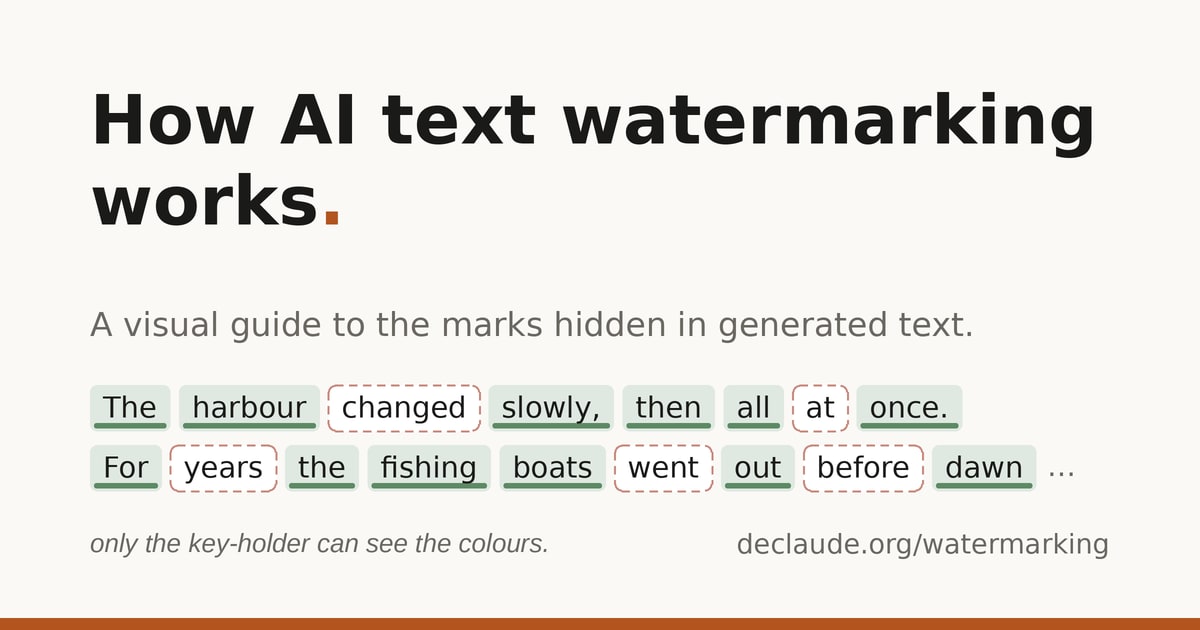
AI text watermarking functions by subtly influencing word choice during generation, creating a statistical signature without altering the visible text. This approach mirrors abstract mathematical proofs where systems cannot fully define themselves from within.
The Invisible Signature: How AI Watermarking Redefines Textual Integrity
The Mechanics of Probabilistic Watermarking
At its core, AI text watermarking represents a departure from traditional digital watermarking, which typically relies on embedding data within pixels or file metadata. As artificial intelligence models like Google’s Gemini and newer iterations of Claude demonstrate, true textual watermarking does not reside in the characters themselves but in the underlying statistical process of generation. By influencing the 'weighted dice' that an LLM rolls when selecting the next token in a sequence, developers can create a subtle, detectable pattern in word choices that survives copy-pasting and manual reformatting.
Theoretical Foundations: From Gödel to Generative Models
The challenge of defining a system from within its own constraints finds a fascinating parallel in the history of logic. In 1931, Kurt Gödel fundamentally altered mathematics by proving that any consistent axiomatic system is necessarily incomplete. He demonstrated that there exist true statements that cannot be proven within the system's own rules. Similarly, modern AI watermarking functions by operating within the 'probabilistic space' of language, embedding a signature that is effectively invisible to the end-user but statistically significant to the system that generated it.
Implementation Across Industry Leaders
The landscape of AI accountability is shifting rapidly. Since 2024, Google has pioneered the integration of watermarking within its Gemini suite. By August 2026, competitors like Anthropic’s Claude have expanded these capabilities, moving from experimental API-based implementations to model-level integration. This evolution suggests that the industry is moving toward a standard where the provenance of AI-generated content can be verified, even when the output is stripped of its original digital container.
The Persistence Problem
One of the most significant hurdles in verifying digital content is the fragility of metadata. Traditional watermarks are often lost during simple actions like copying text from a web browser into a document editor. By shifting the watermark into the choice of words—the 'stochastic fingerprint' of the model—developers have solved the durability issue. Because the watermark is a property of the sequence of words rather than a file-level attribute, it remains embedded in the text regardless of how the user interacts with the interface.
Broader Implications and Future Trends
The ability to verify AI-generated text has profound implications for digital discourse, academic integrity, and the combatting of misinformation. As these models become more sophisticated, the 'watermark' becomes an essential tool for distinguishing synthetic output from human-authored content. Looking ahead, we can expect this technology to become a standard feature in all generative models, potentially evolving into a universal protocol for AI transparency that aligns with the mathematical limitations of closed systems identified by logicians nearly a century ago.