'Dil mein Babar, munh mein Ram': Anti-SP posters ignite fresh political storm in UP
Source Entity
TOI NEWS DESK
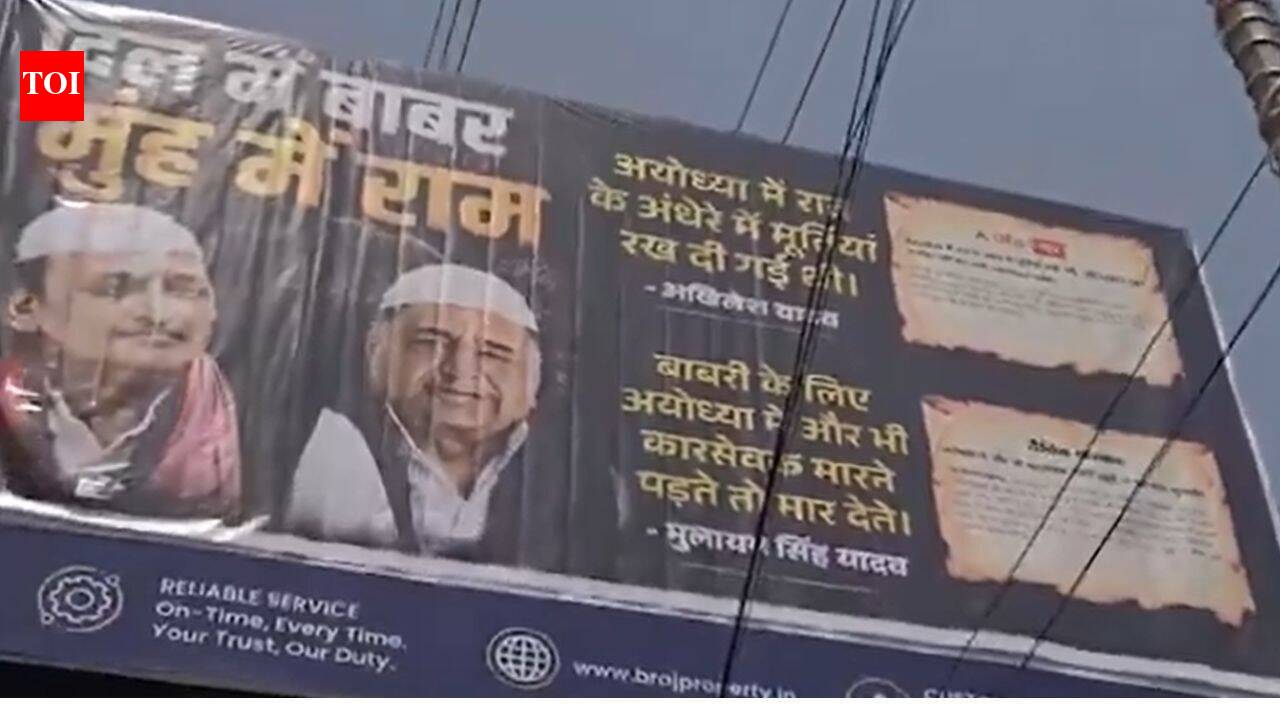
Posters targeting Mulayam Singh Yadav and Akhilesh Yadav appeared across Uttar Pradesh. The Samajwadi Party accused the BJP of inciting communal sentiments with these displays. Uttar Pradesh minister Om Prakash Rajbhar defended the posters as appropriate responses. Samajwadi Party workers removed the controversial hoardings in several locations. Police are examining CCTV footage to identify those responsible for the posters.
Political Polarization in Uttar Pradesh: The 'Babar vs. Ram' Narrative
Uttar Pradesh has once again become the epicenter of a fierce political clash following the appearance of controversial posters targeting the leadership of the Samajwadi Party (SP). The posters, featuring the provocative slogan 'Dil mein Babar, munh mein Ram' (Babar in the heart, Ram on the lips), directly target the legacy of Mulayam Singh Yadav and the current leadership of Akhilesh Yadav. This incident is not merely a localized dispute over hoardings but a calculated strike at the perceived ideological contradictions of the Samajwadi Party, aiming to paint the party as duplicitous in its approach to religious and communal identities.
The Core of the Conflict and Allegations
The Samajwadi Party has reacted with indignation, explicitly accusing the Bharatiya Janata Party (BJP) of orchestrating this campaign to incite communal sentiments across the state. By framing the SP leaders as secretly supporting Babur—the founder of the Mughal Empire and a figure often used in political discourse to symbolize foreign intrusion—while publicly professing devotion to Lord Ram, the posters attempt to alienate the SP from its Hindu voter base. The SP's response underscores a broader anxiety regarding the use of religious polarization as a tool for political mobilization in the lead-up to electoral cycles.
Institutional Defense and Political Justification
Adding fuel to the fire, Uttar Pradesh minister Om Prakash Rajbhar has defended the posters, characterizing them as appropriate responses to the SP's political stance. This defense is significant as it suggests a level of tacit approval or strategic alignment within the ruling coalition to use aggressive rhetoric against the opposition. Rajbhar's comments indicate a strategy of 'counter-narrative' building, where the ruling alliance seeks to challenge the SP's claims of secularism by labeling them as hypocritical, thereby consolidating a specific ideological vote bank.
Ground Reaction and Law Enforcement Response
The tension transitioned from rhetorical to physical as Samajwadi Party workers took to the streets to dismantle the controversial hoardings. These spontaneous actions highlight the volatility of the ground situation in UP, where political symbols often become flashpoints for confrontation. In response, the state police have initiated an investigation, utilizing CCTV footage to identify the individuals responsible for putting up the posters. This move by the police is critical in determining whether the campaign was a grassroots effort or a coordinated political operation.
Historical Context and Ideological Warfare
To understand the gravity of the 'Babar vs. Ram' slogan, one must look at the historical landscape of Uttar Pradesh. The state has been the primary battleground for the conflict between the Hindutva ideology and the socialist-secular framework. The reference to Babur and Ram is a direct invocation of the Ayodhya dispute, a central pillar of identity politics in India. By linking the SP leadership to Babur, the detractors are attempting to revive deep-seated historical grievances to frame the SP as 'anti-national' or 'anti-Hindu,' a tactic that has historically proven effective in polarizing the electorate in this region.
Future Trends and Conclusive Summary
Looking forward, this incident suggests a trend toward increasingly aggressive symbolic warfare in Uttar Pradesh politics. As parties vie for dominance, the use of religious iconography and historical antagonism is likely to intensify. This event serves as a stark reminder that in UP, politics is rarely just about governance; it is a complex game of identity, perception, and the strategic manipulation of communal sentiments. In summary, the anti-SP poster row is a symptomatic eruption of the deep ideological divide that continues to define the political trajectory of India's most populous state.