Can you use autoregressive diffusion to generate market data?
Source Entity
Hacker News
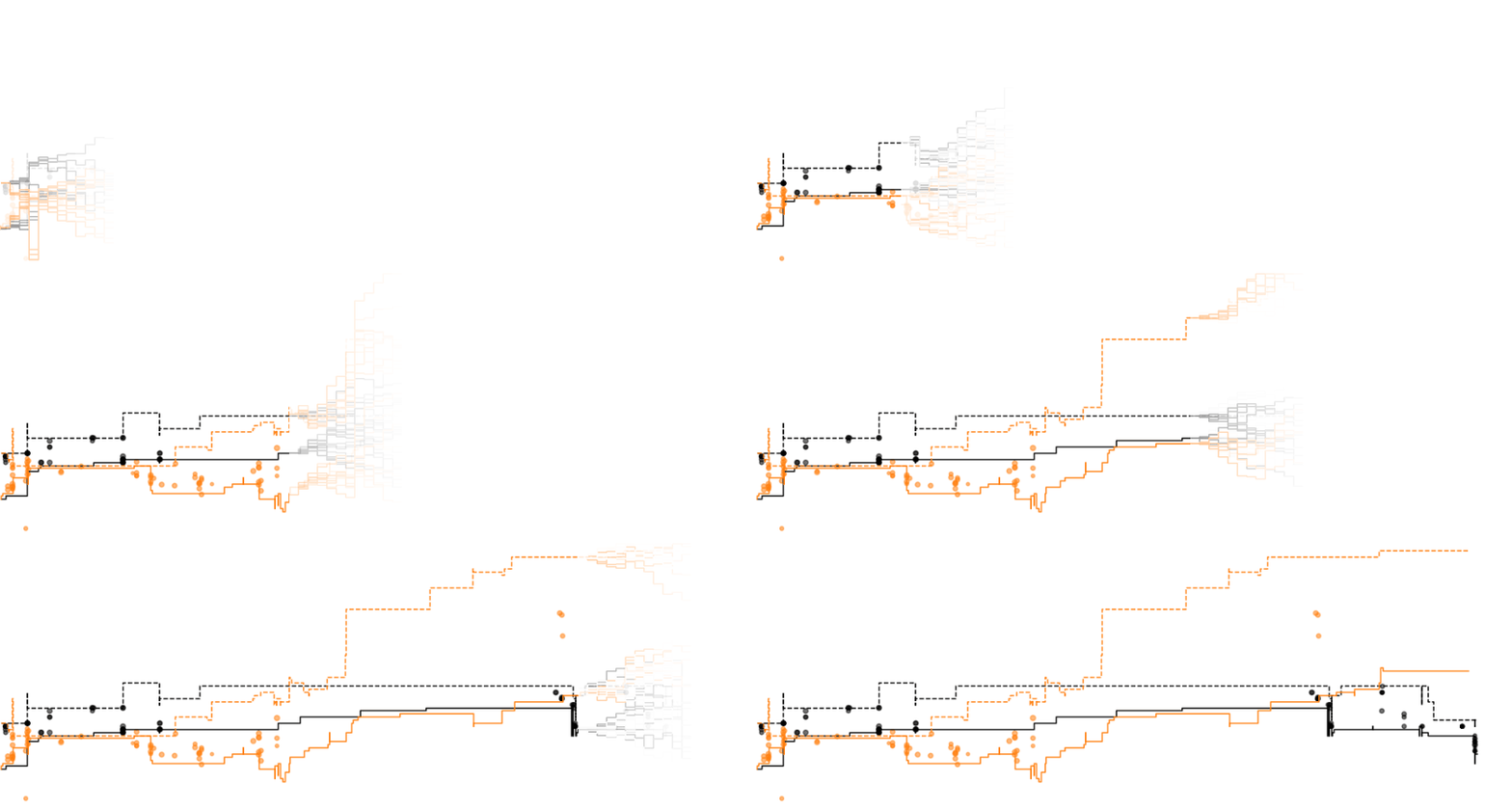
An analysis of 2026 summer intern research explores the potential of using autoregressive diffusion models to synthesize complex market data. This approach aims to move beyond simple point estimates by generating realistic order book events and timing.
The Frontier of Financial Synthesis
The intersection of generative AI and quantitative finance is witnessing a significant shift, as highlighted by recent 2026 summer intern projects. Traditionally, quantitative models have functioned primarily as predictive engines, consuming streams of market data—such as resting orders, cancellations, and trade executions—to calculate a symbol’s future price. However, the current research explores a paradigm shift: moving from static point estimates to the generative synthesis of full market microstructures.
Moving Beyond Point Estimates
By leveraging autoregressive diffusion models, researchers are attempting to simulate the granular texture of market activity. Unlike conventional models that output a single predicted price, this generative approach aims to reconstruct the entire order book environment. This includes the precise timing of event arrivals on an exchange, providing a high-fidelity simulation that captures the stochastic nature of market participants in a way that traditional forecasting fails to achieve.
Understanding Market Data as a Generative Input
At the heart of this challenge is a fundamental question: what is the true nature of market data? To successfully apply diffusion models, one must treat market events not just as a time series, but as a complex, multi-dimensional data structure. The project posits that if a model can learn the underlying distribution of order book transitions and event sequences, it can generate 'rollouts' that possess the same statistical properties and behavioral nuances as real-world exchange data.
Implications for Quantitative Finance
If successful, the ability to synthesize realistic market data would be transformative for backtesting and risk management. Currently, quantitative firms rely heavily on historical data, which is inherently limited by the specific conditions that occurred in the past. Generative models offer the potential to create 'synthetic histories' that allow firms to stress-test their algorithms against hypothetical market regimes, potentially uncovering vulnerabilities that historical datasets cannot reveal.
Future Trends and Technical Challenges
While the application of autoregressive diffusion to finance is in its nascent stages, the trend suggests a move toward deeper integration of generative architectures in algorithmic trading. The difficulty lies in maintaining the causality and coherence of the synthesized order book. As these models evolve, they will likely become central tools in simulating market liquidity and volatility, fundamentally changing how quantitative researchers approach the modeling of exchange-traded assets.
Conclusion
The exploration of autoregressive diffusion for market data generation represents an ambitious leap in quantitative modeling. By shifting the focus from simple prediction to the generative synthesis of market events, researchers are opening new avenues for understanding the complex mechanics of exchange-traded symbols. While the methodology requires rigorous validation, the potential for high-texture simulations marks a significant milestone in financial technology innovation.