What driving across Europe costs in tolls, vignettes, bridges and fuel
Source Entity
Hacker News
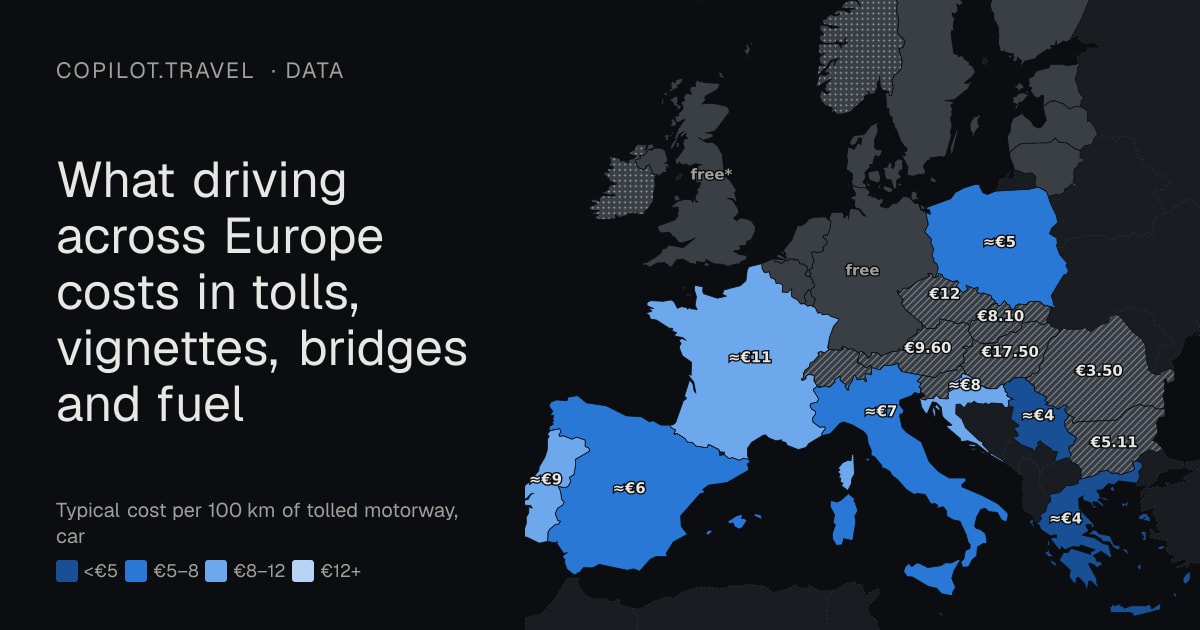
Driving across Europe involves a complex landscape of tolls, vignettes, and fuel costs that vary significantly by country. Motorists must navigate four distinct payment models to manage their travel expenses effectively.
Navigating European Road Infrastructure Costs
Traveling across Europe by vehicle requires more than just a map; it necessitates a deep understanding of the continent's fragmented and diverse road pricing systems. As travelers move across borders, they encounter four primary methods of infrastructure funding: distance-based tolls paid per kilometer, time-based vignettes, fixed bridge fees, and, in some rare cases, toll-free passage. These disparate systems create a complex financial landscape for both tourists and logistics operators planning long-distance routes.
The Economics of Distance-Based Tolling
Distance-based tolling is a common model for major motorways in Western and Southern Europe. The cost per 100 kilometers varies significantly depending on the national infrastructure policy. For instance, France sits at the higher end of the spectrum with costs around €11 per 100 km, while Spain and Italy hover near €6 and €7 respectively. Portugal and Croatia follow with costs of approximately €9 and €8. These tariffs are designed to maintain high-quality road standards, yet they represent a significant variable expense for long-haul road trips.
The Vignette System: A Time-Based Alternative
In contrast to the pay-as-you-go model, many Central and Eastern European nations utilize a vignette system. Countries such as Austria, Bulgaria, Switzerland, the Czech Republic, Hungary, Romania, Slovenia, and Slovakia require drivers to purchase a sticker or digital permit that grants access to motorways for a specific duration—typically days, weeks, or months. This system simplifies the driving experience by eliminating toll booths but requires pre-planning to ensure compliance before entering the motorway network.
Regional Price Variations and Infrastructure Planning
Regional disparities in pricing reflect different approaches to public funding. Countries like Serbia and Greece offer more affordable transit costs, averaging about €4 per 100 km. These lower costs are often influenced by the age of the infrastructure, the density of the network, and the government's strategy for incentivizing road travel. Understanding these variations is essential for budget-conscious travelers who must factor these costs alongside fluctuating fuel prices, which remain a primary concern for any vehicle-based journey.
Challenges for International Travel
For those planning a trans-European journey, the lack of a unified payment system poses a logistical hurdle. A motorist might start in a vignette-based country like Austria and quickly transition to a distance-tolled system in Italy or France. This necessitates careful route planning to avoid unexpected fees or potential fines for failing to display the correct vignette. As European integration continues, the challenge remains to harmonize these diverse systems to facilitate smoother cross-border movement.
Future Trends and Conclusion
Looking ahead, the shift toward digitized vignettes and electronic toll collection is likely to continue, aiming to reduce traffic congestion at physical toll plazas. However, the underlying economic model—balancing infrastructure maintenance costs against user affordability—will remain a localized political decision. For the foreseeable future, travelers must continue to consult current tariff maps to accurately forecast the costs of crossing the European continent by road.