A 1542 papal cipher cracked with simulated annealing
Source Entity
Hacker News
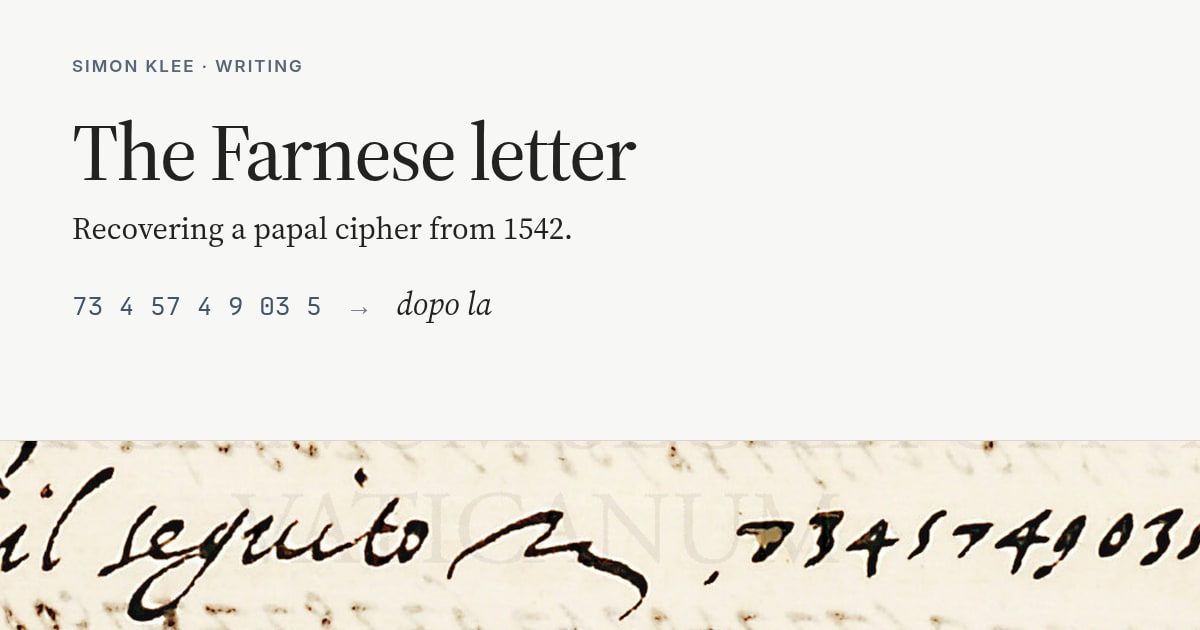
Researchers are utilizing advanced computational techniques like simulated annealing and AI models to decrypt historical ciphers. These breakthroughs demonstrate the evolving power of modern algorithms in solving long-standing cryptographic puzzles.
The Intersection of Cryptography and Modern Computation
Recent advancements in computational linguistics and algorithmic problem-solving have shed new light on historical secrets. By applying simulated annealing, researchers have successfully cracked a 1542 papal cipher sent from Rome to the court of Charles V in Spain. This achievement highlights the transition of cryptanalysis from manual, human-centric labor to automated, high-speed computational analysis.
Deciphering the Papal Code
The 1542 document presents unique challenges that underscore the complexity of early modern cryptography. The cipher uses a mix of Italian text and digit-based codes, where specific digits act as nulls, serving no purpose other than to confuse potential interceptors. Because the system lacks clear delimiters between codes, researchers face the dual challenge of determining where a code ends and identifying the correct substitution key. The use of simulated annealing—a probabilistic technique for approximating the global optimum of a given function—allows researchers to navigate these non-deterministic branching paths efficiently.
The ADFGVX Legacy in WWI
Beyond Renaissance-era correspondence, modern AI systems like GPT-6 Astra are now being tested against military-grade ciphers from the early 20th century. The German ADFGVX method, a World War I-era transposition and substitution cipher, is a hallmark of historical cryptographic difficulty. By mapping letters to a grid defined by a keyword, the ADFGVX system created a complex layer of security that was significantly more robust than earlier monoalphabetic ciphers.
Computational Power and AI Integration
The ability of AI models to handle the ADFGVX grid structure signifies a major leap in how we approach historical archives. Unlike the papal cipher, which relies on identifying digit groupings, the ADFGVX method requires understanding the underlying grid geometry and the keyword used to scramble the plaintext. AI, by recognizing patterns across thousands of permutations, can bypass the manual labor that previously left these messages in the 'unsolved' category.
Broader Implications for Historical Research
These developments suggest a future where the 'unsolved' lists of the world—including infamous documents like the Voynich manuscript—may finally be reconciled. As computational power grows, the barrier to entry for historical cryptanalysis lowers, potentially unlocking lost narratives hidden in state archives. This is not merely an exercise in mathematics; it is a restoration of historical data that has remained inaccessible for centuries.
Conclusion: A New Era of Decryption
The successful application of simulated annealing to Renaissance ciphers and the deployment of AI against WWI military codes mark a pivotal moment in digital humanities. As we refine these tools, the line between 'unreadable' and 'clear' continues to blur, promising a future where the secrets of the past are rendered fully transparent through the lens of modern technology.
Multiple Citing Sources