Declarative Dragging
Source Entity
Hacker News
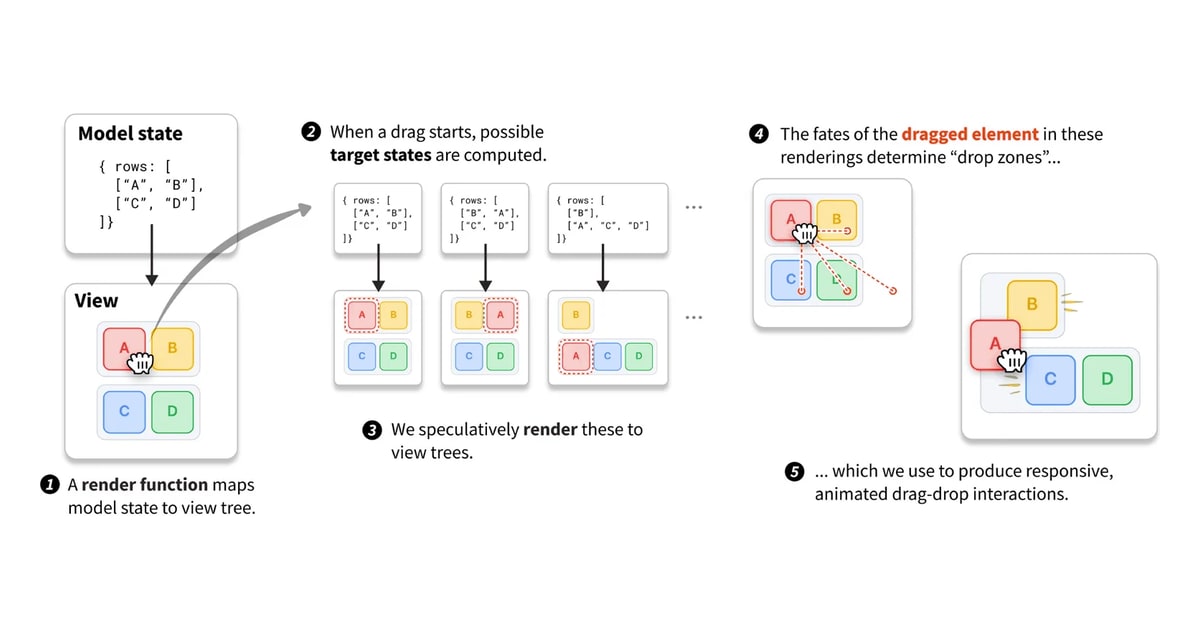
Declarative Dragging is a new paradigm that simplifies drag-and-drop implementation by defining potential end-states instead of manual animation code. This approach uses speculative rendering to automatically generate smooth interactions, reducing the technical barrier for developers and designers.
The Shift Toward Declarative Dragging
Modern user interface design relies heavily on drag-and-drop interactions to make digital content feel tactile and intuitive. However, the implementation of these features has historically been a labor-intensive process, requiring developers to write complex, imperative code to manage geometry, real-time feedback, and animation states. The emergence of 'Declarative Dragging' represents a fundamental shift in how we approach this problem, moving away from explicit instruction toward a state-based definition of user intent.
Simplifying Complex Interactions
Traditionally, a developer must calculate coordinates, handle event listeners, and interpolate animations manually to create a seamless drag experience. This 'fiddly' nature often discourages creators—from educators building interactive lessons to game developers—from implementing sophisticated drag features. By allowing a developer to simply specify the target 'future states' of an application, the system handles the heavy lifting, effectively abstracting the underlying complexity of the UI layer.
The Mechanics of Speculative Rendering
At the heart of this new system is the concept of speculative rendering. Instead of pre-programming every possible trajectory for an object, the engine renders potential outcomes where an element might land. By combining these 'possible worlds' into a unified interaction loop, the system can determine valid drop zones and generate responsive, fluid movement automatically. This methodology ensures that the UI remains consistent while drastically reducing the lines of code required for complex interactions.
Broad Implications for Creative Tooling
This development holds significant promise for the democratization of software building. For creative tool builders, the ability to define interactions declaratively means that complex design software can be built with more agility. Mathematicians and educators, who often need bespoke drag-and-drop functionality for data visualization or interactive learning, can now focus on the logic of their applications rather than the minutiae of animation frameworks.
Future Trends in Interface Design
The move toward declarative paradigms is a growing trend in software engineering, seen previously in the widespread adoption of frameworks like React or SwiftUI. By applying this logic to drag-and-drop interactions, we are likely to see a new generation of highly interactive, web-based tools that are more performant and easier to maintain. As these systems mature, we can expect a standard shift where manual animation programming becomes the exception rather than the rule.
Conclusion
Declarative Dragging effectively bridges the gap between high-level conceptual design and low-level implementation. By shifting the burden of visual behavior from the developer to the engine, this approach streamlines the creation of digital interfaces, making them more accessible to a wider range of creators. As this technology evolves, it will undoubtedly redefine the standards for interactivity in both web and desktop applications.