Delhi chokes after Deepavali as smog pushes air quality into ‘severe’ category
Source Entity
India Latest News: Top National Headlines Today & Breaking News | The Hindu
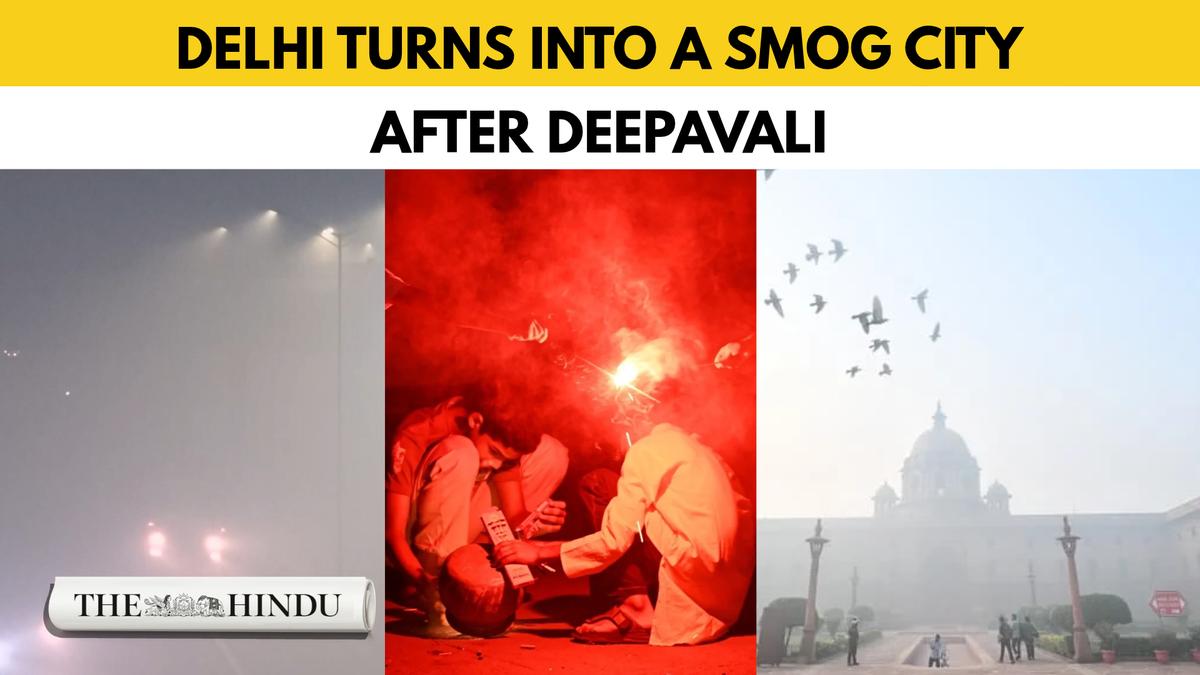
Delhi's air quality has plummeted to a near-severe AQI of 383 on Diwali morning, with multiple monitoring stations reporting levels exceeding 400. Experts warn that the toxic haze is expected to persist through November 9 due to firecracker emissions.
Delhi's Air Quality Crisis: A Diwali of Toxic Haze
Delhi, the national capital, woke up to a precarious environmental situation this Diwali, as the Air Quality Index (AQI) surged to 383. According to the Central Pollution Control Board (CPCB), the city remains on the precipice of the 'severe' category, a threshold that marks significant health risks for the general population. This development follows a period of marginal fluctuation, where the AQI had seen slight improvements from 382 on Friday to 369 on Saturday, only to be neutralized by the environmental impact of pre-Diwali firecracker usage.
The Geography of Pollution
The crisis is not distributed uniformly across the capital, as evidenced by data from 54 monitoring stations. While the overall AQI sits at 383, a alarming 24 stations have already crossed the 'severe' threshold (AQI > 400). Notable hotspots include Jahangirpuri, which recorded an extreme AQI of 450, followed closely by Punjabi Bagh (449), R K Puram (448), Bawana (446), and IIT Delhi (445). Even iconic locations such as India Gate, situated near the Kartavya Path, are struggling with 'very poor' air quality at an AQI of 398.
Atmospheric Trends and Forecasts
The Air Quality Early Warning System (EWS) for Delhi provides a grim outlook for the immediate future. Projections indicate that the air quality is likely to remain entrenched in the 'severe' category through November 8 and 9. This persistence is often exacerbated by meteorological conditions that trap pollutants near the surface, preventing dispersion. The reliance on the Sameer app and CPCB data confirms that the current haze is a direct consequence of localized emissions compounding with existing atmospheric stressors.
Broader Health and Social Implications
The 'very poor' and 'severe' categorization of air quality carries severe implications for public health. An AQI in the 300-400 range is known to cause respiratory distress in healthy individuals and acute aggravation in those with pre-existing cardiovascular or pulmonary conditions. The sight of citizens jogging near the Kartavya Path amid such toxic conditions underscores the challenge of balancing cultural traditions like Diwali with the mounting necessity for public health safeguards.
Conclusion and Future Outlook
The current situation highlights the cyclical nature of Delhi's pollution crisis, where festivals act as catalysts for rapid degradation of air quality. As the city navigates the post-Diwali period, the concentration of PM2.5 pollutants—specifically reaching levels as high as 450 in certain pockets—suggests that immediate policy intervention and public adherence to anti-pollution measures are critical. Without a significant shift in environmental management and reduced reliance on combustion-based celebrations, the capital remains highly vulnerable to these annual spikes in toxic smog.
Multiple Citing Sources
Verification Required?