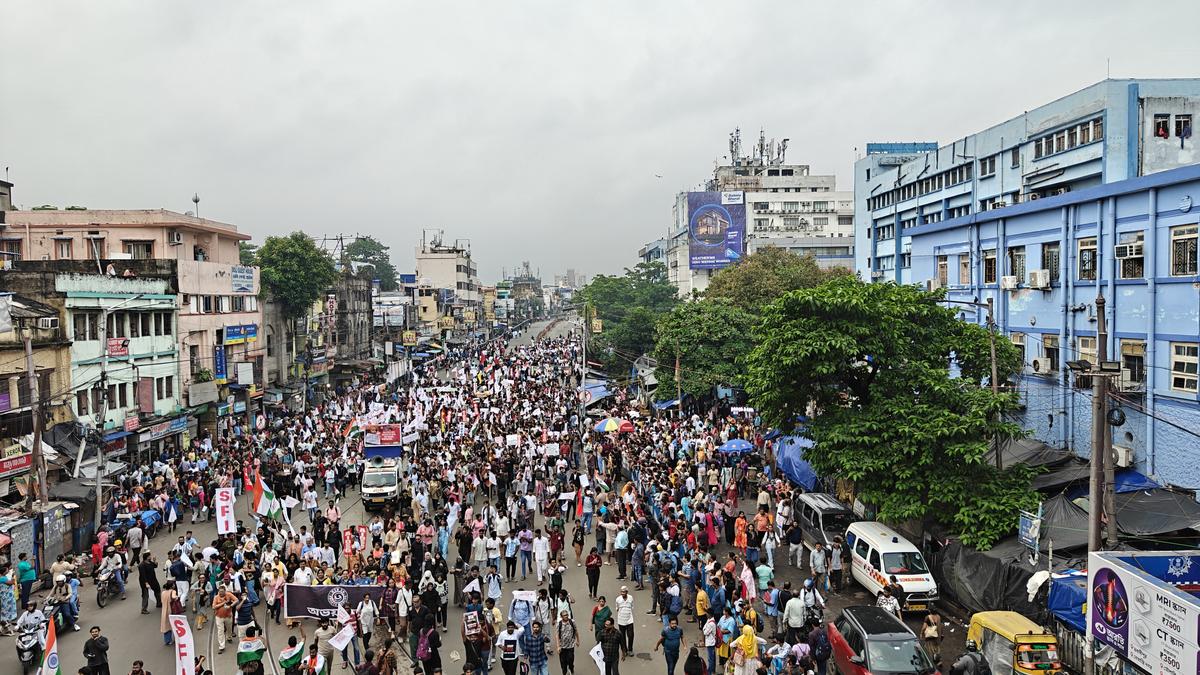
Violence erupts as police, protesters clash at CJP-Left students’ rally in Kolkata
Source Entity
India Latest News: Top National Headlines Today & Breaking News | The Hindu
The Delhi High Court dismissed a PIL seeking an NIA investigation into the Cockroach Janta Party's 'Chalo Sansad' march. The court ruled that law enforcement authorities have the jurisdiction to handle alleged vandalism and that NIA referrals are the prerogative of the Centre.
Delhi High Court Dismisses Plea for NIA Probe into 'Chalo Sansad' March
On July 24, 2026, the Delhi High Court officially declined to entertain a Public Interest Litigation (PIL) that sought to mandate an investigation by the National Investigation Agency (NIA) into the recent 'Chalo Sansad' march. The march, organized by the Cockroach Janta Party (CJP), was held on July 20 to protest against the NEET-UG paper leak and broader systemic grievances. The legal challenge centered on allegations of violence and vandalism that occurred during the demonstration, which saw protesters moving from Jantar Mantar toward Parliament House.
Judicial Stance on Institutional Jurisdiction
The Bench, led by Chief Justice D. K. Upadhyaya and Justice Tejas Karia, provided a clear demarcation between judicial oversight and executive function. The Court emphasized that the alleged incidents of vandalism were already within the notice and knowledge of the relevant law enforcement authorities. By asserting that it is the responsibility of the Centre—rather than the judiciary—to refer cases to the NIA, the Court underscored the principle of separation of powers. This judicial restraint signals that the court expects standard administrative and criminal procedures to be exhausted before invoking specialized anti-terror agencies.
Contextualizing the 'Chalo Sansad' Protest
The protest itself was a reaction to the NEET-UG paper leak, a significant issue that has stirred public discourse and student unrest across India. The march, which culminated in clashes and a police lathi charge, highlights the volatile intersection of student activism and national security concerns. The Delhi High Court’s refusal to escalate the investigation to the NIA reflects a cautious approach to labeling civil unrest as a matter of national security, preferring instead to allow existing police mechanisms to address the allegations of both vandalism and potential police excesses.
Balancing Protest and Public Order
This legal development follows the Court’s earlier decision to seek responses from the Centre and Delhi Police regarding separate pleas that alleged police misconduct during the demonstrations. By addressing both the violence of the protesters and the reported excesses of the police, the Court is attempting to maintain a balanced oversight of the events. The observation that the Jantar Mantar incident was not an 'isolated' event suggests that the judiciary is closely monitoring the broader pattern of protests rather than treating individual incidents in a vacuum.
Implications for Future Demonstrations
The dismissal of the PIL, following the intervention of Solicitor General Tushar Mehta, effectively puts the onus back on the executive branch to manage the fallout of the July 20 protests through standard legal channels. For future organizers and demonstrators, this ruling serves as a reminder that the judiciary will likely defer to the established law enforcement hierarchy to handle protest-related violence, unless a clear and compelling case for federal intervention is established. As the situation remains under scrutiny, the focus shifts back to the ongoing investigation by the Delhi Police and the government’s response to the underlying concerns regarding the NEET-UG examination process.
Multiple Citing Sources
Verification Required?